This work has been selected by scholars as being culturally important, and is part of the knowledge base of civilization as we know it. This work was reproduced from the original artifact, and remains as true to the original work as possible. Therefore, you will see the original copyright references, library stamps (as most of these works have been housed in our most important libraries around the world), and other notations in the work. This work is in the public domain in the United States of America, and possibly other nations. Within the United States, you may freely copy and distribute…mehr
This work has been selected by scholars as being culturally important, and is part of the knowledge base of civilization as we know it. This work was reproduced from the original artifact, and remains as true to the original work as possible. Therefore, you will see the original copyright references, library stamps (as most of these works have been housed in our most important libraries around the world), and other notations in the work. This work is in the public domain in the United States of America, and possibly other nations. Within the United States, you may freely copy and distribute this work, as no entity (individual or corporate) has a copyright on the body of the work. As a reproduction of a historical artifact, this work may contain missing or blurred pages, poor pictures, errant marks, etc. Scholars believe, and we concur, that this work is important enough to be preserved, reproduced, and made generally available to the public. We appreciate your support of the preservation process, and thank you for being an important part of keeping this knowledge alive and relevant.
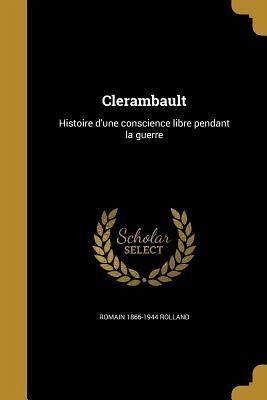
Romain Rolland, né à Clamecy (Nièvre) le 29 janvier 1866 et mort à Vézelay le 30 décembre 1944, est un écrivain français, lauréat du prix Nobel de littérature de 1915. D'une culture forgée par la passion de l'art et de la musique (opéra, Michel-Ange, Scarlatti, Lully, Beethoven, amitié avec Richard Strauss) et le culte des héros, il chercha sa vie durant un moyen de communion entre les hommes. Son exigence de justice le poussa à souhaiter la paix ' au-dessus de la mêlée ' pendant et après la Première Guerre mondiale. Il est animé par un idéal humaniste et la quête d'un monde non violent, par son admiration pour Léon Tolstoï, grande figure de la non-violence, par les philosophies de l'Inde (conversations avec Rabindranath Tagore et Gandhi), l'enseignement de Râmakrishna et Vivekananda, par sa fascination pour ¿Abd-al-Bah¿¿ (il y fait référence dans Clerambault), puis par le ' monde nouveau ' qu'il espérait voir se construire en Union soviétique. Il se trouve à partir du milieu des années 1920, de par son engagement de plus en plus affirmé en faveur de l'URSS, au cur des réseaux de soutien au régime soviétique et devient le plus connu des ' Amis de l'URSS ' européens.
Es gelten unsere Allgemeinen Geschäftsbedingungen: www.buecher.de/agb
Impressum
www.buecher.de ist ein Internetauftritt der buecher.de internetstores GmbH
Geschäftsführung: Monica Sawhney | Roland Kölbl | Günter Hilger
Sitz der Gesellschaft: Batheyer Straße 115 - 117, 58099 Hagen
Postanschrift: Bürgermeister-Wegele-Str. 12, 86167 Augsburg
Amtsgericht Hagen HRB 13257
Steuernummer: 321/5800/1497
USt-IdNr: DE450055826