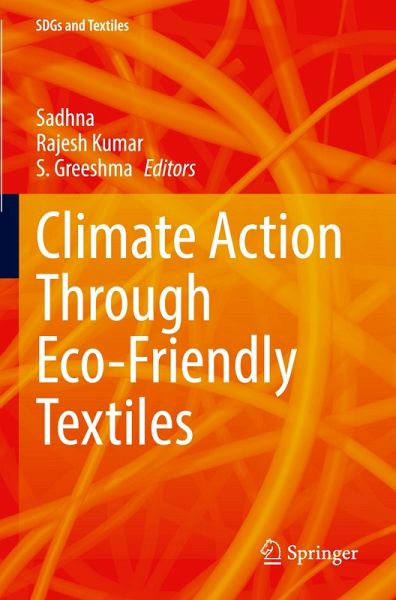
This book covers the latest developments in sustainable textiles and how they can help mitigate the fashion industry's environmental impact. It focuses on innovative textile production approaches by prioritizing eco-friendly materials, responsible sourcing, ethical manufacturing practices, using cutting-edge technology to create textiles that are not only sustainable but also high-performing and durable. This book further explores the wide range of possibilities for reducing the fashion industry's environmental impact, from natural dyeing techniques to biodegradable fibers. This book will be…mehr
This book covers the latest developments in sustainable textiles and how they can help mitigate the fashion industry's environmental impact. It focuses on innovative textile production approaches by prioritizing eco-friendly materials, responsible sourcing, ethical manufacturing practices, using cutting-edge technology to create textiles that are not only sustainable but also high-performing and durable. This book further explores the wide range of possibilities for reducing the fashion industry's environmental impact, from natural dyeing techniques to biodegradable fibers. This book will be of interest to students, researchers, fashion industry professionals, environmentalists and anyone who is interested in learning more about sustainable fashion.
Sadhna received her Master of Science in Clothing and Textiles from Banasthali Vidyapith, Tonk, Rajasthan, India. Dr Sadhna focuses on natural fibres research and woven fabrics, dyeing, and finishing. Her recent research interests include the tactile properties of seams by evaluating the characteristics of seams, such as seam compression, seam thickness, seam bending behaviour, and surface friction of seams. In 2019, she received her Doctoral of Philosophy degree in Clothing and Textiles from Banasthali Vidyapith, Tonk, Rajasthan, India. Before joining Woxsen University, she was associated with Swami Vivakanand Subharti University, Meerut- India, as Head of the Department and Assistant Professor in the Fashion and Textile Department. She is engaged in the teaching and research of Apparel and Textile Science in the Department of Fashion Design at Woxsen University. She is actively involved in her additional post-Margaret L. Bishop Professor of Strategic Design & Management. She has been awarded the title "Excellent facilitator for students and Administrative skills" by Swami Vivakanand Subharti University, Meerut, India, and Best Researcher award ITSR Foundation Award-2020, organized by the Institute of Technical and Scientific Research. Rajesh Kumar is a graduate specialising in Knitwear from NIFT, Mumbai, and holds a degree in Masters of Fashion Management from Manipal academy of higher education, Manipal, Karnataka. His research interest is in Natural fibers and new product development. He has 12 years of industry and academic experience. He has served as an Assistant professor at Manipal academy of higher education, where he worked for five years, and he was an Academic Coordinator at Swami Vivakanand Subharti University, Meerut, India. He works as Program Director, Department of Fashion Design at Woxsen University, Hyderabad, Telangana. He has recently published two research papers titled "Traditional Craft Skills in India -Reflection of Sikki Craft ofBihar and Pathways to sustainability" and Impact of Stitch Density on Tactile Comfort Properties of Seams, respectively. He has been awarded the title "Best Performer for students and Administrative skills" by Woxsen University, Hyderabad, Telangana, India. S. Greeshma is a Ph.D. Scholar from the Department of Fashion Design, School of Arts and Design, Woxsen University, Telangana. She holds a bachelor's degree in Costume Design and Fashion from Hindusthan College of Arts and Science and a master's degree in Textiles From Avinashilingam University. She also has an experience of 2.5 years working as an assistant professor at Rathinam College of Arts and Science and has published various articles including "Eco-Design: Focal Point of Sustainable Textiles", "Minimalism - Fashion Trend for 2020", "Sustainable Textiles" etc.
Inhaltsangabe
Chapter 1: Introduction To Climate Action, Waste Management, And Eco Textiles.- Chapter 2: Impact Of The Textile Industry On Global Climate Change.- Chapter 3: Eco Textiles - An Overview.- Chapter 4: Role Of New-Gen Textile Fibers In Reducing The Environmental Impact Of Textiles.- Chapter 5: Role of Chemicals in Textile Processing and Its Alternatives.- Chapter 6: Water Consumption and Microfibers: The Biggest Threat.- Chapter 7: Eco-Friendly Dyeing Approach: Natural Dyeing - A Need of The Hour.- Chapter 8: Optimized Resource Consumption.- Chapter 9: Importance of Market Segmentation and Applications of Oekotech.- Chapter 10: Implementation and Environment Protection Through ISWM (Integrated Solid waste Management) in Textiles.- Chapter 11: Role of Governments and Consumers.- Chapter 12: Eco Textiles: The Present and The Future.- Chapter 13: The Conclusion: Overview of The Importance of Eco Textiles and The Commitment to be Made to Have A Sustainable Environment.
Chapter 1: Introduction To Climate Action, Waste Management, And Eco Textiles.- Chapter 2: Impact Of The Textile Industry On Global Climate Change.- Chapter 3: Eco Textiles - An Overview.- Chapter 4: Role Of New-Gen Textile Fibers In Reducing The Environmental Impact Of Textiles.- Chapter 5: Role of Chemicals in Textile Processing and Its Alternatives.- Chapter 6: Water Consumption and Microfibers: The Biggest Threat.- Chapter 7: Eco-Friendly Dyeing Approach: Natural Dyeing - A Need of The Hour.- Chapter 8: Optimized Resource Consumption.- Chapter 9: Importance of Market Segmentation and Applications of Oekotech.- Chapter 10: Implementation and Environment Protection Through ISWM (Integrated Solid waste Management) in Textiles.- Chapter 11: Role of Governments and Consumers.- Chapter 12: Eco Textiles: The Present and The Future.- Chapter 13: The Conclusion: Overview of The Importance of Eco Textiles and The Commitment to be Made to Have A Sustainable Environment.
Es gelten unsere Allgemeinen Geschäftsbedingungen: www.buecher.de/agb
Impressum
www.buecher.de ist ein Internetauftritt der buecher.de internetstores GmbH
Geschäftsführung: Monica Sawhney | Roland Kölbl | Günter Hilger
Sitz der Gesellschaft: Batheyer Straße 115 - 117, 58099 Hagen
Postanschrift: Bürgermeister-Wegele-Str. 12, 86167 Augsburg
Amtsgericht Hagen HRB 13257
Steuernummer: 321/5800/1497
USt-IdNr: DE450055826