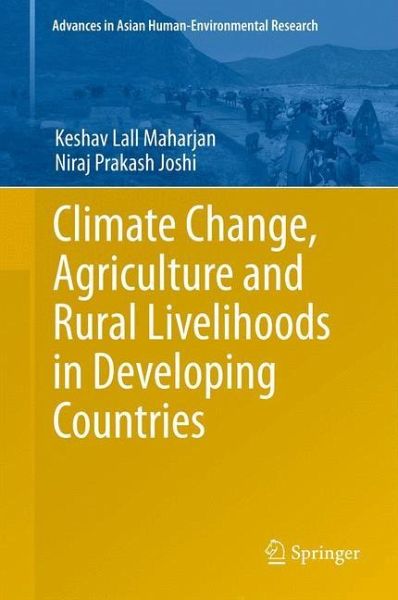
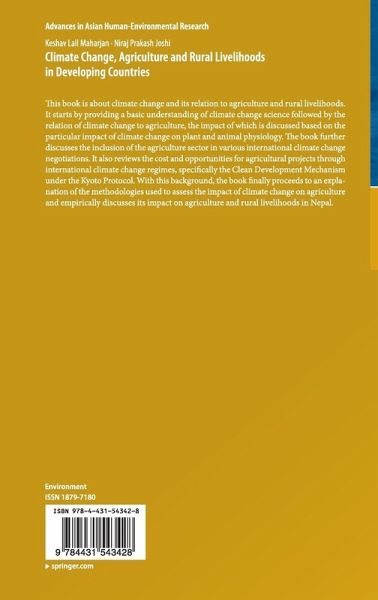
This book is about climate change and its relation to agriculture and rural livelihoods. It starts by providing a basic understanding of climate change science followed by the relation of climate change to agriculture, the impact of which is discussed based on the particular impact of climate change on plant and animal physiology. The book further discusses the inclusion of the agriculture sector in various international climate change negotiations. It also reviews the cost and opportunities for agricultural projects through international climate change regimes, specifically the Clean…mehr
This book is about climate change and its relation to agriculture and rural livelihoods. It starts by providing a basic understanding of climate change science followed by the relation of climate change to agriculture, the impact of which is discussed based on the particular impact of climate change on plant and animal physiology. The book further discusses the inclusion of the agriculture sector in various international climate change negotiations. It also reviews the cost and opportunities for agricultural projects through international climate change regimes, specifically the Clean Development Mechanism under the Kyoto Protocol. With this background, the book finally proceeds to an explanation of the methodologies used to assess the impact of climate change on agriculture.
Artikelnr. des Verlages: 86191435, 978-4-431-54342-8
Seitenzahl: 192
Erscheinungstermin: 29. Mai 2013
Englisch
Abmessung: 241mm x 160mm x 16mm
Gewicht: 460g
ISBN-13: 9784431543428
ISBN-10: 4431543422
Artikelnr.: 37057095
Herstellerkennzeichnung
Springer-Verlag GmbH
Tiergartenstr. 17
69121 Heidelberg
ProductSafety@springernature.com
Autorenporträt
Keshav Lall Maharjan (Dr. of Agriculture in Agricultural Economics, Kyoto University, Japan) is currently a professor at the Graduate School for International Development and Cooperation, Hiroshima University, Japan, where he has been teaching, conducting research, and chairing various steering and decision-making committees since its foundation in 1994. He gives lectures for graduate students on subjects including rural economics, south Asian studies, international development, and cooperation studies. He conducts weekly seminars at the graduate school that address pertinent issues in agricultural economics, rural development, sustainable development, cultural dynamics, climate change, and rural livelihood strategies in developing countries. He also offers support for graduate students writing their Master's theses and doctoral dissertations on the related topics of development sciences, educational development, and cultural and regional studies, which include issues concerning natural resource management, food security, poverty dynamics, local governance, rural society, and community dynamics. In doing so he considers agriculture and rural regions as not merely sources of cheap labor, cheap food and cheaper intermediate inputs, and subordinate to urban areas and centers as marginal and peripheral regions but also representing a dignifi ed way of life for people who are guardians of nature and are more conscious about the earth, humans, and their interaction, so as to sustain this culture and civilization for generations hereafter. Rural regions are the places that make these things happen. Hence, fi eldwork to grasp the diverse realities of rural regions location-specifi cally before generalizing the research is given importance in his research, lectures, and his work with graduate students in terms of their research, writing journal articlesand dissertations. Some 20 students have received their Ph.D. from Hiroshima University under his guidance. In order to disseminate research fi ndings, consolidate ideas and concepts, and share knowledge with other professionals, he regularly participates in local, national, and international seminars and conferences organized by academic societies, research institutions, and various organizations and like-minded individuals, including agricultural economists, ruralogists, sociologists, environmentalists,¿anthropologists, educationalists, policy makers, development practitioners, farmers, social activists, local leaders, and opinion shapers. Some of his earlier books in English include Peasantry in Nepal: A Study on Subsistence Farmers and Their Activities Pertaining to Food Security , Hiroshima: Research Center for Regional Geography, Hiroshima University, 2003 and Impacts of Irrigation and Drainage Schemes on Rural Economic Activities in Bangladesh, Hiroshima: Research Center for Regional Geography, Hiroshima University, 1997. He has also contributed chapters to publications including Climate Change: Asian Perspective , Jaipur: Rawat Publication, 2012; Public Policy and Local Development-Opportunities and Constraints , International Geographical Union Commission on Geography and Public Policy,2008; Political and Social Transformation in North India and Nepal , New Delhi: Manohar Publishers, 2007; Small-Scale Livelihoods and Natural Resource Management in Marginal Areas of Monsoon Asia , Dehra Dun: Bishen Singh Mahendra Pal Singh, 2006; New Challenges Facing Asian Agriculture under Globalization , Selangor: Malaysian Agricultural Economics Association, 2005; Translating Development: The Case of Nepal , New Delhi: Social Science Press, 2003; and Sustainable Agriculture, Poverty and Food Security, Jaipur: Rawat Publications, 2002. He contributes to various related academic journals and has more than one hundred blind reviewed articles to his credit. He has also produced numerous books and journal articles in Japanese. Niraj Prakash Joshi, Ph.D., is currently working as a resear
Inhaltsangabe
Background information on climate change and agriculture.- Global scenario of greenhouse gas emission.- Effects of climate change on plant and animal physiology.- Agriculture in international climate change negotiations.- Cost and opportunities from mitigation and adaptation in agriculture.- Methodologies to assess the impact of climate change in agriculture.- Effects of climate change on regional agriculture production, food price and food insecurity.- Climate change in Nepalese context: Impacts, mitigation issues, and relation with poverty.- Effect of climate variables on yield of major food-crops in Nepal: A time-series analysis.- Community perceptions of climate change and its impacts.
Background information on climate change and agriculture.- Global scenario of greenhouse gas emission.- Effects of climate change on plant and animal physiology.- Agriculture in international climate change negotiations.- Cost and opportunities from mitigation and adaptation in agriculture.- Methodologies to assess the impact of climate change in agriculture.- Effects of climate change on regional agriculture production, food price and food insecurity.- Climate change in Nepalese context: Impacts, mitigation issues, and relation with poverty.- Effect of climate variables on yield of major food-crops in Nepal: A time-series analysis.- Community perceptions of climate change and its impacts.
Es gelten unsere Allgemeinen Geschäftsbedingungen: www.buecher.de/agb
Impressum
www.buecher.de ist ein Internetauftritt der buecher.de internetstores GmbH
Geschäftsführung: Monica Sawhney | Roland Kölbl | Günter Hilger
Sitz der Gesellschaft: Batheyer Straße 115 - 117, 58099 Hagen
Postanschrift: Bürgermeister-Wegele-Str. 12, 86167 Augsburg
Amtsgericht Hagen HRB 13257
Steuernummer: 321/5800/1497
USt-IdNr: DE450055826