South Florida is frequently cited as the part of the United State of America as most susceptible to the devastation accompanying sea level rise. Several scholarly studies have shown the negative impact of coastal location in Florida on housing values. Are the residents of South Florida concerned? Is susceptibility to sea level rise actually affecting the housing market in terms of demand, the availability of home mortgages, or house prices? Are people living at particular risk from sea level rise aware of this risk and more open to new information about climate change? Do they support policies…mehr
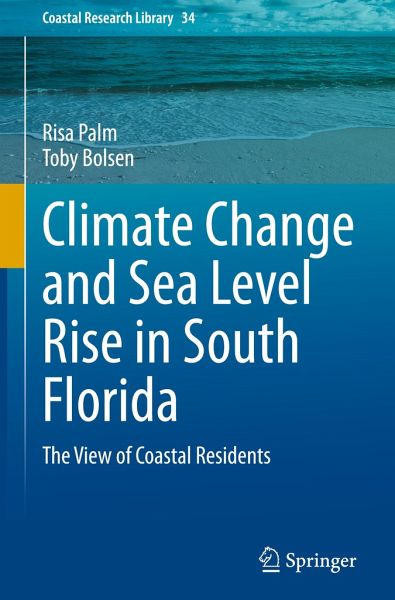
South Florida is frequently cited as the part of the United State of America as most susceptible to the devastation accompanying sea level rise. Several scholarly studies have shown the negative impact of coastal location in Florida on housing values. Are the residents of South Florida concerned? Is susceptibility to sea level rise actually affecting the housing market in terms of demand, the availability of home mortgages, or house prices? Are people living at particular risk from sea level rise aware of this risk and more open to new information about climate change? Do they support policies and laws to mitigate the pace and extent of climate change? Answers to these questions are not only of general interest, but they are also key to our understanding of the human dimensions of this problem.
This book describes the results of a detailed survey in which respondents viewed a local map displaying flooding to their own community that would result from a Category 3 hurricane in 2033. It discusses political party identification and ideology that has an overwhelming impact in shaping views about sea level rise and climate change. This book has enormous implications for the effectiveness of communicating risk information. The text is important if we, as a nation, are to design communication strategies that will lead to broader policy to combat or mitigate this risk.
Palm and Bolsen are the authors of a 2020 Springer book titled Climate Change and Sea-level Rise in South Florida. They have a combined deep experience in survey methodology, the study of political communication, the study of environmental hazards and the portrayal of research findings for an audience of university students and general readers. By combining the insights of human geography and political science, they are able to address this complex human-environmental problem. Palm is the author of 14 books and monographs as well as numerous scholarly articles and invited book chapters. Among her previous books are textbooks for introductory human geography courses (An Invitation to Geography, McGraw-Hill, 2 editions), upper division courses in American cities (Geography of American Cities, Oxford University Press) and natural hazards (Natural Hazards: An Integrative Framework for Research and Planning, Johns Hopkins University Press). She has also published three monographs on earthquake hazards with Westview Press (now part of Harper Collins) including Earthquake Insurance: a longitudinal study, Earthquake Insurance in California: Environmental policy and individual decision-making, and Illusions of Safety: culture and earthquake hazard response in the US and Japan, and another monograph on earthquake hazards with The University of Chicago Press Geography Research Papers (After a California Earthquake: attitude and behavior change). She has received research honors from the American Association of Geographers and served as president of this association. Bolsen is the author of over 40 scholarly articles and book chapters. His research focuses on the study of political behavior, public opinion formation, political communication, experimental methods, and U.S. energy and climate policy. He has published research in numerous high-impact journals such as the American Journal of Political Science, Political Behavior, Public Opinion Quarterly, Journal of Communication, Political Communication, Climatic Change, Science Communication, Energy Policy, Environmental Communication, and many other outlets. He has received several Best Paper Awards for published work presented at academic conferences.
Inhaltsangabe
Chapter 1. Introduction.- Chapter 2. The Science of Climate Change and Sea-Level Rise.- Chapter 3. A Partisan and Polarized Issue in the United States.- Chapter 4. The South Florida Study Area.- Chapter 5. Study Methods and General Findings.- Chapter 6. Results from South Florida Experiment.- Chapter 7. Denial of Risk.- Chapter 8. Prospects for Mitigation.
Chapter 1. Introduction.- Chapter 2. The Science of Climate Change and Sea-Level Rise.- Chapter 3. A Partisan and Polarized Issue in the United States.- Chapter 4. The South Florida Study Area.- Chapter 5. Study Methods and General Findings.- Chapter 6. Results from South Florida Experiment.- Chapter 7. Denial of Risk.- Chapter 8. Prospects for Mitigation.
Es gelten unsere Allgemeinen Geschäftsbedingungen: www.buecher.de/agb
Impressum
www.buecher.de ist ein Internetauftritt der buecher.de internetstores GmbH
Geschäftsführung: Monica Sawhney | Roland Kölbl | Günter Hilger
Sitz der Gesellschaft: Batheyer Straße 115 - 117, 58099 Hagen
Postanschrift: Bürgermeister-Wegele-Str. 12, 86167 Augsburg
Amtsgericht Hagen HRB 13257
Steuernummer: 321/5800/1497
USt-IdNr: DE450055826