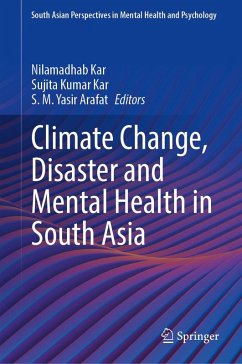
This book discusses disaster psychiatry and the impact of climate change in South Asia. South Asia consists of eight LMICs. As a region, it is one of the most disaster-prone areas of the world. Besides the increased frequency, disasters affect a large number of people in this area, as it is densely populated. Impact of the disasters is also considerably higher considering the scarcity of resources in the area. Recent studies identified that LMICs are more affected by climate change than high-income countries. However, little we know about the mental health impact of frequent disasters like…mehr
This book discusses disaster psychiatry and the impact of climate change in South Asia. South Asia consists of eight LMICs. As a region, it is one of the most disaster-prone areas of the world. Besides the increased frequency, disasters affect a large number of people in this area, as it is densely populated. Impact of the disasters is also considerably higher considering the scarcity of resources in the area. Recent studies identified that LMICs are more affected by climate change than high-income countries. However, little we know about the mental health impact of frequent disasters like cyclones, river erosions, droughts, floods, tsunamis, and the long-term effects of climate change in South Asian countries.
Mental health consequences of the disasters are not contained within the immediate post-disaster period, rather it continues long-term. Ironically, despite the population affected being usually large, the information about the sequelae is really scant. In addition, the support systems and resources for the survivors are not as robust as in the developed world. It appears that the enormity of the concerns is not appreciated by the authorities in these countries, primarily because of a lack of information and inadequate or ineffective professional suggestions. While the challenges continue, many survivors with mental health problems secondary to disasters are not recognized, treated, or rehabilitated appropriately. There is an urgent need to emphasize these aspects, especially in the South Asia region, considering its enhanced vulnerabilities.
Produktdetails
Produktdetails
South Asian Perspectives in Mental Health and Psychology
Prof. Nilamadhab Kar, MD, DNB, DPM, FRCPsych is a Consultant Psychiatrist in the Black Country Healthcare NHS Foundation Trust, Wolverhampton, UK. He is the College Tutor for undergraduate and postgraduate psychiatry training and the lead for the International Clinical Fellowship Programme in Psychiatry for the Trust. He is Professor of Psychiatry at the University of Wolverhampton, UK and is a visiting Honorary Professor in the Faculty of Contemplative and Behavioural Sciences, at the Sri Sri University, India. His research contributions have been in the fields of stress-related mental health disorders, preventive psychiatry, disaster mental health, geriatric psychiatry, clinical psychopharmacology and quality of life. Besides journal articles and book chapters, he has written and edited a few medical books which include Handbook of Dementia, Comprehensive Textbook of Sexual Medicine and Handbook for Disaster Workers. He is the editor of Journal of Geriatric Care and Research and is on the editorial board of several medical and literary journals. He has received a few National level awards from the Indian Psychiatric Society and Professional awards in the UK. He is engaged in various charitable works through Geriatric Care and Research Organisation (GeriCaRe), which has received a national award from the Government of India. He supports health research and education through Quality of Life Research and Development Foundation (QoLReF) in India and The Institute of Insight, in the UK. He is actively engaged in public education in mental health, regularly writes for newspapers and magazines, and conducts health related talks and seminars. Dr. Sujita Kumar Kar is currently working as an Additional Professor of Psychiatry at King George's Medical University, Lucknow, Uttar Pradesh, India. He is the editor-in-chief of Indian Journal of Health, Sexuality and Culture. He is also the editorial board member and reviewer of various national and international journals. He had written 62 book chapters and more than 450 articles in various national & international journals and made 70 presentations at various national and international conferences. He has been included in the global 2% researcher list released by Stanford University in 2021, 2022 and 2023. His research interests include brain stimulation, neuropsychiatry, and suicide prevention. Dr. S M Yasir Arafat is currently working as an Associate Consultant of Psychiatry at Bangladesh Specialized Hospital Ltd. (BSHL), Dhaka, Bangladesh. He is affiliated with Dnet as an honorary Research Fellow and Biomedical Research Foundation, Bangladesh as Senior Research Fellow. He was affiliated with the University of Bristol, UK as Visiting Senior Research Associate, (August 2021-2023). He completed MD in Psychiatry from Bangabandhu Sheikh Mujib Medical University, Dhaka and MBBS from the Dhaka Medical College, Dhaka, Bangladesh. He also did an MPH in Health Economics and MBA in Marketing. Dr. Arafat has (co)authored more than 350 peer-reviewed articles and book chapters, and (co)edited several books with Springer. He has been included in the global 2% researcher list in 2021, 2022, and 2023. He is acting as editorial member in more than 10 leading journals in mental health published by Frontiers, Wiley, Springer, and Taylor and Francis. His research focused on mental health, suicidal behavior, psychometrics, panic buying, and psycho-sexual disorders.
Inhaltsangabe
Chapter 1. Mental Health vulnerabilities of South Asian due to Disaster and Climate change : an Overview .- Chapter 2. Ecological Systems Theory, Disaster, and Mental Health in South Asia.- Chapter 3. Mental health effect of Disaster and Climate Change in Afghanistan .- Chapter 4. Mental health effect of Disaster and Climate Change in Bangladesh.- Chapter 5. Mental health effect of Disaster and Climate Change in Bhutan.- Chapter 6. Mental health effect of Disaster and Climate Change in India.- Chapter 7. Mental health effect of Disaster and Climate Change in Nepal.- Chapter 8. Mental health effect of Disaster and Climate Change in Pakistan.- Chapter 9. Mental health effect of Disaster and Climate Change in Sri Lanka .- Chapter 10. Trauma Informed Care focusing Disaster and Climate Change in South Asia.- Chapter 11. Mental Health and Disaster Management in South Asia.- Chapter 12. Public mental health aspects of disaster and climate change in South Asia.
Chapter 1. Mental Health vulnerabilities of South Asian due to Disaster and Climate change : an Overview .- Chapter 2. Ecological Systems Theory, Disaster, and Mental Health in South Asia.- Chapter 3. Mental health effect of Disaster and Climate Change in Afghanistan .- Chapter 4. Mental health effect of Disaster and Climate Change in Bangladesh.- Chapter 5. Mental health effect of Disaster and Climate Change in Bhutan.- Chapter 6. Mental health effect of Disaster and Climate Change in India.- Chapter 7. Mental health effect of Disaster and Climate Change in Nepal.- Chapter 8. Mental health effect of Disaster and Climate Change in Pakistan.- Chapter 9. Mental health effect of Disaster and Climate Change in Sri Lanka .- Chapter 10. Trauma Informed Care focusing Disaster and Climate Change in South Asia.- Chapter 11. Mental Health and Disaster Management in South Asia.- Chapter 12. Public mental health aspects of disaster and climate change in South Asia.
Es gelten unsere Allgemeinen Geschäftsbedingungen: www.buecher.de/agb
Impressum
www.buecher.de ist ein Internetauftritt der buecher.de internetstores GmbH
Geschäftsführung: Monica Sawhney | Roland Kölbl | Günter Hilger
Sitz der Gesellschaft: Batheyer Straße 115 - 117, 58099 Hagen
Postanschrift: Bürgermeister-Wegele-Str. 12, 86167 Augsburg
Amtsgericht Hagen HRB 13257
Steuernummer: 321/5800/1497
USt-IdNr: DE450055826