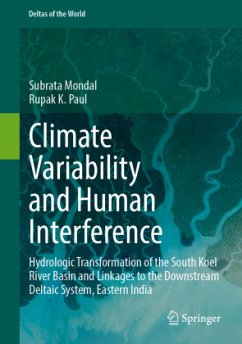
129,99 €
inkl. MwSt.
Versandkostenfrei*Erscheint vorauss. April 2026
Melden Sie sich
hier
hier
für den Produktalarm an, um über die Verfügbarkeit des Produkts informiert zu werden.

65 °P sammeln
Andere Kunden interessierten sich auch für
 Water Resources in Delta Region in India129,99 €
 Water Resources in Delta Region in India129,99 €
 Deltas Resilience121,99 €
 Water Resources in Delta Region in India129,99 €
 Digital Land Resources to Support Sustainable Development in Egypt137,99 €
 Geology of the Nile Deltas and Natural Resources119,99 €
 Human Interference on River Health98,99 €

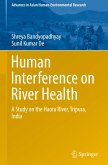
This book presents a focused analysis of how climate variability and human interference reshape runoff behavior in the monsoon-influenced South Koel River Basin of Eastern India. Employing geospatial techniques, SWAT-based hydrological simulation, and statistical analyses, it provides an empirical understanding of how rainfall and land use and land cover dynamics influence hydrologic processes and runoff alteration in the basin.
The study analyzes temporal variations in rainfall and runoff using methods such as the Buishand U and Range tests, Standard Normal Homogeneity, Pettitt, Mann-Kendall, Modified Mann-Kendall, and Sequential Mann-Kendall tests. It distinguishes the impacts of climate variability and land use/land cover (LULC) change through simulation-based attribution. Additionally, it evaluates the sensitivity of LULC components - forest, agriculture, and built-up areas - on runoff using one-way ANCOVA, while assessing upstream downstream hydrologic connectivity and its implications for the Brahmani Baitarani deltaic system through changes in flow, sediment, and nutrient fluxes.
Concluding with key scientific insights and management recommendations, the volume highlights basin-specific vulnerabilities and offers a decision-support framework for sustainable water governance. It serves as a valuable reference for geographers, hydrologists, environmental scientists, policy planners, and postgraduate researchers engaged in studies of climate, land use and land cover, and runoff interactions.
The study analyzes temporal variations in rainfall and runoff using methods such as the Buishand U and Range tests, Standard Normal Homogeneity, Pettitt, Mann-Kendall, Modified Mann-Kendall, and Sequential Mann-Kendall tests. It distinguishes the impacts of climate variability and land use/land cover (LULC) change through simulation-based attribution. Additionally, it evaluates the sensitivity of LULC components - forest, agriculture, and built-up areas - on runoff using one-way ANCOVA, while assessing upstream downstream hydrologic connectivity and its implications for the Brahmani Baitarani deltaic system through changes in flow, sediment, and nutrient fluxes.
Concluding with key scientific insights and management recommendations, the volume highlights basin-specific vulnerabilities and offers a decision-support framework for sustainable water governance. It serves as a valuable reference for geographers, hydrologists, environmental scientists, policy planners, and postgraduate researchers engaged in studies of climate, land use and land cover, and runoff interactions.