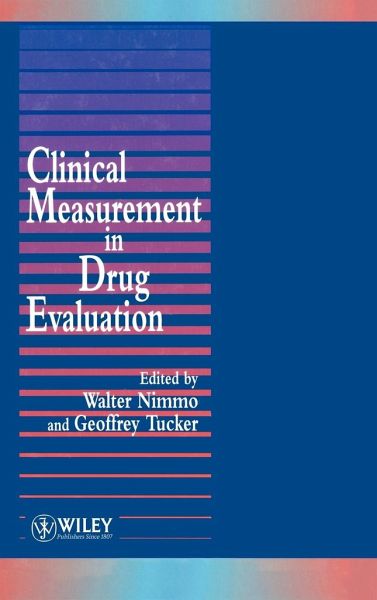
Measurement of the therapeutic and adverse effects of drugs remains a high priority for the pharmaceutical industry, particularly in proving clinical efficacy and safety, and in the evaluation and development of new drugs. Here, an international field of authors have provided a text devoted to the principles and practice of drug evaluation. Emphasis has been given to surrogate end points, peripheral vascular disease, the reliability of collection and interpretation of data and the identification, predictability and interpretation of drug interactions and adverse effects. This volume will be of…mehr
Measurement of the therapeutic and adverse effects of drugs remains a high priority for the pharmaceutical industry, particularly in proving clinical efficacy and safety, and in the evaluation and development of new drugs. Here, an international field of authors have provided a text devoted to the principles and practice of drug evaluation. Emphasis has been given to surrogate end points, peripheral vascular disease, the reliability of collection and interpretation of data and the identification, predictability and interpretation of drug interactions and adverse effects. This volume will be of enormous value to pharmacologists, cardiologists, psychiatrists and haematologists, as well as medical and research staff in industry and academia.
Walter S. Nimmo is the editor of Clinical Measurement in Drug Evaluation, published by Wiley. Geoffrey T. Tucker is the editor of Clinical Measurement in Drug Evaluation , published by Wiley.
Inhaltsangabe
Contributors. Preface. SURROGATE ENDPOINTS AS A MEASURE OF DRUG EFFECTS. A Regulatory Authority's Opinion About Surrogate Endpoints (R.Temple). What to Measure in Dementia (L. Whalley & S. Gerhand). Twenty-foour-hour ambulatory arterial (blood) pressuremeasurement and the assessment of antihypertensive drug efficacy(J. Hasford, W. Meister). Potential Measurements in Patients with Osteoporosis (C.Miller). Are bronchial challenge studies indicators of antiasthmaticactivity? (A. J. Frew, S. T. Holgate) DRUGS AFFECTING BLOOD FLOW TO THE PERIPHERAL CIRCULATION. Measurements of Blood Rheology for the Evaluation ofPharmacological Agents (G. Nash). Platelet Function Tests (P. Wyld). Assessment of the Effects of Drugs on the Peripheral Vasculature(D. Webb & M. Hand). PRECISION, VALIDITY AND REPRODUCIBILITY OF MEASUREMENT. Bias and Confounding in Clinical Studies (D. Jones). What Does Good Clinical Practice Have to Say About ClinicalMeasurement? (E. Hvidberg). Measurement of bioequivalence and its relevance to tthe clinicalsituation (T. Salmonson) The 'Clinical Trial' of the Clinical Trial (A. Feinstein). Patient compliancewith prescribed drug regimens: overview of thepast 30 yers of research (j. Urguhart). MEASUREMENT OF ADVERSE EVENTS. Prediction of drug interactions: implications of recent advancesin drug metabolism (G. T. Tucker). What number of patients is necessary to establish drug safety?(P. R. Jackson, E. J. Wallis, W. w. Yeo, L E. Ramsay) Accuracy of adverse data from post-marketing studies and theinfluence on extension of licensed indications (D. H.Lawson). Controlled Clinical Trials: Contribution to Drug Safety (M.Langman). Predicting Adverse Drug Reactions (C. George). THE EDINBURGH DRUG ABSORPTION FOUNDATION LECTURE. Interactions in First-Pass Metabolism and Variability in DrugResponse (P. Neuvonen). Index.
Contributors. Preface. SURROGATE ENDPOINTS AS A MEASURE OF DRUG EFFECTS. A Regulatory Authority's Opinion About Surrogate Endpoints (R.Temple). What to Measure in Dementia (L. Whalley & S. Gerhand). Twenty-foour-hour ambulatory arterial (blood) pressuremeasurement and the assessment of antihypertensive drug efficacy(J. Hasford, W. Meister). Potential Measurements in Patients with Osteoporosis (C.Miller). Are bronchial challenge studies indicators of antiasthmaticactivity? (A. J. Frew, S. T. Holgate) DRUGS AFFECTING BLOOD FLOW TO THE PERIPHERAL CIRCULATION. Measurements of Blood Rheology for the Evaluation ofPharmacological Agents (G. Nash). Platelet Function Tests (P. Wyld). Assessment of the Effects of Drugs on the Peripheral Vasculature(D. Webb & M. Hand). PRECISION, VALIDITY AND REPRODUCIBILITY OF MEASUREMENT. Bias and Confounding in Clinical Studies (D. Jones). What Does Good Clinical Practice Have to Say About ClinicalMeasurement? (E. Hvidberg). Measurement of bioequivalence and its relevance to tthe clinicalsituation (T. Salmonson) The 'Clinical Trial' of the Clinical Trial (A. Feinstein). Patient compliancewith prescribed drug regimens: overview of thepast 30 yers of research (j. Urguhart). MEASUREMENT OF ADVERSE EVENTS. Prediction of drug interactions: implications of recent advancesin drug metabolism (G. T. Tucker). What number of patients is necessary to establish drug safety?(P. R. Jackson, E. J. Wallis, W. w. Yeo, L E. Ramsay) Accuracy of adverse data from post-marketing studies and theinfluence on extension of licensed indications (D. H.Lawson). Controlled Clinical Trials: Contribution to Drug Safety (M.Langman). Predicting Adverse Drug Reactions (C. George). THE EDINBURGH DRUG ABSORPTION FOUNDATION LECTURE. Interactions in First-Pass Metabolism and Variability in DrugResponse (P. Neuvonen). Index.
Es gelten unsere Allgemeinen Geschäftsbedingungen: www.buecher.de/agb
Impressum
www.buecher.de ist ein Internetauftritt der buecher.de internetstores GmbH
Geschäftsführung: Monica Sawhney | Roland Kölbl | Günter Hilger
Sitz der Gesellschaft: Batheyer Straße 115 - 117, 58099 Hagen
Postanschrift: Bürgermeister-Wegele-Str. 12, 86167 Augsburg
Amtsgericht Hagen HRB 13257
Steuernummer: 321/5800/1497
USt-IdNr: DE450055826