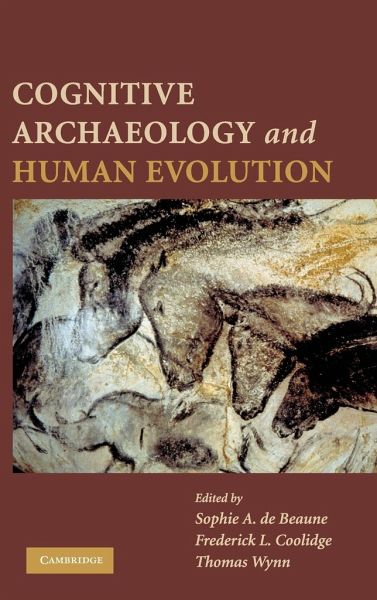
Cognitive Archaeology and Human Evolution
Herausgeber: de Beaune, Sophie A.; Wynn, Thomas; Coolidge, Frederick L.
Cognitive Archaeology and Human Evolution
Herausgeber: de Beaune, Sophie A.; Wynn, Thomas; Coolidge, Frederick L.
- Gebundenes Buch
- Merkliste
- Auf die Merkliste
- Bewerten Bewerten
- Teilen
- Produkt teilen
- Produkterinnerung
- Produkterinnerung
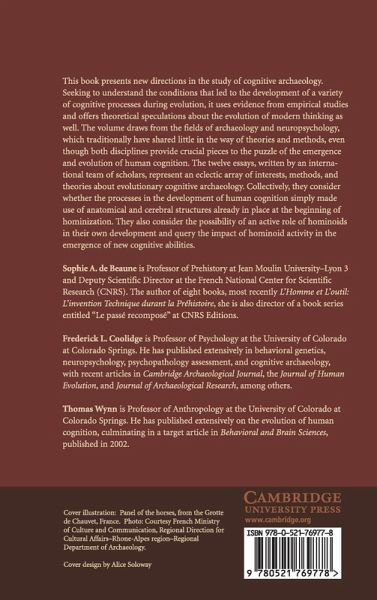
Uses evidence from empirical studies to understand conditions that led to the development of cognitive processes during evolution.
Andere Kunden interessierten sich auch für
Maurice BlochAnthropology and the Cognitive Challenge66,99 €
Maurice BlochAnthropology and the Cognitive Challenge31,99 €
Cognitive Models in Palaeolithic Archaeology110,99 €
Cognitive Archaeology as Symbolic Archaeology44,99 €
Cognitive Archaeology55,99 €
Settlement, Society and Cognition in Human Evolution121,99 €
Benoit DubreuilHuman Evolution and the Origins of Hierarchies47,99 €-
-
-
Uses evidence from empirical studies to understand conditions that led to the development of cognitive processes during evolution.
Produktdetails
- Produktdetails
- Verlag: Cambridge University Press
- Seitenzahl: 200
- Erscheinungstermin: 11. Januar 2016
- Englisch
- Abmessung: 235mm x 157mm x 15mm
- Gewicht: 448g
- ISBN-13: 9780521769778
- ISBN-10: 0521769779
- Artikelnr.: 26033217
- Herstellerkennzeichnung
- Libri GmbH
- Europaallee 1
- 36244 Bad Hersfeld
- gpsr@libri.de
- Verlag: Cambridge University Press
- Seitenzahl: 200
- Erscheinungstermin: 11. Januar 2016
- Englisch
- Abmessung: 235mm x 157mm x 15mm
- Gewicht: 448g
- ISBN-13: 9780521769778
- ISBN-10: 0521769779
- Artikelnr.: 26033217
- Herstellerkennzeichnung
- Libri GmbH
- Europaallee 1
- 36244 Bad Hersfeld
- gpsr@libri.de
1. The emergence of cognitive abilities: the contribution of
neuropsychology to archaeology Sophie A. de Beaune; 2. Technical invention
in the Paleolithic: what if the answer comes from the cognitive and
neuropsychological sciences? Sophie A. de Beaune; 3. Innovation and
creativity: a neuropsychological perspective Andreas Kyriacou; 4. The
archaeology of consciousness Matt Rossano; 5. Prehistoric handedness and
prehistoric language Natalie Uomini; 6. How to think a simple spear Miriam
Haidle; 7. Long-term memory and middle Pleistocene 'mysterians' Michael J.
Walker; 8. The quest for a common semantics: observations on definitional
criteria of cognitive processes in prehistory Carolina Maestro and Carmine
Collina; 9. Cognition and the emergence of language: a contribution from
lithic technology Jacques Pelegrin; 10. Language and the origin of symbolic
thought Ian Tattersall; 11. Implications of a strict standard for
recognizing modern cognition in the Paleolithic Thomas Wynn and Frederick
L. Coolidge; 12. Imagination and recursion: issues in the emergence of
language Eric Reuland; 13. Whither evolutionary cognitive archaeology?
Thomas Wynn.
neuropsychology to archaeology Sophie A. de Beaune; 2. Technical invention
in the Paleolithic: what if the answer comes from the cognitive and
neuropsychological sciences? Sophie A. de Beaune; 3. Innovation and
creativity: a neuropsychological perspective Andreas Kyriacou; 4. The
archaeology of consciousness Matt Rossano; 5. Prehistoric handedness and
prehistoric language Natalie Uomini; 6. How to think a simple spear Miriam
Haidle; 7. Long-term memory and middle Pleistocene 'mysterians' Michael J.
Walker; 8. The quest for a common semantics: observations on definitional
criteria of cognitive processes in prehistory Carolina Maestro and Carmine
Collina; 9. Cognition and the emergence of language: a contribution from
lithic technology Jacques Pelegrin; 10. Language and the origin of symbolic
thought Ian Tattersall; 11. Implications of a strict standard for
recognizing modern cognition in the Paleolithic Thomas Wynn and Frederick
L. Coolidge; 12. Imagination and recursion: issues in the emergence of
language Eric Reuland; 13. Whither evolutionary cognitive archaeology?
Thomas Wynn.
1. The emergence of cognitive abilities: the contribution of
neuropsychology to archaeology Sophie A. de Beaune; 2. Technical invention
in the Paleolithic: what if the answer comes from the cognitive and
neuropsychological sciences? Sophie A. de Beaune; 3. Innovation and
creativity: a neuropsychological perspective Andreas Kyriacou; 4. The
archaeology of consciousness Matt Rossano; 5. Prehistoric handedness and
prehistoric language Natalie Uomini; 6. How to think a simple spear Miriam
Haidle; 7. Long-term memory and middle Pleistocene 'mysterians' Michael J.
Walker; 8. The quest for a common semantics: observations on definitional
criteria of cognitive processes in prehistory Carolina Maestro and Carmine
Collina; 9. Cognition and the emergence of language: a contribution from
lithic technology Jacques Pelegrin; 10. Language and the origin of symbolic
thought Ian Tattersall; 11. Implications of a strict standard for
recognizing modern cognition in the Paleolithic Thomas Wynn and Frederick
L. Coolidge; 12. Imagination and recursion: issues in the emergence of
language Eric Reuland; 13. Whither evolutionary cognitive archaeology?
Thomas Wynn.
neuropsychology to archaeology Sophie A. de Beaune; 2. Technical invention
in the Paleolithic: what if the answer comes from the cognitive and
neuropsychological sciences? Sophie A. de Beaune; 3. Innovation and
creativity: a neuropsychological perspective Andreas Kyriacou; 4. The
archaeology of consciousness Matt Rossano; 5. Prehistoric handedness and
prehistoric language Natalie Uomini; 6. How to think a simple spear Miriam
Haidle; 7. Long-term memory and middle Pleistocene 'mysterians' Michael J.
Walker; 8. The quest for a common semantics: observations on definitional
criteria of cognitive processes in prehistory Carolina Maestro and Carmine
Collina; 9. Cognition and the emergence of language: a contribution from
lithic technology Jacques Pelegrin; 10. Language and the origin of symbolic
thought Ian Tattersall; 11. Implications of a strict standard for
recognizing modern cognition in the Paleolithic Thomas Wynn and Frederick
L. Coolidge; 12. Imagination and recursion: issues in the emergence of
language Eric Reuland; 13. Whither evolutionary cognitive archaeology?
Thomas Wynn.