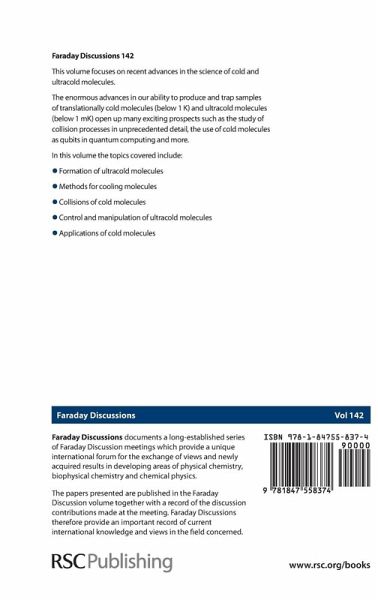
Faraday Discussions covers a variety of topics in rapidly developing areas of the physical sciences, with a focus on physical chemistry and its interfaces with other scientific disciplines.
Faraday Discussions covers a variety of topics in rapidly developing areas of the physical sciences, with a focus on physical chemistry and its interfaces with other scientific disciplines.
Faraday Discussions documents a long-established series of Faraday Discussion meetings which provide a unique international forum for the exchange of views and newly acquired results in developing areas of physical chemistry, biophysical chemistry and chemical physics. The papers presented are published in the Faraday Discussion volume together with a record of the discussion contributions made at the meeting. Faraday Discussions therefore provide an important record of current international knowledge and views in the field concerned. The latest (2012) impact factor of Faraday Discussions is 3.82.
Inhaltsangabe
Molecular Collisions, from Warm to Ultracold; Testing the Time-invariance of Fundamental Constants Using Microwave Spectroscopy on Cold Diatomic Radicals; Prospects for Measuring the Electric Dipole Moment of the Electron Using Electrically Trapped Polar Molecules; Buffer Gas Cooling of Polyatomic Ions in rf Multi-electrode Traps; Ion-molecule Chemistry at Very Low Temperatures: Cold Chemical Reactions Between Coulomb-crystallized Ions and Velocity-selected Neutral Molecules; Collision Experiments with Stark-decelerated Beams; Dynamics of Oh(2p)-He Collisions in Combined Electric and Magnetic Fields; Production of Cold ND3 by Kinematic Cooling; Manipulating the Motion of Large Neutral Molecules; Sympathetic Cooling by Collisions with Ultracold Rare Gas Atoms, and Recent Progress in Optical Stark Deceleration; Prospects for Sympathetic Cooling of Polar Molecules: NH with Alkali-metal and Alkaline-earth Atoms - a New Hope; Continuous Guided Beams of Slow and Internally Cold Polar Molecules; Broadband Lasers to Detect and Cool the Vibration of Cold Molecules; Dark State Experiments with Ultracold, Deeply-bound Triplet Molecules; Precision Molecular Spectroscopy for Ground State Transfer of Molecular Quantum Gases; Rotational Spectroscopy of Single Carbonyl Sulfide Molecules Embedded in Superfluid Helium Nanodroplets; Self-organisation and Cooling of a Large Ensemble of Particles in Optical Cavities; Formation of Ultracold Dipolar Molecules in the Lowest Vibrational Levels by Photoassociation; Ultracold Polar Molecules near Quantum Degeneracy; Ultracold Molecules from Ultracold Atoms: A Case Study with the KRb Molecule; Two-photon Coherent Control of Femtosecond Photoassociation; A Pump---probe Study of the Photoassociation of Cold Rubidium Molecules; Fano Profiles in Two-photon Photoassociation Spectra.
Molecular Collisions, from Warm to Ultracold; Testing the Time-invariance of Fundamental Constants Using Microwave Spectroscopy on Cold Diatomic Radicals; Prospects for Measuring the Electric Dipole Moment of the Electron Using Electrically Trapped Polar Molecules; Buffer Gas Cooling of Polyatomic Ions in rf Multi-electrode Traps; Ion-molecule Chemistry at Very Low Temperatures: Cold Chemical Reactions Between Coulomb-crystallized Ions and Velocity-selected Neutral Molecules; Collision Experiments with Stark-decelerated Beams; Dynamics of Oh(2p)-He Collisions in Combined Electric and Magnetic Fields; Production of Cold ND3 by Kinematic Cooling; Manipulating the Motion of Large Neutral Molecules; Sympathetic Cooling by Collisions with Ultracold Rare Gas Atoms, and Recent Progress in Optical Stark Deceleration; Prospects for Sympathetic Cooling of Polar Molecules: NH with Alkali-metal and Alkaline-earth Atoms - a New Hope; Continuous Guided Beams of Slow and Internally Cold Polar Molecules; Broadband Lasers to Detect and Cool the Vibration of Cold Molecules; Dark State Experiments with Ultracold, Deeply-bound Triplet Molecules; Precision Molecular Spectroscopy for Ground State Transfer of Molecular Quantum Gases; Rotational Spectroscopy of Single Carbonyl Sulfide Molecules Embedded in Superfluid Helium Nanodroplets; Self-organisation and Cooling of a Large Ensemble of Particles in Optical Cavities; Formation of Ultracold Dipolar Molecules in the Lowest Vibrational Levels by Photoassociation; Ultracold Polar Molecules near Quantum Degeneracy; Ultracold Molecules from Ultracold Atoms: A Case Study with the KRb Molecule; Two-photon Coherent Control of Femtosecond Photoassociation; A Pump---probe Study of the Photoassociation of Cold Rubidium Molecules; Fano Profiles in Two-photon Photoassociation Spectra.
Es gelten unsere Allgemeinen Geschäftsbedingungen: www.buecher.de/agb
Impressum
www.buecher.de ist ein Internetauftritt der buecher.de internetstores GmbH
Geschäftsführung: Monica Sawhney | Roland Kölbl | Günter Hilger
Sitz der Gesellschaft: Batheyer Straße 115 - 117, 58099 Hagen
Postanschrift: Bürgermeister-Wegele-Str. 12, 86167 Augsburg
Amtsgericht Hagen HRB 13257
Steuernummer: 321/5800/1497
USt-IdNr: DE450055826