
Collecting and Provenance
A Multidisciplinary Approach
Herausgeber: Milosch, Jane; Pearce, Nick
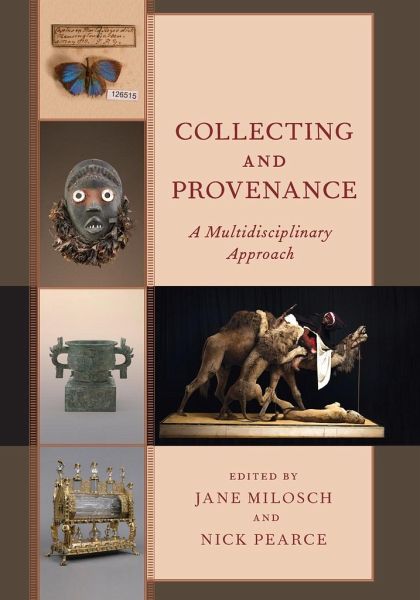
Collecting and Provenance
A Multidisciplinary Approach
Herausgeber: Milosch, Jane; Pearce, Nick
- Broschiertes Buch
- Merkliste
- Auf die Merkliste
- Bewerten Bewerten
- Teilen
- Produkt teilen
- Produkterinnerung
- Produkterinnerung
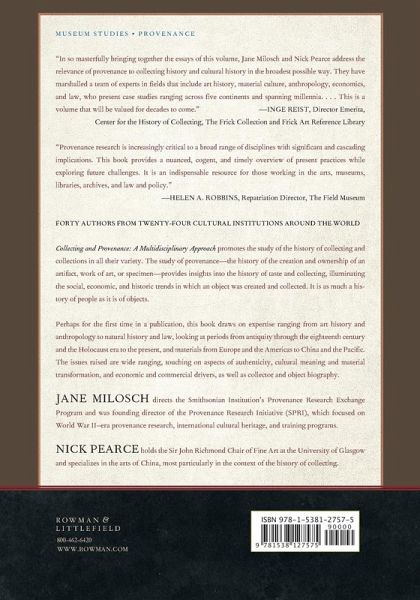
The book fills a gap in the study of provenance, taking the subject holistically and from multiple standpoints, which better reflect the widening interest in provenance from a range of disciplinary perspectives.
Andere Kunden interessierten sich auch für
 Collecting and Provenance182,99 €
 Extreme Collecting131,99 €
 New Collecting168,99 €
 Archives, Museums and Collecting Practices in the Modern Arab World177,99 €
 Collecting the Past28,99 €
 New Collecting50,99 €
 Museum Collecting Lessons167,99 €
-
-
-
The book fills a gap in the study of provenance, taking the subject holistically and from multiple standpoints, which better reflect the widening interest in provenance from a range of disciplinary perspectives.
Produktdetails
- Produktdetails
- Verlag: Rowman & Littlefield Publishers
- Seitenzahl: 452
- Erscheinungstermin: 28. Oktober 2019
- Englisch
- Abmessung: 254mm x 178mm x 24mm
- Gewicht: 844g
- ISBN-13: 9781538127575
- ISBN-10: 1538127571
- Artikelnr.: 56929958
- Herstellerkennzeichnung
- Libri GmbH
- Europaallee 1
- 36244 Bad Hersfeld
- gpsr@libri.de
- Verlag: Rowman & Littlefield Publishers
- Seitenzahl: 452
- Erscheinungstermin: 28. Oktober 2019
- Englisch
- Abmessung: 254mm x 178mm x 24mm
- Gewicht: 844g
- ISBN-13: 9781538127575
- ISBN-10: 1538127571
- Artikelnr.: 56929958
- Herstellerkennzeichnung
- Libri GmbH
- Europaallee 1
- 36244 Bad Hersfeld
- gpsr@libri.de
Jane Milosch directs the Smithsonian Institution's Provenance Research Exchange Program, and was founding director of the Provenance Research Initiative (SPRI), which focused on WWII-era provenance research, international cultural heritage, and training programs. She previously served as Senior Program Officer for Art, leading pan-institutional programs and strategic planning efforts, and was appointed the U.S. Representative to Germany's "Schwabing Art Trove" Task Force. She has held curatorial positions at the Renwick Gallery, Smithsonian American Art Museum, Washington, DC. and in Detroit, Iowa, and Munich, Germany, and is an Honorary Professor in the School of Culture & Creative Arts, University of Glasgow. She was awarded the Cross of the Order of Merit of the Federal Republic of Germany in 2020. Nick Pearce holds the Sir John Richmond Chair of Fine Art at the University of Glasgow, and specializes in the arts of China, most particularly in the context of the history of collecting. His career has spanned both museums and universities, as he has held positions at the Victoria & Albert Museum, The Burrell Collection in Glasgow, and at Durham and Edinburgh universities. He joined the University of Glasgow in 1998, where he has held the positions of Head of History of Art and Head of the School of Culture & Creative Arts, and is a Smithsonian Research Associate.
Foreword
Lynn H. Nicholas, Independent Scholar
Preface
Richard Kurin, Smithsonian Institution
Introduction
Acknowledgements
Nick Pearce, University of Glasgow, and Jane C. Milosch, Smithsonian
Institution
Provenance: Past and Future Challenges
1.The Provenance of Provenances
Christian Huemer, Österreichische Galerie Belvedere
2.Intellectual Property and Ownership History
Christel H. Force, The Metropolitan Museum of Art
3.Provenance Research in Museums: From the Back of the House
to the Front
Jane C. Milosch and Andrea Hull, Smithsonian Provenance Research Initiative
(SPRI)
4.Transforming Research Methodologies: The Frick Art Reference Library's
Collaborative Approach
Louisa Wood Ruby and Samantha Deutch, The Frick Art Reference Library
5.Digging in Digital Archives: Recovering Context for the Getty Museum's
Orpheus Mosaic
Nicole Budrovich, J. Paul Getty Museum
6.Exhibiting Provenance in the University Museum: A Case Study
Nancy Karrels, University of Illinois, Urbana-Champaign
7.Provenance in 2050
David Newbury, J. Paul Getty Trust, and Louise Lippincott, Carnegie Museum
of Art
Objects in Motion
8.Provenance as Palimpsest: The Mazarin Venus
Judith Barr, J. Paul Getty Museum
9.Archaeology, Fakery, and Lunacy: N.S. Brown's Chinese Neolithic
Collection
Nick Pearce, University of Glasgow
10.The Importance of Provenance in Nineteenth-Century Paris and Beyond:
Four Works of Art from Prince Pierre Soltykoff's Famed Collection of
Medieval Art
Christine E. Brennan, The Metropolitan Museum of Art
11.The Medieval Bury Chest: Mapping the Journey from Durham Cathedral to
the Burrell Collection, Glasgow
Elizabeth Hancock, University of Glasgow; Erma Hermens, Rijksmuseum; and
Lindsay Gordon, Glasgow Museums
12.Plunder, Dissolution, and Dodgy Dealing: The International Market for
Spanish Art in the Nineteenth Century
Hilary Macartney, University of Glasgow, and Véronique Gerard Powell,
Paris-Sorbonne Université
13.Documenting the Violin Trade in Paris: The Archives of Albert Caressa
and Émile Français, 1930-1945
Carla Shapreau, University of California, Berkeley; Jean-Philippe Échard
and Christine Laloue, Musée de la musique, Paris
14.Twice Plundered, and Still Far from Home: Tracing Nazi-Looted Books in
Minsk and Moscow
Patricia Kennedy Grimsted, Davis Center for Russian and Eurasian Studies
and the Ukrainian Research Institute, Harvard University
Museums and Collection Formation: Provenancing Art and Nature
15.Lost and Found: Reestablishing Provenance for an Entire Museum
Collection
Ann McMullen and Maria Galban, National Museum of the American Indian
16.Thomas Pattinson Yeats (1746-1782), Naturalist: Connecting Margaret
Bentinck, Duchess of Portland, and William Hunter
E. Geoffrey Hancock, University of Glasgow
17.A Kato Mosi Kaka and Other Tongan Treasures from the United States
Exploring Expedition (1838-1842) in the Smithsonian Institution
Adrienne L. Kaeppler, National Museum of Natural History
18.Provenance and Place in Indigenous Australia
Gaye Sculthorpe, British Museum
19.Pursuing Provenance: Perspectives on the Arts of Africa
Christine Mullen Kreamer, National Museum of African Art
20.One Object, Three Histories: Provenancing the Dromedary
Louise Lippincott, Carnegie Museum of Art
21.Forest Gold
Edward J. Bronikowski, Smithsonian's National Zoological Park Conservation
Biology Institute
Provenance and Collecting Policies: Practical, Legal, and Ethical
Challenges
22.A Voyage into the Half-known: Museum Ethics in the Early Twentieth
Century
Petra Winter, Staatliche Museen, and Carola Thielecke, Stiftung Preußischer
Kulturbesitz
23.Forgotten Language of the Ledger: Signaling Ownership, Authority, and
Provenance with Museum Accession Status
Joshua Gorman, National Museum of American History
24.The Holy Family on an Unholy Odyssey: Legal Ownership of Stolen Trophy
Art
Christa Roodt, University of Glasgow
25.Problems, Practices, and Politics of Provenancing Objects from China's
Yuanmingyuan
Louise Tythacott, University of London
26.Crisis Response and Beyond: The National Gallery of Australia's Asian
Art Provenance Project and Other New Initiatives
Bronwyn Campbell, National Gallery of Australia
27.Antiquities Trafficking and the Provenance Problem
Donna Yates and Emiline Smith, University of Glasgow
28.Before, During, and After: Documenting Museum Collections in Times of
Crisis and Disaster
Brian I. Daniels and Corine Wegener, Smithsonian Cultural Rescue Initiative
Endnotes
Index
About the Contributors
Lynn H. Nicholas, Independent Scholar
Preface
Richard Kurin, Smithsonian Institution
Introduction
Acknowledgements
Nick Pearce, University of Glasgow, and Jane C. Milosch, Smithsonian
Institution
Provenance: Past and Future Challenges
1.The Provenance of Provenances
Christian Huemer, Österreichische Galerie Belvedere
2.Intellectual Property and Ownership History
Christel H. Force, The Metropolitan Museum of Art
3.Provenance Research in Museums: From the Back of the House
to the Front
Jane C. Milosch and Andrea Hull, Smithsonian Provenance Research Initiative
(SPRI)
4.Transforming Research Methodologies: The Frick Art Reference Library's
Collaborative Approach
Louisa Wood Ruby and Samantha Deutch, The Frick Art Reference Library
5.Digging in Digital Archives: Recovering Context for the Getty Museum's
Orpheus Mosaic
Nicole Budrovich, J. Paul Getty Museum
6.Exhibiting Provenance in the University Museum: A Case Study
Nancy Karrels, University of Illinois, Urbana-Champaign
7.Provenance in 2050
David Newbury, J. Paul Getty Trust, and Louise Lippincott, Carnegie Museum
of Art
Objects in Motion
8.Provenance as Palimpsest: The Mazarin Venus
Judith Barr, J. Paul Getty Museum
9.Archaeology, Fakery, and Lunacy: N.S. Brown's Chinese Neolithic
Collection
Nick Pearce, University of Glasgow
10.The Importance of Provenance in Nineteenth-Century Paris and Beyond:
Four Works of Art from Prince Pierre Soltykoff's Famed Collection of
Medieval Art
Christine E. Brennan, The Metropolitan Museum of Art
11.The Medieval Bury Chest: Mapping the Journey from Durham Cathedral to
the Burrell Collection, Glasgow
Elizabeth Hancock, University of Glasgow; Erma Hermens, Rijksmuseum; and
Lindsay Gordon, Glasgow Museums
12.Plunder, Dissolution, and Dodgy Dealing: The International Market for
Spanish Art in the Nineteenth Century
Hilary Macartney, University of Glasgow, and Véronique Gerard Powell,
Paris-Sorbonne Université
13.Documenting the Violin Trade in Paris: The Archives of Albert Caressa
and Émile Français, 1930-1945
Carla Shapreau, University of California, Berkeley; Jean-Philippe Échard
and Christine Laloue, Musée de la musique, Paris
14.Twice Plundered, and Still Far from Home: Tracing Nazi-Looted Books in
Minsk and Moscow
Patricia Kennedy Grimsted, Davis Center for Russian and Eurasian Studies
and the Ukrainian Research Institute, Harvard University
Museums and Collection Formation: Provenancing Art and Nature
15.Lost and Found: Reestablishing Provenance for an Entire Museum
Collection
Ann McMullen and Maria Galban, National Museum of the American Indian
16.Thomas Pattinson Yeats (1746-1782), Naturalist: Connecting Margaret
Bentinck, Duchess of Portland, and William Hunter
E. Geoffrey Hancock, University of Glasgow
17.A Kato Mosi Kaka and Other Tongan Treasures from the United States
Exploring Expedition (1838-1842) in the Smithsonian Institution
Adrienne L. Kaeppler, National Museum of Natural History
18.Provenance and Place in Indigenous Australia
Gaye Sculthorpe, British Museum
19.Pursuing Provenance: Perspectives on the Arts of Africa
Christine Mullen Kreamer, National Museum of African Art
20.One Object, Three Histories: Provenancing the Dromedary
Louise Lippincott, Carnegie Museum of Art
21.Forest Gold
Edward J. Bronikowski, Smithsonian's National Zoological Park Conservation
Biology Institute
Provenance and Collecting Policies: Practical, Legal, and Ethical
Challenges
22.A Voyage into the Half-known: Museum Ethics in the Early Twentieth
Century
Petra Winter, Staatliche Museen, and Carola Thielecke, Stiftung Preußischer
Kulturbesitz
23.Forgotten Language of the Ledger: Signaling Ownership, Authority, and
Provenance with Museum Accession Status
Joshua Gorman, National Museum of American History
24.The Holy Family on an Unholy Odyssey: Legal Ownership of Stolen Trophy
Art
Christa Roodt, University of Glasgow
25.Problems, Practices, and Politics of Provenancing Objects from China's
Yuanmingyuan
Louise Tythacott, University of London
26.Crisis Response and Beyond: The National Gallery of Australia's Asian
Art Provenance Project and Other New Initiatives
Bronwyn Campbell, National Gallery of Australia
27.Antiquities Trafficking and the Provenance Problem
Donna Yates and Emiline Smith, University of Glasgow
28.Before, During, and After: Documenting Museum Collections in Times of
Crisis and Disaster
Brian I. Daniels and Corine Wegener, Smithsonian Cultural Rescue Initiative
Endnotes
Index
About the Contributors
Foreword
Lynn H. Nicholas, Independent Scholar
Preface
Richard Kurin, Smithsonian Institution
Introduction
Acknowledgements
Nick Pearce, University of Glasgow, and Jane C. Milosch, Smithsonian
Institution
Provenance: Past and Future Challenges
1.The Provenance of Provenances
Christian Huemer, Österreichische Galerie Belvedere
2.Intellectual Property and Ownership History
Christel H. Force, The Metropolitan Museum of Art
3.Provenance Research in Museums: From the Back of the House
to the Front
Jane C. Milosch and Andrea Hull, Smithsonian Provenance Research Initiative
(SPRI)
4.Transforming Research Methodologies: The Frick Art Reference Library's
Collaborative Approach
Louisa Wood Ruby and Samantha Deutch, The Frick Art Reference Library
5.Digging in Digital Archives: Recovering Context for the Getty Museum's
Orpheus Mosaic
Nicole Budrovich, J. Paul Getty Museum
6.Exhibiting Provenance in the University Museum: A Case Study
Nancy Karrels, University of Illinois, Urbana-Champaign
7.Provenance in 2050
David Newbury, J. Paul Getty Trust, and Louise Lippincott, Carnegie Museum
of Art
Objects in Motion
8.Provenance as Palimpsest: The Mazarin Venus
Judith Barr, J. Paul Getty Museum
9.Archaeology, Fakery, and Lunacy: N.S. Brown's Chinese Neolithic
Collection
Nick Pearce, University of Glasgow
10.The Importance of Provenance in Nineteenth-Century Paris and Beyond:
Four Works of Art from Prince Pierre Soltykoff's Famed Collection of
Medieval Art
Christine E. Brennan, The Metropolitan Museum of Art
11.The Medieval Bury Chest: Mapping the Journey from Durham Cathedral to
the Burrell Collection, Glasgow
Elizabeth Hancock, University of Glasgow; Erma Hermens, Rijksmuseum; and
Lindsay Gordon, Glasgow Museums
12.Plunder, Dissolution, and Dodgy Dealing: The International Market for
Spanish Art in the Nineteenth Century
Hilary Macartney, University of Glasgow, and Véronique Gerard Powell,
Paris-Sorbonne Université
13.Documenting the Violin Trade in Paris: The Archives of Albert Caressa
and Émile Français, 1930-1945
Carla Shapreau, University of California, Berkeley; Jean-Philippe Échard
and Christine Laloue, Musée de la musique, Paris
14.Twice Plundered, and Still Far from Home: Tracing Nazi-Looted Books in
Minsk and Moscow
Patricia Kennedy Grimsted, Davis Center for Russian and Eurasian Studies
and the Ukrainian Research Institute, Harvard University
Museums and Collection Formation: Provenancing Art and Nature
15.Lost and Found: Reestablishing Provenance for an Entire Museum
Collection
Ann McMullen and Maria Galban, National Museum of the American Indian
16.Thomas Pattinson Yeats (1746-1782), Naturalist: Connecting Margaret
Bentinck, Duchess of Portland, and William Hunter
E. Geoffrey Hancock, University of Glasgow
17.A Kato Mosi Kaka and Other Tongan Treasures from the United States
Exploring Expedition (1838-1842) in the Smithsonian Institution
Adrienne L. Kaeppler, National Museum of Natural History
18.Provenance and Place in Indigenous Australia
Gaye Sculthorpe, British Museum
19.Pursuing Provenance: Perspectives on the Arts of Africa
Christine Mullen Kreamer, National Museum of African Art
20.One Object, Three Histories: Provenancing the Dromedary
Louise Lippincott, Carnegie Museum of Art
21.Forest Gold
Edward J. Bronikowski, Smithsonian's National Zoological Park Conservation
Biology Institute
Provenance and Collecting Policies: Practical, Legal, and Ethical
Challenges
22.A Voyage into the Half-known: Museum Ethics in the Early Twentieth
Century
Petra Winter, Staatliche Museen, and Carola Thielecke, Stiftung Preußischer
Kulturbesitz
23.Forgotten Language of the Ledger: Signaling Ownership, Authority, and
Provenance with Museum Accession Status
Joshua Gorman, National Museum of American History
24.The Holy Family on an Unholy Odyssey: Legal Ownership of Stolen Trophy
Art
Christa Roodt, University of Glasgow
25.Problems, Practices, and Politics of Provenancing Objects from China's
Yuanmingyuan
Louise Tythacott, University of London
26.Crisis Response and Beyond: The National Gallery of Australia's Asian
Art Provenance Project and Other New Initiatives
Bronwyn Campbell, National Gallery of Australia
27.Antiquities Trafficking and the Provenance Problem
Donna Yates and Emiline Smith, University of Glasgow
28.Before, During, and After: Documenting Museum Collections in Times of
Crisis and Disaster
Brian I. Daniels and Corine Wegener, Smithsonian Cultural Rescue Initiative
Endnotes
Index
About the Contributors
Lynn H. Nicholas, Independent Scholar
Preface
Richard Kurin, Smithsonian Institution
Introduction
Acknowledgements
Nick Pearce, University of Glasgow, and Jane C. Milosch, Smithsonian
Institution
Provenance: Past and Future Challenges
1.The Provenance of Provenances
Christian Huemer, Österreichische Galerie Belvedere
2.Intellectual Property and Ownership History
Christel H. Force, The Metropolitan Museum of Art
3.Provenance Research in Museums: From the Back of the House
to the Front
Jane C. Milosch and Andrea Hull, Smithsonian Provenance Research Initiative
(SPRI)
4.Transforming Research Methodologies: The Frick Art Reference Library's
Collaborative Approach
Louisa Wood Ruby and Samantha Deutch, The Frick Art Reference Library
5.Digging in Digital Archives: Recovering Context for the Getty Museum's
Orpheus Mosaic
Nicole Budrovich, J. Paul Getty Museum
6.Exhibiting Provenance in the University Museum: A Case Study
Nancy Karrels, University of Illinois, Urbana-Champaign
7.Provenance in 2050
David Newbury, J. Paul Getty Trust, and Louise Lippincott, Carnegie Museum
of Art
Objects in Motion
8.Provenance as Palimpsest: The Mazarin Venus
Judith Barr, J. Paul Getty Museum
9.Archaeology, Fakery, and Lunacy: N.S. Brown's Chinese Neolithic
Collection
Nick Pearce, University of Glasgow
10.The Importance of Provenance in Nineteenth-Century Paris and Beyond:
Four Works of Art from Prince Pierre Soltykoff's Famed Collection of
Medieval Art
Christine E. Brennan, The Metropolitan Museum of Art
11.The Medieval Bury Chest: Mapping the Journey from Durham Cathedral to
the Burrell Collection, Glasgow
Elizabeth Hancock, University of Glasgow; Erma Hermens, Rijksmuseum; and
Lindsay Gordon, Glasgow Museums
12.Plunder, Dissolution, and Dodgy Dealing: The International Market for
Spanish Art in the Nineteenth Century
Hilary Macartney, University of Glasgow, and Véronique Gerard Powell,
Paris-Sorbonne Université
13.Documenting the Violin Trade in Paris: The Archives of Albert Caressa
and Émile Français, 1930-1945
Carla Shapreau, University of California, Berkeley; Jean-Philippe Échard
and Christine Laloue, Musée de la musique, Paris
14.Twice Plundered, and Still Far from Home: Tracing Nazi-Looted Books in
Minsk and Moscow
Patricia Kennedy Grimsted, Davis Center for Russian and Eurasian Studies
and the Ukrainian Research Institute, Harvard University
Museums and Collection Formation: Provenancing Art and Nature
15.Lost and Found: Reestablishing Provenance for an Entire Museum
Collection
Ann McMullen and Maria Galban, National Museum of the American Indian
16.Thomas Pattinson Yeats (1746-1782), Naturalist: Connecting Margaret
Bentinck, Duchess of Portland, and William Hunter
E. Geoffrey Hancock, University of Glasgow
17.A Kato Mosi Kaka and Other Tongan Treasures from the United States
Exploring Expedition (1838-1842) in the Smithsonian Institution
Adrienne L. Kaeppler, National Museum of Natural History
18.Provenance and Place in Indigenous Australia
Gaye Sculthorpe, British Museum
19.Pursuing Provenance: Perspectives on the Arts of Africa
Christine Mullen Kreamer, National Museum of African Art
20.One Object, Three Histories: Provenancing the Dromedary
Louise Lippincott, Carnegie Museum of Art
21.Forest Gold
Edward J. Bronikowski, Smithsonian's National Zoological Park Conservation
Biology Institute
Provenance and Collecting Policies: Practical, Legal, and Ethical
Challenges
22.A Voyage into the Half-known: Museum Ethics in the Early Twentieth
Century
Petra Winter, Staatliche Museen, and Carola Thielecke, Stiftung Preußischer
Kulturbesitz
23.Forgotten Language of the Ledger: Signaling Ownership, Authority, and
Provenance with Museum Accession Status
Joshua Gorman, National Museum of American History
24.The Holy Family on an Unholy Odyssey: Legal Ownership of Stolen Trophy
Art
Christa Roodt, University of Glasgow
25.Problems, Practices, and Politics of Provenancing Objects from China's
Yuanmingyuan
Louise Tythacott, University of London
26.Crisis Response and Beyond: The National Gallery of Australia's Asian
Art Provenance Project and Other New Initiatives
Bronwyn Campbell, National Gallery of Australia
27.Antiquities Trafficking and the Provenance Problem
Donna Yates and Emiline Smith, University of Glasgow
28.Before, During, and After: Documenting Museum Collections in Times of
Crisis and Disaster
Brian I. Daniels and Corine Wegener, Smithsonian Cultural Rescue Initiative
Endnotes
Index
About the Contributors