NOTE: Before purchasing, check with your instructor to ensure you select the correct ISBN. Several versions of the MyLab(TM) and Mastering(TM) platforms exist for each title, and registrations are not transferable. To register for and use MyLab or Mastering, you may also need a Course ID, which your instructor will provide. Used books, rentals, and purchases made outside of Pearson If purchasing or renting from companies other than Pearson, the access codes for the MyLab platform may not be included, may be incorrect, or may be previously redeemed. Check with the seller before completing your…mehr
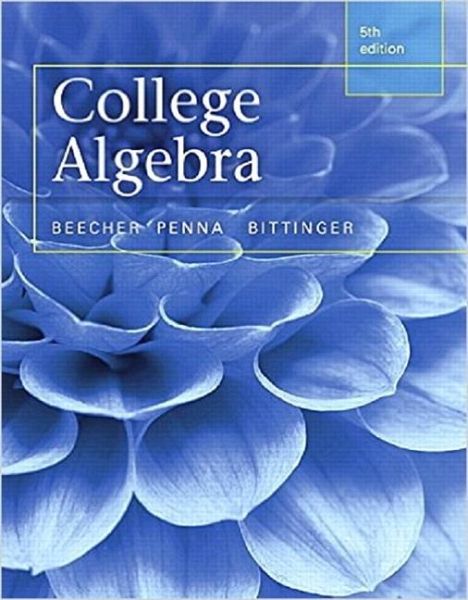
NOTE: Before purchasing, check with your instructor to ensure you select the correct ISBN. Several versions of the MyLab(TM) and Mastering(TM) platforms exist for each title, and registrations are not transferable. To register for and use MyLab or Mastering, you may also need a Course ID, which your instructor will provide. Used books, rentals, and purchases made outside of Pearson If purchasing or renting from companies other than Pearson, the access codes for the MyLab platform may not be included, may be incorrect, or may be previously redeemed. Check with the seller before completing your purchase. For courses in College Algebra. Includes MyLab Math. Prepare. Visualize. Succeed. College Algebra by Beecher, Penna, and Bittinger is known for helping students "see the math" through a focus on visualization and early introduction to functions. The author team has expanded and enhanced the instruction on review topics needed for today's corequisite courses, or simply for students who come to the course underprepared. The College Algebra MyLab Revision with Corequisite Support offers a complete college algebra MyLab Math course with review of key topics from developmental algebra. The authors have built tools specifically for underprepared students - resources that can be used by students independently via videos and notebook, or by instructors through integrating activities and interactive media into the classroom. Ideal either for standard course needs or for courses with students requiring additional preparation, this robust, just-in-time approach to corequisites gives instructors complete flexibility in implementation - no matter how their courses are set up. Personalize learning with MyLab Math By combining trusted author content with digital tools and a flexible platform, MyLab Math personalizes the learning experience and improves results for each student. 0135266408 / 9780135266403 MyLab Math with Pearson eText - Standalone Access Card - for College Algebra MyLab Revision with Corequisite Support Package consists of: * 0135301548 / 9780135301548 MyLab Math - Access Card - for College Algebra MyLab Revision with Corequisite Support * 0321737334 / 9780321737335 MML Course Tools for CourseCompass
Judy Beecher has an undergraduate degree in mathematics from Indiana University and a graduate degree in mathematics from Purdue University. She has taught at both the high school and college levels with many years of developmental math and precalculus teaching experience at Indiana University--Purdue University Indianapolis (IUPUI). In addition to her career in textbook publishing, she enjoys traveling, spending time with her grandchildren, and promoting charity projects for a children's camp. Judy Penna received her undergraduate degree in mathematics from Kansas State University and her graduate degree in mathematics from the University of Illinois. Since then, she has taught at Indiana University--Purdue University Indianapolis (IUPUI) and at Butler University, and continues to focus on writing quality textbooks for undergraduate mathematics students. In her free time she likes to travel, read, knit and spend time with her children. Marvin Bittinger has been teaching math at the university level for more than thirty-eight years. Since 1968, he has been employed at Indiana University--Purdue University Indianapolis (IUPUI), and is now professor emeritus of mathematics education. Professor Bittinger has authored over 190 publications on topics ranging from basic mathematics to algebra and trigonometry to applied calculus. He received his BA in mathematics from Manchester College and his PhD in mathematics education from Purdue University. Special honors include Distinguished Visiting Professor at the United States Air Force Academy and his election to the Manchester College Board of Trustees from 1992 to 1999. His hobbies include hiking in Utah, baseball, golf, and bowling. Professor Bittinger has also had the privilege of speaking at many mathematics conventions, most recently giving a lecture entitled "Baseball and Mathematics." In addition, he also has an interest in philosophy and theology, in particular, apologetics. Professor Bittinger currently lives in Carmel, Indiana with his wife Elaine. He has two grown and married sons, Lowell and Chris, and four granddaughters.
Inhaltsangabe
1. Graphs, Functions, and Models 1.1 Introduction to Graphing 1.2 Functions and Graphs 1.3 Linear Functions, Slope, and Applications 1.4 Equations of Lines and Modeling 1.5 Linear Equations, Functions, Zeros, and Applications 1.6 Solving Linear Inequalities
2. More on Functions 2.1 Increasing, Decreasing, and Piecewise Functions; Applications 2.2 The Algebra of Functions 2.3 The Composition of Functions 2.4 Symmetry 2.5 Transformations 2.6 Variation and Applications
3. Quadratic Functions and Equations; Inequalities 3.1 The Complex Numbers 3.2 Quadratic Equations, Functions, Zeros, and Models 3.3 Analyzing Graphs of Quadratic Functions 3.4 Solving Rational Equations and Radical Equations 3.5 Solving Equations and Inequalities with Absolute Value
4. Polynomial Functions and Rational Functions 4.1 Polynomial Functions and Models 4.2 Graphing Polynomial Functions 4.3 Polynomial Division; The Remainder Theorem and the Factor Theorem 4.4 Theorems about Zeros of Polynomial Functions 4.5 Rational Functions 4.6 Polynomial Inequalities and Rational Inequalities
5. Exponential Functions and Logarithmic Functions 5.1 Inverse Functions 5.2 Exponential Functions and Graphs 5.3 Logarithmic Functions and Graphs 5.4 Properties of Logarithmic Functions 5.5 Solving Exponential Equations and Logarithmic Equations 5.6 Applications and Models: Growth and Decay; Compound Interest
6. Systems of Equations and Matrices 6.1 Systems of Equations in Two Variables 6.2 Systems of Equations in Three Variables 6.3 Matrices and Systems of Equations 6.4 Matrix Operations 6.5 Inverses of Matrices 6.6 Determinants and Cramer s Rule 6.7 Systems of Inequalities and Linear Programming 6.8 Partial Fractions
7. Conic Sections 7.1 The Parabola 7.2 The Circle and the Ellipse 7.3 The Hyperbola 7.4 Nonlinear Systems of Equations and Inequalities
8. Sequences, Series, and Combinatorics 8.1 Sequences and Series 8.2 Arithmetic Sequences and Series 8.3 Geometric Sequences and Series 8.4 Mathematical Induction 8.5 Combinatorics: Permutations 8.6 Combinatorics: Combinations 8.7 The Binomial Theorem 8.8 Probability
1. Graphs, Functions, and Models 1.1 Introduction to Graphing 1.2 Functions and Graphs 1.3 Linear Functions, Slope, and Applications 1.4 Equations of Lines and Modeling 1.5 Linear Equations, Functions, Zeros, and Applications 1.6 Solving Linear Inequalities
2. More on Functions 2.1 Increasing, Decreasing, and Piecewise Functions; Applications 2.2 The Algebra of Functions 2.3 The Composition of Functions 2.4 Symmetry 2.5 Transformations 2.6 Variation and Applications
3. Quadratic Functions and Equations; Inequalities 3.1 The Complex Numbers 3.2 Quadratic Equations, Functions, Zeros, and Models 3.3 Analyzing Graphs of Quadratic Functions 3.4 Solving Rational Equations and Radical Equations 3.5 Solving Equations and Inequalities with Absolute Value
4. Polynomial Functions and Rational Functions 4.1 Polynomial Functions and Models 4.2 Graphing Polynomial Functions 4.3 Polynomial Division; The Remainder Theorem and the Factor Theorem 4.4 Theorems about Zeros of Polynomial Functions 4.5 Rational Functions 4.6 Polynomial Inequalities and Rational Inequalities
5. Exponential Functions and Logarithmic Functions 5.1 Inverse Functions 5.2 Exponential Functions and Graphs 5.3 Logarithmic Functions and Graphs 5.4 Properties of Logarithmic Functions 5.5 Solving Exponential Equations and Logarithmic Equations 5.6 Applications and Models: Growth and Decay; Compound Interest
6. Systems of Equations and Matrices 6.1 Systems of Equations in Two Variables 6.2 Systems of Equations in Three Variables 6.3 Matrices and Systems of Equations 6.4 Matrix Operations 6.5 Inverses of Matrices 6.6 Determinants and Cramer s Rule 6.7 Systems of Inequalities and Linear Programming 6.8 Partial Fractions
7. Conic Sections 7.1 The Parabola 7.2 The Circle and the Ellipse 7.3 The Hyperbola 7.4 Nonlinear Systems of Equations and Inequalities
8. Sequences, Series, and Combinatorics 8.1 Sequences and Series 8.2 Arithmetic Sequences and Series 8.3 Geometric Sequences and Series 8.4 Mathematical Induction 8.5 Combinatorics: Permutations 8.6 Combinatorics: Combinations 8.7 The Binomial Theorem 8.8 Probability
Es gelten unsere Allgemeinen Geschäftsbedingungen: www.buecher.de/agb
Impressum
www.buecher.de ist ein Internetauftritt der buecher.de internetstores GmbH
Geschäftsführung: Monica Sawhney | Roland Kölbl | Günter Hilger
Sitz der Gesellschaft: Batheyer Straße 115 - 117, 58099 Hagen
Postanschrift: Bürgermeister-Wegele-Str. 12, 86167 Augsburg
Amtsgericht Hagen HRB 13257
Steuernummer: 321/5800/1497
USt-IdNr: DE450055826