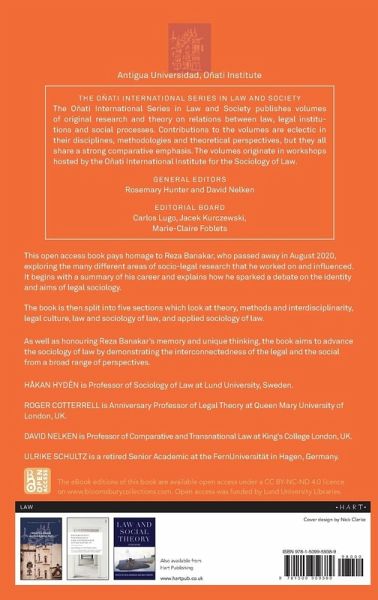
This open access book pays homage to Reza Banakar, who passed away in August 2020, exploring the many different areas of socio-legal research that he worked on and influenced. It begins with a summary of his career and explains how he sparked a debate on the identity and aims of legal sociology. The book is then split into 5 sections: - Theory, including chapters on normativity and the stepchild controversy; - Methods and interdisciplinarity, illustrating how Banakar encouraged socio-legal scholars to push the boundaries of existing socio-legal knowledge through interdisciplinary imagination…mehr
This open access book pays homage to Reza Banakar, who passed away in August 2020, exploring the many different areas of socio-legal research that he worked on and influenced. It begins with a summary of his career and explains how he sparked a debate on the identity and aims of legal sociology. The book is then split into 5 sections: - Theory, including chapters on normativity and the stepchild controversy; - Methods and interdisciplinarity, illustrating how Banakar encouraged socio-legal scholars to push the boundaries of existing socio-legal knowledge through interdisciplinary imagination and methodological flexibility; - Legal culture, with particular focus on Iran - 2 areas of special interest for Banakar; - Law and science, covering topics such as human rights, the right to life, and the COVID-19 pandemic; and - Applied sociology of law, inspired by Banakar's engagement with empirical research and case studies. As well as honouring Reza Banakar's memory and unique thinking, the book aims to advance the sociology of law by demonstrating the interconnectedness of the legal and the social from a broad range of perspectives. The eBook editions of this book are available open access under a CC BY-NC-ND 4.0 licence on bloomsburycollections.com. Open access was funded by Lund University Libraries.
Håkan Hydén is Professor of Sociology of Law at Lund University, Sweden. Roger Cotterrell is Anniversary Professor of Legal Theory at Queen Mary University of London, UK. David Nelken is Professor of Comparative and Transnational Law at King's College London, UK. Ulrike Schultz is a retired Senior Academic at the FernUniversität in Hagen, Germany.
Inhaltsangabe
PART I INTRODUCTION AND BIOGRAPHY 1. Introduction Håkan Hydén (Lund University, Sweden) 2. Bringing the Social and the Legal Together: An Overview of Reza Banakar's Sociology of Law Mariana Motta Vivian (University of the Basque Country, Spain) 3. Engaging with Reza Banakar Max Travers (University of Tasmania, Australia) PART II SOCIOLOGY OF LAW THEORY, LEGAL PLURALISM AND LEGAL THEORY 4. The Place of a Stepchild: Notes on the Establishment of Modern Sociology of Law Roger Cotterrell (Queen Mary University of London, UK) 5. The Stepchild Controversy: Unfortunate Dichotomies in Socio-Legal Theory Peter Bergwall (Lund University, Sweden) 6. Normativity as the Source of Norms Håkan Hydén (Lund University, Sweden) 7. On the Relationship between Normative Pluralism and Justice after Multiculturalism Martin Ramstedt (Oñati International Institute for the Sociology of Law, Spain) 8. Legal Pluralism and the Army: Legal Sociology as Military Sociology Chris Thornhill (University of Manchester, UK) 9. Corporate Strategies within a Transnational Regulatory Field Isabel Schoultz (Lund University, Sweden) 10. Corporate Governance, Soft Law, and Corporate Social Responsibility: Some Legal Theoretical Contributions Mauro Zamboni (Stockholm University, Sweden) 11. Reflections on Law, Religion, and Technology: Legal Mobilisation in the Area of Egyptian Paternity Law Monika Lindbekk (University of Bergen, Norway) PART III SOCIOLOGY OF LAW METHODS AND INTERDISCIPLINARITY 12. Knowledge and Opinion about Law - The Importance of Law-related Education Ulrike Schultz (FernUniversität, Germany) 13. Rights Consciousness in Hungary. What is Behind the Numbers? Lessons of a Focus Group Study Balázs Fekete (Eötvös Loránd University, Hungary) 14. In Conversation with Reza: Theory and Method in Socio-Legal Research Linda Mulcahy (Oxford University, UK) 15. 'The Light in the Tunnel Can Be a Train': About Kafkaesque Double Thoughts Karl Dahlstrand (Lund University, Sweden and Mikael Furugärde, Lund University, Sweden) 16. Socio-Legal Agency in Late Modernity - Reappreciating the Relationship between Normativity and Sociology of Law Pierre Guibentif (Iscte University Institute, Portugal) 17. The Quest for Scientific Methods: Sociology of Law, Jurimetrics and Legal Informatics Peter Wahlgren (Stockholm University, Sweden) 18. Minding the 'Gap' Problem: The Relevance of Combining Top-down and Bottom-up Approaches to the Study of Law's Role in Everyday Life Stine Piilgaard Porner Nielsen (University of Southern Denmark) 19. Doing Fieldwork in Istanbul Courts: Challenges and Strategies Seda Kalem (Istanbul Bilgi University, Turkey) PART IV COMPARATIVE LEGAL CULTURES 20. Legal Culture as an Approach to the Study of Law in Russian Society Marina Kurkchiyan (University of Oxford, UK) 21. Flexible Structures: Using the Legal Culture Concept to Study the Law of Society Carlo Pennisi (University of Catania, Italy) 22. Lawyers and Drivers: On Reading Two Works of Reza Banakar Lawrence M Friedman (Stanford University, USA) 23. Traffic Justice: Law and Society on the Roads of Iran and the Netherlands Marc Hertogh (University of Groningen, the Netherlands) 24. The Cancer of the Law in the Islamic Republic of Iran: Reflections on the Iranian Anti-Israel Law of 2020 Mathieu Deflem (University of South Carolina) 25. Revolutions and Legal Cultures. Perspectives and Reflections Hanne Petersen (University of Copenhagen, Denmark) PART V SOCIOLOGY OF LAW AS SCIENCE 26. Reza Banakar and the Quest for a Sociology of Law Ole Hammerslev (University of Southern Denmark) and Mikael Rask Madsen ( University of Copenhagen, Denmark) 27. Governing through Covid Indicators David Nelken (King's College, London, UK) 28. Safe but not Secure? Risk Management, Communication and Preparedness for a Pandemic in Aviation John Woodlock (Lund University, Sweden) 29. The Interlegal Evocation of Peace in Colombia Nicolás Serrano Cardona (Lund University, Sweden) PART VI APPLIED SOCIOLOGY OF LAW 30. Trade Union Solidarity and the Issue of Minimum Wage Regulation in the EU Ann-Christine Hartzén (Lund University, Sweden) 31. Constitutional Imaginaries: A Socio-legal Perspective of Political and Societal Constitutions Jirí Pribán (Cardiff University, UK) 32. Public Sentiments on Justice, Legal Consciousness, and the Study of Marginalised Groups Peter Scharf Smith (University of Oslo, Norway) 33. Challenging Legal Orthodoxy: New Orientations in Space and Time in Discourses Over Land Tenure Anne Griffiths (Edinburgh University, UK) 34. Sexual Violence, Standard(s) of Proof, and Arbitrariness in Judicial Decision-Making Hildur Fjóla Antonsdóttir (University of Iceland)
PART I INTRODUCTION AND BIOGRAPHY 1. Introduction Håkan Hydén (Lund University, Sweden) 2. Bringing the Social and the Legal Together: An Overview of Reza Banakar's Sociology of Law Mariana Motta Vivian (University of the Basque Country, Spain) 3. Engaging with Reza Banakar Max Travers (University of Tasmania, Australia) PART II SOCIOLOGY OF LAW THEORY, LEGAL PLURALISM AND LEGAL THEORY 4. The Place of a Stepchild: Notes on the Establishment of Modern Sociology of Law Roger Cotterrell (Queen Mary University of London, UK) 5. The Stepchild Controversy: Unfortunate Dichotomies in Socio-Legal Theory Peter Bergwall (Lund University, Sweden) 6. Normativity as the Source of Norms Håkan Hydén (Lund University, Sweden) 7. On the Relationship between Normative Pluralism and Justice after Multiculturalism Martin Ramstedt (Oñati International Institute for the Sociology of Law, Spain) 8. Legal Pluralism and the Army: Legal Sociology as Military Sociology Chris Thornhill (University of Manchester, UK) 9. Corporate Strategies within a Transnational Regulatory Field Isabel Schoultz (Lund University, Sweden) 10. Corporate Governance, Soft Law, and Corporate Social Responsibility: Some Legal Theoretical Contributions Mauro Zamboni (Stockholm University, Sweden) 11. Reflections on Law, Religion, and Technology: Legal Mobilisation in the Area of Egyptian Paternity Law Monika Lindbekk (University of Bergen, Norway) PART III SOCIOLOGY OF LAW METHODS AND INTERDISCIPLINARITY 12. Knowledge and Opinion about Law - The Importance of Law-related Education Ulrike Schultz (FernUniversität, Germany) 13. Rights Consciousness in Hungary. What is Behind the Numbers? Lessons of a Focus Group Study Balázs Fekete (Eötvös Loránd University, Hungary) 14. In Conversation with Reza: Theory and Method in Socio-Legal Research Linda Mulcahy (Oxford University, UK) 15. 'The Light in the Tunnel Can Be a Train': About Kafkaesque Double Thoughts Karl Dahlstrand (Lund University, Sweden and Mikael Furugärde, Lund University, Sweden) 16. Socio-Legal Agency in Late Modernity - Reappreciating the Relationship between Normativity and Sociology of Law Pierre Guibentif (Iscte University Institute, Portugal) 17. The Quest for Scientific Methods: Sociology of Law, Jurimetrics and Legal Informatics Peter Wahlgren (Stockholm University, Sweden) 18. Minding the 'Gap' Problem: The Relevance of Combining Top-down and Bottom-up Approaches to the Study of Law's Role in Everyday Life Stine Piilgaard Porner Nielsen (University of Southern Denmark) 19. Doing Fieldwork in Istanbul Courts: Challenges and Strategies Seda Kalem (Istanbul Bilgi University, Turkey) PART IV COMPARATIVE LEGAL CULTURES 20. Legal Culture as an Approach to the Study of Law in Russian Society Marina Kurkchiyan (University of Oxford, UK) 21. Flexible Structures: Using the Legal Culture Concept to Study the Law of Society Carlo Pennisi (University of Catania, Italy) 22. Lawyers and Drivers: On Reading Two Works of Reza Banakar Lawrence M Friedman (Stanford University, USA) 23. Traffic Justice: Law and Society on the Roads of Iran and the Netherlands Marc Hertogh (University of Groningen, the Netherlands) 24. The Cancer of the Law in the Islamic Republic of Iran: Reflections on the Iranian Anti-Israel Law of 2020 Mathieu Deflem (University of South Carolina) 25. Revolutions and Legal Cultures. Perspectives and Reflections Hanne Petersen (University of Copenhagen, Denmark) PART V SOCIOLOGY OF LAW AS SCIENCE 26. Reza Banakar and the Quest for a Sociology of Law Ole Hammerslev (University of Southern Denmark) and Mikael Rask Madsen ( University of Copenhagen, Denmark) 27. Governing through Covid Indicators David Nelken (King's College, London, UK) 28. Safe but not Secure? Risk Management, Communication and Preparedness for a Pandemic in Aviation John Woodlock (Lund University, Sweden) 29. The Interlegal Evocation of Peace in Colombia Nicolás Serrano Cardona (Lund University, Sweden) PART VI APPLIED SOCIOLOGY OF LAW 30. Trade Union Solidarity and the Issue of Minimum Wage Regulation in the EU Ann-Christine Hartzén (Lund University, Sweden) 31. Constitutional Imaginaries: A Socio-legal Perspective of Political and Societal Constitutions Jirí Pribán (Cardiff University, UK) 32. Public Sentiments on Justice, Legal Consciousness, and the Study of Marginalised Groups Peter Scharf Smith (University of Oslo, Norway) 33. Challenging Legal Orthodoxy: New Orientations in Space and Time in Discourses Over Land Tenure Anne Griffiths (Edinburgh University, UK) 34. Sexual Violence, Standard(s) of Proof, and Arbitrariness in Judicial Decision-Making Hildur Fjóla Antonsdóttir (University of Iceland)
Es gelten unsere Allgemeinen Geschäftsbedingungen: www.buecher.de/agb
Impressum
www.buecher.de ist ein Internetauftritt der buecher.de internetstores GmbH
Geschäftsführung: Monica Sawhney | Roland Kölbl | Günter Hilger
Sitz der Gesellschaft: Batheyer Straße 115 - 117, 58099 Hagen
Postanschrift: Bürgermeister-Wegele-Str. 12, 86167 Augsburg
Amtsgericht Hagen HRB 13257
Steuernummer: 321/5800/1497
USt-IdNr: DE450055826