

Andere Kunden interessierten sich auch für
 Comet/Asteroid Impacts and Human Society168,99 €
 Comet/Asteroid Impacts and Human Society166,99 €
 An Introduction to Comets49,99 €
 An Introduction to Comets68,99 €
 Cometary Science121,99 €
 Io: A New View of Jupiter's Moon121,99 €
 Kometeneinschläge auf die Jovianische Magnetosphäre91,90 €




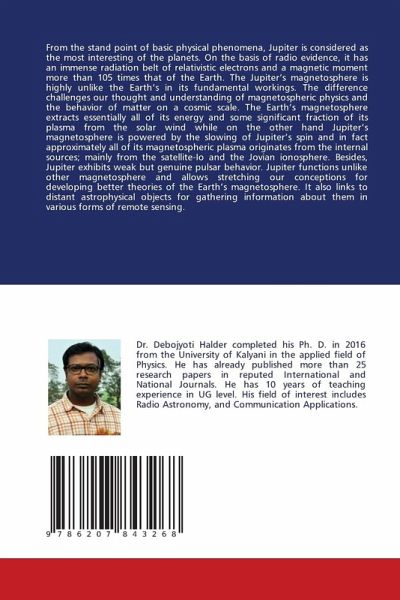
From the stand point of basic physical phenomena, Jupiter is considered as the most interesting of the planets. On the basis of radio evidence, it has an immense radiation belt of relativistic electrons and a magnetic moment more than 105 times that of the Earth. The Jupiter's magnetosphere is highly unlike the Earth's in its fundamental workings. The difference challenges our thought and understanding of magnetospheric physics and the behavior of matter on a cosmic scale. The Earth's magnetosphere extracts essentially all of its energy and some significant fraction of its plasma from the solar wind while on the other hand Jupiter's magnetosphere is powered by the slowing of Jupiter's spin and in fact approximately all of its magnetospheric plasma originates from the internal sources; mainly from the satellite-Io and the Jovian ionosphere. Besides, Jupiter exhibits weak but genuine pulsar behavior. Jupiter functions unlike other magnetosphere and allows stretching our conceptionsfor developing better theories of the Earth's magnetosphere. It also links to distant astrophysical objects for gathering information about them in various forms of remote sensing.