
Andere Kunden interessierten sich auch für
 A Commentary on the Apocalypse of John38,99 €
 The Epistle to the Romans61,99 €
 Introducing Romans41,99 €
 A Commentary on the Epistle to the Hebrews53,99 €
 A Commentary on the Revelation of John31,99 €
 Romans 1-8 MacArthur New Testament Commentary26,99 €
 Romans 9-16 MacArthur New Testament Commentary24,99 €


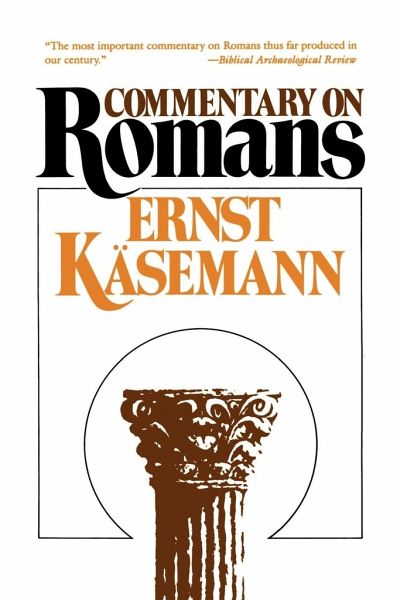
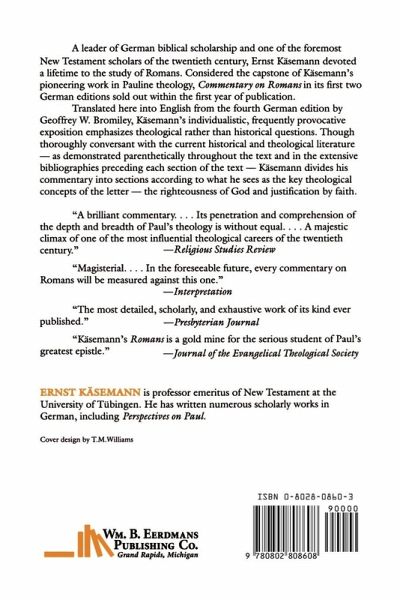
This commentary on Paul's letter to the Romans summarizes and completes Ernst Käsemann's lifelong study of Paul's theology and of this epistle in particular. As is common in his writings, Käsemann in this commentary has gone his own, frequently provocative way. He has emphasized theological rather than historical questions; as a result, this commentary divides Romans into sections according to what Käsemann sees as the key theological concept of the letter — the righteousness of God. That Käsemann has, however, considered seriously the historical as well as theological questions in the extensive literature on Romans is evident in the numerous references in the text and in the bibliographies provided for the major and minor subdivisions of the sections. This commentary has been translated from the German by Geoffrey W. Bromiley, who has translated, among other works, Kittel's Theological Dictionary of the New Testament. Long paragraphs in the original have been divided to provide easier reading, and the references have been converted to English- translation equivalents wherever possible. In addition, this translation incorporates changes that Käsemann made in the German original for the 4th edition.