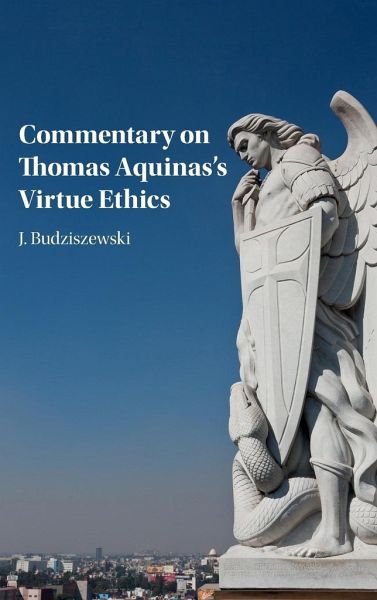
Although St Thomas Aquinas famously claimed that his Summa Theologiae was written for 'beginners', contemporary readers find it unusually difficult. Now, amid a surge of interest in virtue ethics, J. Budziszewski clarifies and analyzes the text's challenging arguments about the moral, intellectual, and spiritual virtues, with a spotlight on the virtue of justice. In what might be the first contemporary commentary on Aquinas' virtue ethics, he juxtaposes the original text with paraphrase and detailed discussion, guiding us through its complex arguments and classical rhetorical figures. Keeping…mehr
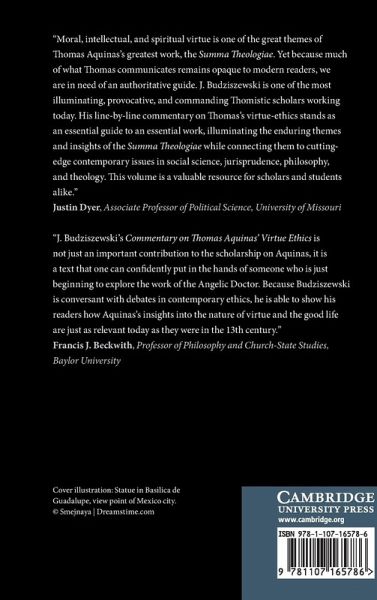
Although St Thomas Aquinas famously claimed that his Summa Theologiae was written for 'beginners', contemporary readers find it unusually difficult. Now, amid a surge of interest in virtue ethics, J. Budziszewski clarifies and analyzes the text's challenging arguments about the moral, intellectual, and spiritual virtues, with a spotlight on the virtue of justice. In what might be the first contemporary commentary on Aquinas' virtue ethics, he juxtaposes the original text with paraphrase and detailed discussion, guiding us through its complex arguments and classical rhetorical figures. Keeping an eye on contemporary philosophical issues, he contextualizes one of the greatest virtue theorists in history and brings Aquinas into the interdisciplinary debates of today. His brisk and clear style illuminates the most crucial of Aquinas' writings on moral character and guides us through the labyrinth of this difficult but pivotal work.
J. Budziszewski is a professor of government and philosophy at the University of Texas, Austin, where he also teaches courses in religious studies and in the law school. His work includes numerous books as well as a blog, The Underground Thomist. Budziszewski thinks and writes chiefly about classical natural law, conscience and self-deception, moral character, family and sexuality, religion and public life, authentic versus counterfeit toleration and liberty, and the state of our common culture.
Inhaltsangabe
Acknowledgments; Ante Studium; Introduction; Part I. Moral Character in General: Commentary on I-II Question 55 Article 4: whether virtue is suitably defined?; Commentary on I-II Question 58 Article 4: whether there can be moral without intellectual virtue?; Commentary on I-II Question 58 Article 5: whether there can be intellectual without moral virtue?; Commentary on I-II Question 61 Article 2: whether there are four cardinal virtues?; Commentary on I-II Question 61 Article 3: whether any other virtues should be called principal rather than these?; Commentary on I-II Question 62 Article 1: whether there are any theological virtues?; Commentary on I-II Question 63 Article 1: whether virtue is in us by nature?; Commentary on I-II Question 63 Article 2: whether any virtue is caused in us by habituation?; Commentary on I-II Question 65 Article 1: whether the moral virtues are connected with each other?; Commentary on I-II Question 84 Article 4: whether the seven capital vices are suitably reckoned?; Part II. The Virtue of Justice Especially in Relation to Law: Commentary on II-II Question 30 Article 3: whether mercy is a virtue?; Commentary on II-II Question 58 Article 1: whether justice is fittingly defined as being the perpetual and constant will to render to each one his right?; Commentary on II-II Question 60 Article 1: whether judgment is an act of justice?; Commentary on II-II Question 60 Article 2: whether it is lawful to judge?; Commentary on II-II Question 60 Article 5: whether we should always judge according to the written law?; Commentary on II-II Question 60 Article 6: whether judgment is rendered perverse by being usurped?; Commentary on II-II Question 80 Article 1: whether the virtues annexed to justice are suitably enumerated?; Commentary on II-II Question 122 Article 1: whether the precepts of the Decalogue are precepts of justice?; Index.
Acknowledgments; Ante Studium; Introduction; Part I. Moral Character in General: Commentary on I-II Question 55 Article 4: whether virtue is suitably defined?; Commentary on I-II Question 58 Article 4: whether there can be moral without intellectual virtue?; Commentary on I-II Question 58 Article 5: whether there can be intellectual without moral virtue?; Commentary on I-II Question 61 Article 2: whether there are four cardinal virtues?; Commentary on I-II Question 61 Article 3: whether any other virtues should be called principal rather than these?; Commentary on I-II Question 62 Article 1: whether there are any theological virtues?; Commentary on I-II Question 63 Article 1: whether virtue is in us by nature?; Commentary on I-II Question 63 Article 2: whether any virtue is caused in us by habituation?; Commentary on I-II Question 65 Article 1: whether the moral virtues are connected with each other?; Commentary on I-II Question 84 Article 4: whether the seven capital vices are suitably reckoned?; Part II. The Virtue of Justice Especially in Relation to Law: Commentary on II-II Question 30 Article 3: whether mercy is a virtue?; Commentary on II-II Question 58 Article 1: whether justice is fittingly defined as being the perpetual and constant will to render to each one his right?; Commentary on II-II Question 60 Article 1: whether judgment is an act of justice?; Commentary on II-II Question 60 Article 2: whether it is lawful to judge?; Commentary on II-II Question 60 Article 5: whether we should always judge according to the written law?; Commentary on II-II Question 60 Article 6: whether judgment is rendered perverse by being usurped?; Commentary on II-II Question 80 Article 1: whether the virtues annexed to justice are suitably enumerated?; Commentary on II-II Question 122 Article 1: whether the precepts of the Decalogue are precepts of justice?; Index.
Es gelten unsere Allgemeinen Geschäftsbedingungen: www.buecher.de/agb
Impressum
www.buecher.de ist ein Internetauftritt der buecher.de internetstores GmbH
Geschäftsführung: Monica Sawhney | Roland Kölbl | Günter Hilger
Sitz der Gesellschaft: Batheyer Straße 115 - 117, 58099 Hagen
Postanschrift: Bürgermeister-Wegele-Str. 12, 86167 Augsburg
Amtsgericht Hagen HRB 13257
Steuernummer: 321/5800/1497
USt-IdNr: DE450055826