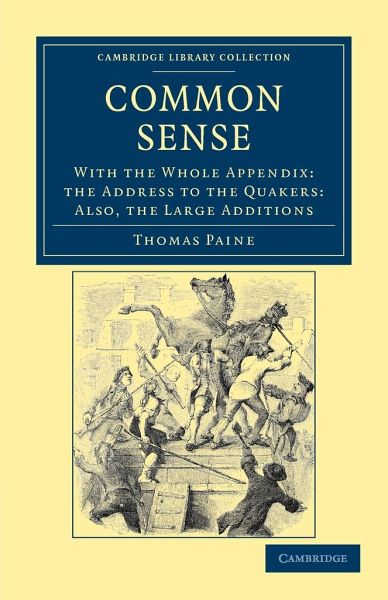
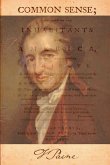
This famous pamphlet - published anonymously in 1776 because of its seditious content - by the British political radical Thomas Paine (1737-1809) laid out his pioneering ideas for American independence, and earned him the title of 'Father of the American Revolution'. The Declaration of Independence, written chiefly by Thomas Jefferson and famously promulgated later that year, was influenced by Paine's arguments in this work: that America was too large to be governed by a country as small as Britain - which, he claimed, was ruling America only for its own financial gain - and that the colonies…mehr
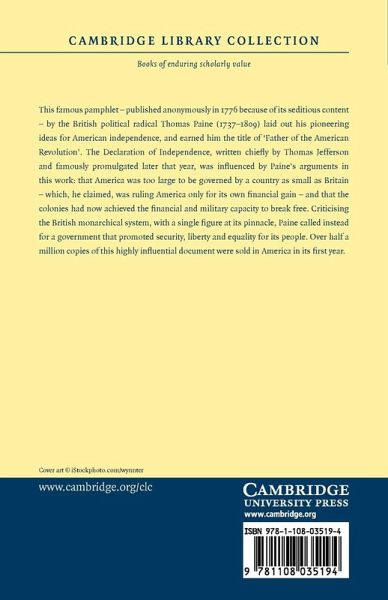
This famous pamphlet - published anonymously in 1776 because of its seditious content - by the British political radical Thomas Paine (1737-1809) laid out his pioneering ideas for American independence, and earned him the title of 'Father of the American Revolution'. The Declaration of Independence, written chiefly by Thomas Jefferson and famously promulgated later that year, was influenced by Paine's arguments in this work: that America was too large to be governed by a country as small as Britain - which, he claimed, was ruling America only for its own financial gain - and that the colonies had now achieved the financial and military capacity to break free. Criticising the British monarchical system, with a single figure at its pinnacle, Paine called instead for a government that promoted security, liberty and equality for its people. Over half a million copies of this highly influential document were sold in America in its first year.
Thomas Paine was an English-born American political activist, philosopher, political theorist, and revolutionary who lived from February 9, 1737, to June 8, 1809. He wrote The American Crisis (1776-1783) and Common Sense (1776-1783), two of the most important pamphlets at the outset of the American Revolution. He also contributed to the Patriots' 1776 decision to declare their hitherto unpopular goal of independence from Great Britain. His opinions were consistent with Enlightenment values for universal human rights. In an era before compulsory schooling, he attended Thetford Grammar School (1744-1749). He became his father's apprentice when he was 13 years old. After finishing his apprenticeship, Paine enlisted at the age of 19 and served for a short time as a privateer before returning to Britain in 1759. He opened a store in Sandwich, Kent, after becoming a master staymaker there. Paine traveled from France to the United States in 1802, or maybe 1803, paying for the passage of Marguerite Brazier, the wife of Thomas Bonneville, as well as the couple's three boys, Benjamin, Louis, and Thomas, for whom Paine served as godfather. In the early years of the Second Great Awakening, a period of intense political partisanship, Paine returned to the United States.
Inhaltsangabe
Introduction Common Sense Additions to Common Sense Appendix to Common Sense A dialogue between the ghost of General Montgomery, and an American delegate.
Introduction Common Sense Additions to Common Sense Appendix to Common Sense A dialogue between the ghost of General Montgomery, and an American delegate.
Es gelten unsere Allgemeinen Geschäftsbedingungen: www.buecher.de/agb
Impressum
www.buecher.de ist ein Internetauftritt der buecher.de internetstores GmbH
Geschäftsführung: Monica Sawhney | Roland Kölbl | Günter Hilger
Sitz der Gesellschaft: Batheyer Straße 115 - 117, 58099 Hagen
Postanschrift: Bürgermeister-Wegele-Str. 12, 86167 Augsburg
Amtsgericht Hagen HRB 13257
Steuernummer: 321/5800/1497
USt-IdNr: DE450055826