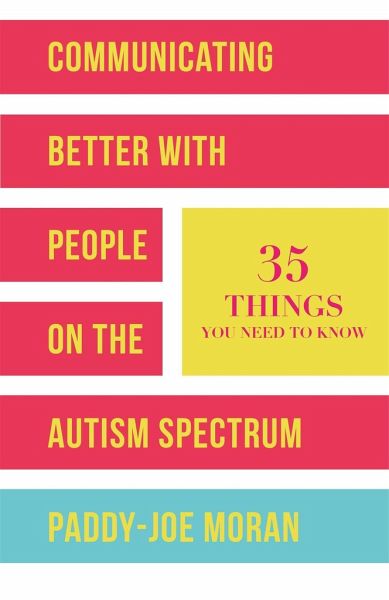
An essential quick read for all professionals working with people with autism, this book contains 35 tips for effective and sensitive communication with individuals on the spectrum. Focusing on positive language and the importance of taking the individual's lead on their preferred terminology, these tips are easy to implement in everyday practice.
An essential quick read for all professionals working with people with autism, this book contains 35 tips for effective and sensitive communication with individuals on the spectrum. Focusing on positive language and the importance of taking the individual's lead on their preferred terminology, these tips are easy to implement in everyday practice.
Paddy-Joe Moran was diagnosed with autism when he was eight. He is a writer and blogger and runs the online advice service Ask-Pergers?. Paddy-Joe co-authored Helping Children with Autism Spectrum Conditions through Everyday Transitions and Create a Reward Plan for your Child with Asperger Syndrome, both published by Jessica Kingsley Publishers. He is based in Manchester, UK.
Inhaltsangabe
Introduction. 1. Person first language - to use it or not? 2. Use non-patronising language. 3. Use age-appropriate language. 4. Use neutral language. 5. Let yourself be guided on preferred terminology. 6. Don't use the word normal. 7. There is nothing `mild` about Asperger syndrome. 8. Say `on the spectrum`. 9. Address the person directly. 10. Refer to parents by name. 11. Adapting your language and the way you speak. 12. You will be taken literally. 13. Sarcasm. 14. The use of functioning labels. 15. Non-verbal vs pre-verbal. 16. Pre-conceived ideas. 17. Appearances can be deceptive. 18. Triad of Impairments. 19. Giftedness is not a given. 20. Autism is a neurological condition. 21. Autistic person, not patient. 22. No need to grieve. 23. Puzzling. 24. Facial expressions. 25. Body language. 26. Environment. 27. Physical contact. 28. Have a time limit on the session. 29. Offer breaks during sessions. 30. Explain what will be happening, and when. 31. Stick to the plan. 32. Ask specific rather than open-ended questions. 33. Pace your speech. 34. Alternatives to non-verbal communication. 35. Things to consider when offering food. Conclusion.
Introduction. 1. Person first language - to use it or not? 2. Use non-patronising language. 3. Use age-appropriate language. 4. Use neutral language. 5. Let yourself be guided on preferred terminology. 6. Don't use the word normal. 7. There is nothing `mild` about Asperger syndrome. 8. Say `on the spectrum`. 9. Address the person directly. 10. Refer to parents by name. 11. Adapting your language and the way you speak. 12. You will be taken literally. 13. Sarcasm. 14. The use of functioning labels. 15. Non-verbal vs pre-verbal. 16. Pre-conceived ideas. 17. Appearances can be deceptive. 18. Triad of Impairments. 19. Giftedness is not a given. 20. Autism is a neurological condition. 21. Autistic person, not patient. 22. No need to grieve. 23. Puzzling. 24. Facial expressions. 25. Body language. 26. Environment. 27. Physical contact. 28. Have a time limit on the session. 29. Offer breaks during sessions. 30. Explain what will be happening, and when. 31. Stick to the plan. 32. Ask specific rather than open-ended questions. 33. Pace your speech. 34. Alternatives to non-verbal communication. 35. Things to consider when offering food. Conclusion.
Es gelten unsere Allgemeinen Geschäftsbedingungen: www.buecher.de/agb
Impressum
www.buecher.de ist ein Internetauftritt der buecher.de internetstores GmbH
Geschäftsführung: Monica Sawhney | Roland Kölbl | Günter Hilger
Sitz der Gesellschaft: Batheyer Straße 115 - 117, 58099 Hagen
Postanschrift: Bürgermeister-Wegele-Str. 12, 86167 Augsburg
Amtsgericht Hagen HRB 13257
Steuernummer: 321/5800/1497
USt-IdNr: DE450055826