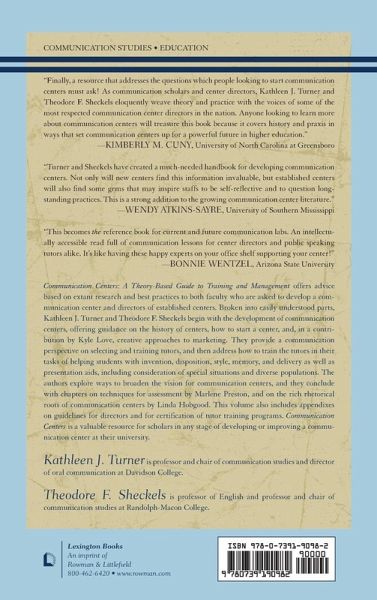
Communication Centers: A Theory-Based Guide to Training and Management addresses what communication centers are and why they are valuable, examines their rich rhetorical roots, and offers advice to faculty who are asked to develop a communication center. Directors of established centers and peer tutors will also find valuable information.
Communication Centers: A Theory-Based Guide to Training and Management addresses what communication centers are and why they are valuable, examines their rich rhetorical roots, and offers advice to faculty who are asked to develop a communication center. Directors of established centers and peer tutors will also find valuable information.
Kathleen J. Turner is professor and chair of communication studies and director of oral communication at Davidson College.
Inhaltsangabe
Introduction: What is a Communication Center? Part I: Developing a Communication Center Chapter 1: A Brief History of Communication Centers Chapter 2: Starting a Communication Center Chapter 3: Successful Marketing of Communication Centers, Kyle Anne Barnett Love Part II: Becoming a Communication Center Tutor Chapter 4: Becoming a Peer Tutor: A Communication Perspective Chapter 5: Tutoring Tasks: Invention Chapter 6: Tutoring Tasks: Disposition Chapter 7: Tutoring Tasks: Style, Memory, and Delivery Chapter 8: Tutoring Tasks: Presentation Aids Part III: Taking the Center Farther Chapter 9: Tutoring Tasks: Special Situations and Diverse Populations Chapter 10: Considering the Possibilities Chapter 11: Assessment of Your Communication Center: Anathema or Asset?, Marlene M. Preston Afterword: The Rhetorical Roots of Communication Centers, Linda Bartlett Hobgood Appendix A: The Evaluation of Communication Center Directors: Procedures and Criteria Appendix B: Tutor Training and Certificatio
Introduction: What is a Communication Center? Part I: Developing a Communication Center Chapter 1: A Brief History of Communication Centers Chapter 2: Starting a Communication Center Chapter 3: Successful Marketing of Communication Centers, Kyle Anne Barnett Love Part II: Becoming a Communication Center Tutor Chapter 4: Becoming a Peer Tutor: A Communication Perspective Chapter 5: Tutoring Tasks: Invention Chapter 6: Tutoring Tasks: Disposition Chapter 7: Tutoring Tasks: Style, Memory, and Delivery Chapter 8: Tutoring Tasks: Presentation Aids Part III: Taking the Center Farther Chapter 9: Tutoring Tasks: Special Situations and Diverse Populations Chapter 10: Considering the Possibilities Chapter 11: Assessment of Your Communication Center: Anathema or Asset?, Marlene M. Preston Afterword: The Rhetorical Roots of Communication Centers, Linda Bartlett Hobgood Appendix A: The Evaluation of Communication Center Directors: Procedures and Criteria Appendix B: Tutor Training and Certificatio
Es gelten unsere Allgemeinen Geschäftsbedingungen: www.buecher.de/agb
Impressum
www.buecher.de ist ein Internetauftritt der buecher.de internetstores GmbH
Geschäftsführung: Monica Sawhney | Roland Kölbl | Günter Hilger
Sitz der Gesellschaft: Batheyer Straße 115 - 117, 58099 Hagen
Postanschrift: Bürgermeister-Wegele-Str. 12, 86167 Augsburg
Amtsgericht Hagen HRB 13257
Steuernummer: 321/5800/1497
USt-IdNr: DE450055826