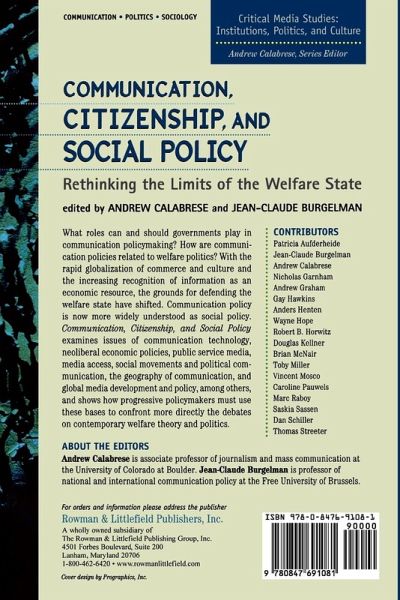
Communication, Citizenship, and Social Policy examines issues of communication technology, neoliberal economic policies, public service media, media access, social movements and political communication, the geography of communication, and global media development and policy, among others, and shows how progressive policymakers must use these bases to confront more directly the debates on contemporary welfare theory and politics.
Communication, Citizenship, and Social Policy examines issues of communication technology, neoliberal economic policies, public service media, media access, social movements and political communication, the geography of communication, and global media development and policy, among others, and shows how progressive policymakers must use these bases to confront more directly the debates on contemporary welfare theory and politics.
Andrew Calabrese is associate professor of journalism and mass communication at the University of Colorado at Boulder. Jean-Claude Burgelman is professor of national and international communication policy at the Free University of Brussels.
Inhaltsangabe
Chapter 1 Introduction Part 2 Communication Technology and the Geography of Citizenship Chapter 3 The State and the New Geography of Power Chapter 4 Citizenship and the Technopoles Part 5 The Neoliberal Transition Chapter 6 That Deep Romantic Chasm: Libertarianism, Neoliberalism, and the Computer Culture Chapter 7 From Citizenship to Consumer Sovereignty: The Paradigm Shift in European Audiovisual Policy Chapter 8 Will Information Societies Be Welfare Societies? Chapter 9 Ideology, Communication, and Capitalist Crisis: The New Zealand Experience Part 10 Social Policy in Telecommunications Chapter 11 Amartya Sen's "Capabilities" Approach to the Evaluation of Welfare: Its Application to Communications Chapter 12 The Future of the Welfare State and Its Challenges for Communication Policy Chapter 13 Social Movement in Telecommunications: Rethinking the Public Service History of U.S. Telecommunications, 1894-1919 Part 14 Public Service Broadcasting Chapter 15 Public Service Journalism in Post-Tory Britain: Problems and Prospects Chapter 16 Public Service Broadcasting in Australia: Value and Difference Part 17 Participatory Politics and Citizen Access Chapter 18 Telecommunications Reform in Postapartheid South Africa Chapter 19 Policies for Participation: Myth, Reality, and the Media in Local Initiatives in the United Kingdom Chapter 20 The Public Interest in U.S. Electronic Media Today: The DBS Debate Chapter 21 New Technologies, the Welfare State, and the Prospects for Democratization Part 22 Global Media Development and Policy Chapter 23 The Welfare State, the Information Society, and the Ambivalence of Social Movements Chapter 24 Television and Citizenship: A New International Division of Cultural Labor? Chapter 25 Communication Policy and Globalization as a Social Project Chapter 26 Afterword Chapter 27 Index Chapter 28 About the Editors and Contributors
Chapter 1 Introduction Part 2 Communication Technology and the Geography of Citizenship Chapter 3 The State and the New Geography of Power Chapter 4 Citizenship and the Technopoles Part 5 The Neoliberal Transition Chapter 6 That Deep Romantic Chasm: Libertarianism, Neoliberalism, and the Computer Culture Chapter 7 From Citizenship to Consumer Sovereignty: The Paradigm Shift in European Audiovisual Policy Chapter 8 Will Information Societies Be Welfare Societies? Chapter 9 Ideology, Communication, and Capitalist Crisis: The New Zealand Experience Part 10 Social Policy in Telecommunications Chapter 11 Amartya Sen's "Capabilities" Approach to the Evaluation of Welfare: Its Application to Communications Chapter 12 The Future of the Welfare State and Its Challenges for Communication Policy Chapter 13 Social Movement in Telecommunications: Rethinking the Public Service History of U.S. Telecommunications, 1894-1919 Part 14 Public Service Broadcasting Chapter 15 Public Service Journalism in Post-Tory Britain: Problems and Prospects Chapter 16 Public Service Broadcasting in Australia: Value and Difference Part 17 Participatory Politics and Citizen Access Chapter 18 Telecommunications Reform in Postapartheid South Africa Chapter 19 Policies for Participation: Myth, Reality, and the Media in Local Initiatives in the United Kingdom Chapter 20 The Public Interest in U.S. Electronic Media Today: The DBS Debate Chapter 21 New Technologies, the Welfare State, and the Prospects for Democratization Part 22 Global Media Development and Policy Chapter 23 The Welfare State, the Information Society, and the Ambivalence of Social Movements Chapter 24 Television and Citizenship: A New International Division of Cultural Labor? Chapter 25 Communication Policy and Globalization as a Social Project Chapter 26 Afterword Chapter 27 Index Chapter 28 About the Editors and Contributors
Es gelten unsere Allgemeinen Geschäftsbedingungen: www.buecher.de/agb
Impressum
www.buecher.de ist ein Internetauftritt der buecher.de internetstores GmbH
Geschäftsführung: Monica Sawhney | Roland Kölbl | Günter Hilger
Sitz der Gesellschaft: Batheyer Straße 115 - 117, 58099 Hagen
Postanschrift: Bürgermeister-Wegele-Str. 12, 86167 Augsburg
Amtsgericht Hagen HRB 13257
Steuernummer: 321/5800/1497
USt-IdNr: DE450055826