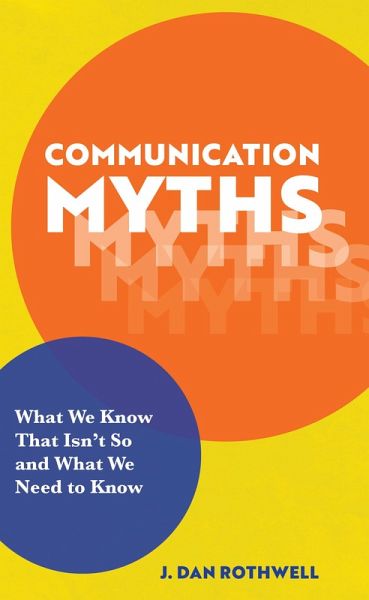
Stop stereotyping. Avoid conflict. Skip small talk. Be open-minded to everyone's opinions. These sound like good rules for life, but what if they are based on myths that actually prevent us from communicating effectively and appropriately with each other? In Communication Myths: What We Know That Isn't So and What We Need to Know , J. Dan Rothwell debunks common misconceptions about our interactions with others that can easily result in embarrassment, insult, or catastrophe. These myths come from underappreciating the complexities of communication and relying on bad information from…mehr
Stop stereotyping. Avoid conflict. Skip small talk. Be open-minded to everyone's opinions. These sound like good rules for life, but what if they are based on myths that actually prevent us from communicating effectively and appropriately with each other? In Communication Myths: What We Know That Isn't So and What We Need to Know , J. Dan Rothwell debunks common misconceptions about our interactions with others that can easily result in embarrassment, insult, or catastrophe. These myths come from underappreciating the complexities of communication and relying on bad information from unqualified and sensationalist sources, especially those peddling misinformation on social media. With clear insight and a good dose of humor, Rothwell explores how human communication really works and provides a critical antidote to the damage caused by these pervasive and pernicious myths. As the only book dedicated extensively and incisively to communication myths, this guide to interpersonal, group, and organizational communication, plus public speaking excellence is an invaluable resource for readers of every age, profession, and background.
J. Dan Rothwell is the award-winning author of six books on communication, including his most recent It's All of Our Business. For more than four decades, Rothwell taught students at Cabrillo College (where he served as department chair and is currently a member of the Board of Trustees), Western Washington University, and other universities and colleges across the country. During his extensive teaching career, he received more than two dozen teaching awards, including an international, national, regional, and state award. He resides in the Monterey Bay area, his "little slice of paradise."
Inhaltsangabe
PART ONE COMMUNICATION BEDROCK Chapter 1 Myth: Communication Is Simply Exchanging Information Emotional Intelligence AI Chatbots Message Dimensions Fields of Experience Chapter 2 Myth: Communication Is Just Common Sense Individualist vs. Collectivist Cultures Conversational Narcissism Chapter 3 Myth: Skill Building Is Key to Communication Success Knowledge Skills Sensitivity Commitment Ethics Chapter 4 Myth: Communicate More for Success Galore Quantity vs. Quality Information Overload Multitasking Chapter 5 Myth: Communication Is a Magic Elixir Irreconcilable Differences Systemic Problems Chapter 6 Myth: Meanings Are in Words Taboo Words Sniglets Contronyms Portmanteuas Chapter 7 Myth: Sign Language Isn't a Language but Body Language Is Structure Productivity Displacement Self-reflexiveness Chapter 8 Myth: 93% of Communication Is Nonverbal Power of Language Power of Nonverbal Communication PART TWO BETWEEN YOU AND ME Chapter 9 Myth: Stop Stereotyping Positive Stereotypes Perceptual Distortions Self-fulfilling Prophecies Chapter 10 Myth: So Much Verbal and Nonverbal Communication Is Meaningless Noise Connecting bids Turning Toward Turning Away Turning Against Chapter 11 Myth: Negative-Positive Communication Balance Should Be the Goal Negativity bias Magic Ratio Defensive vs. Supportive Communication Chapter 12 Myth: Power Is Relationship Poison Dominance Prevention Defiance Resistance Empowerment Chapter 13 Myth: Conflict Is the Death Star of Relationships Destructive vs. Constructive Conflict 5 Conflict Management Styles Chapter 14 Myth: Tame Your Temper by Venting Your Anger Destructive vs. Constructive Anger Reframing Asymmetry PART 3 THE GROUP EXPERIENCE Chapter 15 Myth: Group Meetings Are Life Sucking Black Holes Meeting Recovery Syndrome Synergy Standard Agenda Murphy's Law Chapter 16 Myth: Leaders Are Born Not Made Traits Perspective Implicit Theories of Leadership Psychopathic Leaders Narcissistic Leaders Distributive Leadership Chapter 17 Myth: Women Are Less Qualified to Be Leaders than Men Gender Bias Manologues Hepeating Blended Leadership Style PART 4: PUBLIC SPEAKING Chapter 18 Myth: Only a Natural Gift of Gab Makes an Effective Public Speaker Functional vs. Dysfunctional Speech Anxiety Illusion of Transparency Communication Orientation Chapter 19 Myth: Some Public Speaking Topics Are Hopelessly Boring Nature of Attention Identification Humor Novelty Startling Strategy Chapter 20 Myth: Open-mindedness Means Open to All Possibilities Bothsidesing Conspiracy Theories Probability Model Self-correction Chapter 21 Myth: Experts Can Be Wrong So We Shouldn't Value Them Source Credibility Source Citations Danger of AI/ChatGPT Chapter 22 Myth: Effective Speeches Require a Manuscript Oral vs. Written Speeches Extemporaneous Speeches Outlining Impromptu Speeches Chapter 23 Myth: Logic and Evidence Are the Most Effective Persuaders Ethos Attitude-Behavior Consistency Fear Appeals Anger Appeals Cognitive Dissonance
PART ONE COMMUNICATION BEDROCK Chapter 1 Myth: Communication Is Simply Exchanging Information Emotional Intelligence AI Chatbots Message Dimensions Fields of Experience Chapter 2 Myth: Communication Is Just Common Sense Individualist vs. Collectivist Cultures Conversational Narcissism Chapter 3 Myth: Skill Building Is Key to Communication Success Knowledge Skills Sensitivity Commitment Ethics Chapter 4 Myth: Communicate More for Success Galore Quantity vs. Quality Information Overload Multitasking Chapter 5 Myth: Communication Is a Magic Elixir Irreconcilable Differences Systemic Problems Chapter 6 Myth: Meanings Are in Words Taboo Words Sniglets Contronyms Portmanteuas Chapter 7 Myth: Sign Language Isn't a Language but Body Language Is Structure Productivity Displacement Self-reflexiveness Chapter 8 Myth: 93% of Communication Is Nonverbal Power of Language Power of Nonverbal Communication PART TWO BETWEEN YOU AND ME Chapter 9 Myth: Stop Stereotyping Positive Stereotypes Perceptual Distortions Self-fulfilling Prophecies Chapter 10 Myth: So Much Verbal and Nonverbal Communication Is Meaningless Noise Connecting bids Turning Toward Turning Away Turning Against Chapter 11 Myth: Negative-Positive Communication Balance Should Be the Goal Negativity bias Magic Ratio Defensive vs. Supportive Communication Chapter 12 Myth: Power Is Relationship Poison Dominance Prevention Defiance Resistance Empowerment Chapter 13 Myth: Conflict Is the Death Star of Relationships Destructive vs. Constructive Conflict 5 Conflict Management Styles Chapter 14 Myth: Tame Your Temper by Venting Your Anger Destructive vs. Constructive Anger Reframing Asymmetry PART 3 THE GROUP EXPERIENCE Chapter 15 Myth: Group Meetings Are Life Sucking Black Holes Meeting Recovery Syndrome Synergy Standard Agenda Murphy's Law Chapter 16 Myth: Leaders Are Born Not Made Traits Perspective Implicit Theories of Leadership Psychopathic Leaders Narcissistic Leaders Distributive Leadership Chapter 17 Myth: Women Are Less Qualified to Be Leaders than Men Gender Bias Manologues Hepeating Blended Leadership Style PART 4: PUBLIC SPEAKING Chapter 18 Myth: Only a Natural Gift of Gab Makes an Effective Public Speaker Functional vs. Dysfunctional Speech Anxiety Illusion of Transparency Communication Orientation Chapter 19 Myth: Some Public Speaking Topics Are Hopelessly Boring Nature of Attention Identification Humor Novelty Startling Strategy Chapter 20 Myth: Open-mindedness Means Open to All Possibilities Bothsidesing Conspiracy Theories Probability Model Self-correction Chapter 21 Myth: Experts Can Be Wrong So We Shouldn't Value Them Source Credibility Source Citations Danger of AI/ChatGPT Chapter 22 Myth: Effective Speeches Require a Manuscript Oral vs. Written Speeches Extemporaneous Speeches Outlining Impromptu Speeches Chapter 23 Myth: Logic and Evidence Are the Most Effective Persuaders Ethos Attitude-Behavior Consistency Fear Appeals Anger Appeals Cognitive Dissonance
Es gelten unsere Allgemeinen Geschäftsbedingungen: www.buecher.de/agb
Impressum
www.buecher.de ist ein Internetauftritt der buecher.de internetstores GmbH
Geschäftsführung: Monica Sawhney | Roland Kölbl | Günter Hilger
Sitz der Gesellschaft: Batheyer Straße 115 - 117, 58099 Hagen
Postanschrift: Bürgermeister-Wegele-Str. 12, 86167 Augsburg
Amtsgericht Hagen HRB 13257
Steuernummer: 321/5800/1497
USt-IdNr: DE450055826