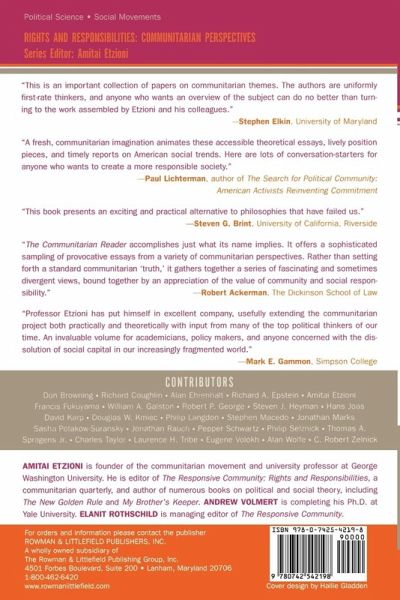
The Communitarian Reader: Beyond the Essentials brings together essays by prominent social thinkers reflecting on issues ranging from moral obligations to civil liberties after 9/11. The result is a book both practical and theoretical, and an essential guide for all interested in further exploring this important social movement.
The Communitarian Reader: Beyond the Essentials brings together essays by prominent social thinkers reflecting on issues ranging from moral obligations to civil liberties after 9/11. The result is a book both practical and theoretical, and an essential guide for all interested in further exploring this important social movement.
Amitai Etzioni is the founder of the communitarian movement and university professor at George Washington University. He is the editor of The Responsive Community: Rights and Responsibilities, a communitarian quarterly and the author of numerous books on political and social theory, including The New Golden Rule and My Brother's Keeper. Andrew Volmert is completing his PhD at Yale University. Elanit Rothschild is mangaging editor of The Responsive Community.
Inhaltsangabe
Chapter 1 Introduction Chapter 2 The Responsive Community Platform: Rights and Responsibilities Part 3 I Theory and Social Philosophy Chapter 4 No Community, No Democracy Chapter 5 Combining Value Pluralism and Moral Universalism: Isaiah Berlin and Beyond Chapter 6 Legislating Morality in Liberal Democracies Chapter 7 On a Communitarian Faith Chapter 8 Are Particularistic Obligations Justified? A Communitarian Examination Part 9 II The Communitarian Society Chapter 10 Enforcing Norms: When the Law Gets in the Way Chapter 11 Social Mores Are Not Enough Chapter 12 Confessions of an Alleged Libertarian (and the Virtues of "Soft" Communitarianism) Chapter 13 The Contours of Remoralization Chapter 14 The Duty to Rescue: A Liberal Communitarian Approach Chapter 15 Does Socioeconomic Inequality Undermine Community? Implications for Communitarian Theory Chapter 16 Americans as Communitarians: An Empirical Study Part 17 III Community Chapter 18 Developing Civil Society: Can the Workplace Replace Bowling? Chapter 19 Self-Sacrifice, Self-Fulfillment, and Mutuality: The Evolution of Marriage Chapter 20 Peer Marriage Chapter 21 Community and the Corner Store: Retrieving Human-Scale Commerce Chapter 22 Boston's Ten Point Coalition: A Faith-Based Approach to Fighting Crime in the Inner City Chapter 23 Can Design Make Community? Part 24 IV Communitarian Policies Chapter 25 Rights and Responsibilities, 2001 Chapter 26 Confusing Freedom with License-Licenses Terrorism, Not Freedom Chapter 27 We Can Strike a Balance on Civil Liberties Chapter 28 Liberal Sectarianism? Social Capital, Religious Communities, and Public Funds Chapter 29 The Benefits of Surveillance? Chapter 30 Military Secrets and First Amendment Values Chapter 31 Diversity Within Unity: A New Approach to Immigrants and Minorities Part 32 V Dialogues Chapter 33 Virtue and the State: A Dialogue between a Communitarian and a Social Conservative Chapter 34 Virtue, Self-Interest, and the Good: A Dialogue on Communitarianism and Classical Liberalism
Chapter 1 Introduction Chapter 2 The Responsive Community Platform: Rights and Responsibilities Part 3 I Theory and Social Philosophy Chapter 4 No Community, No Democracy Chapter 5 Combining Value Pluralism and Moral Universalism: Isaiah Berlin and Beyond Chapter 6 Legislating Morality in Liberal Democracies Chapter 7 On a Communitarian Faith Chapter 8 Are Particularistic Obligations Justified? A Communitarian Examination Part 9 II The Communitarian Society Chapter 10 Enforcing Norms: When the Law Gets in the Way Chapter 11 Social Mores Are Not Enough Chapter 12 Confessions of an Alleged Libertarian (and the Virtues of "Soft" Communitarianism) Chapter 13 The Contours of Remoralization Chapter 14 The Duty to Rescue: A Liberal Communitarian Approach Chapter 15 Does Socioeconomic Inequality Undermine Community? Implications for Communitarian Theory Chapter 16 Americans as Communitarians: An Empirical Study Part 17 III Community Chapter 18 Developing Civil Society: Can the Workplace Replace Bowling? Chapter 19 Self-Sacrifice, Self-Fulfillment, and Mutuality: The Evolution of Marriage Chapter 20 Peer Marriage Chapter 21 Community and the Corner Store: Retrieving Human-Scale Commerce Chapter 22 Boston's Ten Point Coalition: A Faith-Based Approach to Fighting Crime in the Inner City Chapter 23 Can Design Make Community? Part 24 IV Communitarian Policies Chapter 25 Rights and Responsibilities, 2001 Chapter 26 Confusing Freedom with License-Licenses Terrorism, Not Freedom Chapter 27 We Can Strike a Balance on Civil Liberties Chapter 28 Liberal Sectarianism? Social Capital, Religious Communities, and Public Funds Chapter 29 The Benefits of Surveillance? Chapter 30 Military Secrets and First Amendment Values Chapter 31 Diversity Within Unity: A New Approach to Immigrants and Minorities Part 32 V Dialogues Chapter 33 Virtue and the State: A Dialogue between a Communitarian and a Social Conservative Chapter 34 Virtue, Self-Interest, and the Good: A Dialogue on Communitarianism and Classical Liberalism
Es gelten unsere Allgemeinen Geschäftsbedingungen: www.buecher.de/agb
Impressum
www.buecher.de ist ein Internetauftritt der buecher.de internetstores GmbH
Geschäftsführung: Monica Sawhney | Roland Kölbl | Günter Hilger
Sitz der Gesellschaft: Batheyer Straße 115 - 117, 58099 Hagen
Postanschrift: Bürgermeister-Wegele-Str. 12, 86167 Augsburg
Amtsgericht Hagen HRB 13257
Steuernummer: 321/5800/1497
USt-IdNr: DE450055826