
Andere Kunden interessierten sich auch für
 Perceptions et compréhension des mémoriaux du génocide rwandais par la communauté61,99 €
 Peace and Reconciliation in Rwanda Post 1994 Genocide against Tutsi27,99 €
 Women's empowerment in the post 1994 genocide against Tutsi in Rwanda58,99 €
 Sexual Violence and Genocide in Bosnia and Rwanda32,99 €
 Gender in a post-traumatic context: the case of Rwanda41,99 €
 Women's Roles in the 1994 Rwanda Genocide and the Empowerment of Women in the Aftermath32,99 €
 Investigating Moroccans' Perceptions of Female Virginity33,99 €

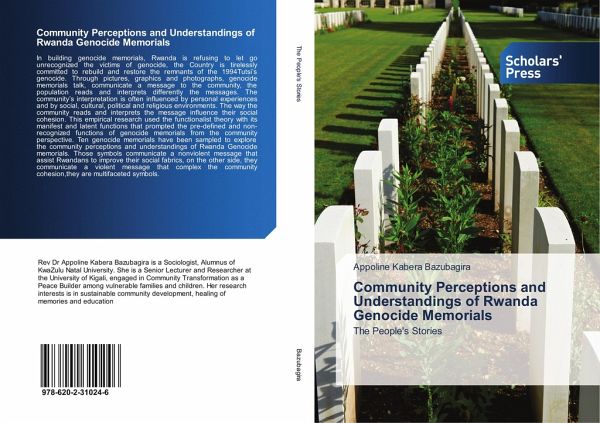
In building genocide memorials, Rwanda is refusing to let go unrecognized the victims of genocide, the Country is tirelessly committed to rebuild and restore the remnants of the 1994Tutsi's genocide. Through pictures, graphics and photographs, genocide memorials talk, communicate a message to the community, the population reads and interprets differently the messages. The community's interpretation is often influenced by personal experiences and by social, cultural, political and religious environments. The way the community reads and interprets the message influence their social cohesion. This empirical research used the functionalist theory with its manifest and latent functions that prompted the pre-defined and non-recognized functions of genocide memorials from the community perspective. Ten genocide memorials have been sampled to explore the community perceptions and understandings of Rwanda Genocide memorials. Those symbols communicate a nonviolent message that assist Rwandans to improve their social fabrics, on the other side, they communicate a violent message that complex the community cohesion,they are multifaceted symbols.