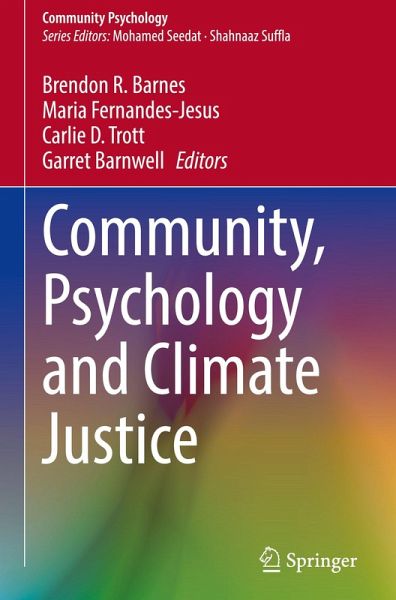
This book uniquely focuses on community psychology and climate justice. Climate change in general has been an area of increasing interest to psychologists in recent years, particularly in its cognitive, perceptual, and affective aspects. Because communities are often on the forefront of resistance to the deleterious effects of climate change, psychologists have become aware of the ramifications of large scale resource developments, toxic contamination, and dispossession, to name a few. The current conceptualizations and approaches to climate change, however, are not adequate to today's needs.…mehr
This book uniquely focuses on community psychology and climate justice. Climate change in general has been an area of increasing interest to psychologists in recent years, particularly in its cognitive, perceptual, and affective aspects. Because communities are often on the forefront of resistance to the deleterious effects of climate change, psychologists have become aware of the ramifications of large scale resource developments, toxic contamination, and dispossession, to name a few. The current conceptualizations and approaches to climate change, however, are not adequate to today's needs. Addressing this gap, this volume emphasize the politics of social justice, going beyond internal psychological variables. it explores the legacy of colonialism, highlights the needs of indigenous peoples, and takes an expansive interdisciplinary stance including critical theory, queer theory, feminism.
Brendon Barnes is a professor at the University of Johannesburg with training in psychology and public health. He has worked for over two decades on studies of air pollution, housing, lead poisoning, mercury, water and sanitation, and climate activism funded by large international funders. His research also focuses on marginalisation and African youth climate activists. He has won teaching, academic citizenship, and research awards. He is known for championing the integration of justice in environmental and climate change programmes. Maria Fernandes-Jesus is an assistant professor in psychology at the University of Sussex. Her research focuses on understanding processes and dynamics involved in collective action, community-based engagement with climate change, climate justice, youth participation, solidarity, social movements, and political imaginaries of climate futures. She has been involved in several interdisciplinary and international research projects related to these and other topics. Carlie D. Trott is an associate professor in the Department of Psychology at the University of Cincinnati where she heads the Collaborative Sustainability Lab. Trott’s research aims to bring visibility to, and work against the inequitable impacts of climate change, socially and geographically. Trott’s climate justice research employs community-engaged, participatory, and action research methods and aims to centre the perspectives and experiences of those most affected by climate disruption and environmental injustice. Garret Barnwell is a clinical psychologist working as a psychotherapist, community psychology practitioner and researcher. His community psychology practice and research focus on Eco psychosocial accompaniment, and how communities are resisting land, climate and environmental injustices for the flourishing of life. Barnwell was an expert on the landmark youth-led #cancel coal case climate case launched against the South African government’s plans for new coal-fired power. He also serves as an advisor on the American Psychological Association Climate Change Task Force.
Inhaltsangabe
Chapter 1. Introduction to Community, Psychology and Climate Justice.- Part I. (Re)imagining structure, capital and systems for alternative futures.- Chapter 2. What Would It Mean to Win? Imagining Alternative Ecopolitical Futures with Young Climate Justice Activists.- Chapter 3. Who Is Responsible for Tackling Our Environmental and Wider Social Challenges? Participant Data and Reflections for Community Psychology.- Chapter 4. The Climate Crisis is Political Violence: What Can Psychology Do?.- Chapter 5. Three Radical R s of Environmentalism: From Reduce, Reuse, Recycle to Regulation, Redistribution, and Reparations .- Chapter 6. Resisting Capitalism, Resisting Climate Change: Community Psychology in and against the Capitalocene.- Part II. Intersectional Politics and Action.- Chapter 7. Disability and Climate Justice: Poetry as Praxis.- Chapter 8. Reflections on Violence Against Women and Climate Change Collaborative Research in the Asia Pacific Region.- Chapter 9. You should be grateful that you are here : A collaborative autoethnographic study on Black youth Activism representation.- Chapter 10. Queering Eco-Anxiety: An Autoethnographic and Intimate Exploration of Moving from Distress to Possibility Amidst the Climate Crisis.- Chapter 11. Decolonial Considerations of Environmentalism.- Part III. Praxis.- Chapter 12. Healing the Frontlines - Nurturing Radical Care in the Climate Justice Movement.- Chapter 13. Advancing Participatory Methodologies for the Symbiocene: Theory, Allyship and Multisensory Techniques.- Chapter 14. Working Towards Representation, Diversity, and Capacity Building in Conservation: Using Photovoice to Explore Justice-Driven Conservation.- Chapter 15. Exploring the Possible Role of Community Psychology Responses to Climate Change-Induced Internal Displacement in Benue, Nigeria.- Chapter 16. Building Solidarity Across Borders in the Struggles for Climate Justice.
Chapter 1. Introduction to Community, Psychology and Climate Justice.- Part I. (Re)imagining structure, capital and systems for alternative futures.- Chapter 2. What Would It Mean to Win? Imagining Alternative Ecopolitical Futures with Young Climate Justice Activists.- Chapter 3. Who Is Responsible for Tackling Our Environmental and Wider Social Challenges? Participant Data and Reflections for Community Psychology.- Chapter 4. The Climate Crisis is Political Violence: What Can Psychology Do?.- Chapter 5. Three Radical R s of Environmentalism: From Reduce, Reuse, Recycle to Regulation, Redistribution, and Reparations .- Chapter 6. Resisting Capitalism, Resisting Climate Change: Community Psychology in and against the Capitalocene.- Part II. Intersectional Politics and Action.- Chapter 7. Disability and Climate Justice: Poetry as Praxis.- Chapter 8. Reflections on Violence Against Women and Climate Change Collaborative Research in the Asia Pacific Region.- Chapter 9. You should be grateful that you are here : A collaborative autoethnographic study on Black youth Activism representation.- Chapter 10. Queering Eco-Anxiety: An Autoethnographic and Intimate Exploration of Moving from Distress to Possibility Amidst the Climate Crisis.- Chapter 11. Decolonial Considerations of Environmentalism.- Part III. Praxis.- Chapter 12. Healing the Frontlines - Nurturing Radical Care in the Climate Justice Movement.- Chapter 13. Advancing Participatory Methodologies for the Symbiocene: Theory, Allyship and Multisensory Techniques.- Chapter 14. Working Towards Representation, Diversity, and Capacity Building in Conservation: Using Photovoice to Explore Justice-Driven Conservation.- Chapter 15. Exploring the Possible Role of Community Psychology Responses to Climate Change-Induced Internal Displacement in Benue, Nigeria.- Chapter 16. Building Solidarity Across Borders in the Struggles for Climate Justice.
Es gelten unsere Allgemeinen Geschäftsbedingungen: www.buecher.de/agb
Impressum
www.buecher.de ist ein Internetauftritt der buecher.de internetstores GmbH
Geschäftsführung: Monica Sawhney | Roland Kölbl | Günter Hilger
Sitz der Gesellschaft: Batheyer Straße 115 - 117, 58099 Hagen
Postanschrift: Bürgermeister-Wegele-Str. 12, 86167 Augsburg
Amtsgericht Hagen HRB 13257
Steuernummer: 321/5800/1497
USt-IdNr: DE450055826