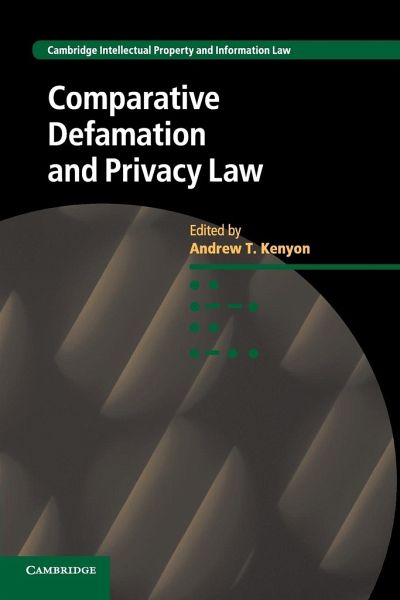
Comparative Defamation and Privacy Law
Herausgeber: Kenyon, Andrew T.
Comparative Defamation and Privacy Law
Herausgeber: Kenyon, Andrew T.
- Broschiertes Buch
- Merkliste
- Auf die Merkliste
- Bewerten Bewerten
- Teilen
- Produkt teilen
- Produkterinnerung
- Produkterinnerung
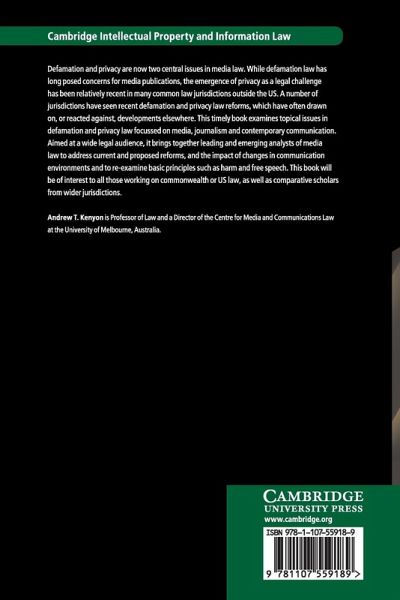
Leading experts from common law jurisdictions examine defamation and privacy, two major and interrelated issues for law and media.
Andere Kunden interessierten sich auch für
Comparative Defamation and Privacy Law127,99 €
Timon Hughes-DaviesTort Law176,99 €
Maria R RieggerLegal Issues Authors Must Consider8,49 €
Brijbhan SinghPlagiarism and Tortious Liability. Connection between Law of Torts and Plagiarism15,95 €
Andrew T. Kenyon / Megan Richardson / Sam Ricketson (ed.)Landmarks in Australian Intellectual Property Law122,99 €
The Law of Reputation and Brands in the Asia Pacific72,99 €
Copyright Law in an Age of Limitations and Exceptions148,99 €-
-
-
Leading experts from common law jurisdictions examine defamation and privacy, two major and interrelated issues for law and media.
Produktdetails
- Produktdetails
- Verlag: Cambridge University Press
- Seitenzahl: 400
- Erscheinungstermin: 14. Februar 2018
- Englisch
- Abmessung: 229mm x 152mm x 21mm
- Gewicht: 577g
- ISBN-13: 9781107559189
- ISBN-10: 1107559189
- Artikelnr.: 51380391
- Herstellerkennzeichnung
- Libri GmbH
- Europaallee 1
- 36244 Bad Hersfeld
- gpsr@libri.de
- Verlag: Cambridge University Press
- Seitenzahl: 400
- Erscheinungstermin: 14. Februar 2018
- Englisch
- Abmessung: 229mm x 152mm x 21mm
- Gewicht: 577g
- ISBN-13: 9781107559189
- ISBN-10: 1107559189
- Artikelnr.: 51380391
- Herstellerkennzeichnung
- Libri GmbH
- Europaallee 1
- 36244 Bad Hersfeld
- gpsr@libri.de
1. Defamation and privacy in an era of 'more speech' Andrew T. Kenyon; 2.
'Anyone ... in any medium'? The scope of Canada's responsible communication
defence Hilary Young; 3. 'Ceci n'est pas une pipe': the autopoietic inanity
of the single meaning rule Andrew Scott; 4. New York Times v. Sullivan at
50 years: defamation in separate orbits David Partlett; 5. Defamation and
democracy Russell L. Weaver; 6. 'A reasonable expectation of privacy': a
coherent or redundant concept? Eric Barendt; 7. The effects of media
intrusion into grief: a case study Nicole Moreham and Yvette Tinsley; 8.
Press freedom, the public interest and privacy Gavin Phillipson; 9. The
Atlantic divide on privacy and free speech Kirsty Hughes and Neil M.
Richards; 10. The 'right to be forgotten' by search engines under data
privacy law: a legal and policy analysis of the Costeja decision David
Lindsay; 11. 'Privacy for the weak, transparency for the powerful' Melissa
de Zwart; 12. The trouble with dignity Amy Gajda; 13. The uncertain
landscape of Article 8 of the ECHR: the protection of reputation as a
fundamental human right? Tanya Aplin and Jason Bosland; 14. Vindicating
reputation and privacy David Rolph; 15. Divining the dignity torts: a
possible future for defamation and privacy Ursula Cheer; 16. Reverberations
of Sullivan? Considering defamation and privacy law reform Andrew T. Kenyon
and Megan Richardson.
'Anyone ... in any medium'? The scope of Canada's responsible communication
defence Hilary Young; 3. 'Ceci n'est pas une pipe': the autopoietic inanity
of the single meaning rule Andrew Scott; 4. New York Times v. Sullivan at
50 years: defamation in separate orbits David Partlett; 5. Defamation and
democracy Russell L. Weaver; 6. 'A reasonable expectation of privacy': a
coherent or redundant concept? Eric Barendt; 7. The effects of media
intrusion into grief: a case study Nicole Moreham and Yvette Tinsley; 8.
Press freedom, the public interest and privacy Gavin Phillipson; 9. The
Atlantic divide on privacy and free speech Kirsty Hughes and Neil M.
Richards; 10. The 'right to be forgotten' by search engines under data
privacy law: a legal and policy analysis of the Costeja decision David
Lindsay; 11. 'Privacy for the weak, transparency for the powerful' Melissa
de Zwart; 12. The trouble with dignity Amy Gajda; 13. The uncertain
landscape of Article 8 of the ECHR: the protection of reputation as a
fundamental human right? Tanya Aplin and Jason Bosland; 14. Vindicating
reputation and privacy David Rolph; 15. Divining the dignity torts: a
possible future for defamation and privacy Ursula Cheer; 16. Reverberations
of Sullivan? Considering defamation and privacy law reform Andrew T. Kenyon
and Megan Richardson.
1. Defamation and privacy in an era of 'more speech' Andrew T. Kenyon; 2.
'Anyone ... in any medium'? The scope of Canada's responsible communication
defence Hilary Young; 3. 'Ceci n'est pas une pipe': the autopoietic inanity
of the single meaning rule Andrew Scott; 4. New York Times v. Sullivan at
50 years: defamation in separate orbits David Partlett; 5. Defamation and
democracy Russell L. Weaver; 6. 'A reasonable expectation of privacy': a
coherent or redundant concept? Eric Barendt; 7. The effects of media
intrusion into grief: a case study Nicole Moreham and Yvette Tinsley; 8.
Press freedom, the public interest and privacy Gavin Phillipson; 9. The
Atlantic divide on privacy and free speech Kirsty Hughes and Neil M.
Richards; 10. The 'right to be forgotten' by search engines under data
privacy law: a legal and policy analysis of the Costeja decision David
Lindsay; 11. 'Privacy for the weak, transparency for the powerful' Melissa
de Zwart; 12. The trouble with dignity Amy Gajda; 13. The uncertain
landscape of Article 8 of the ECHR: the protection of reputation as a
fundamental human right? Tanya Aplin and Jason Bosland; 14. Vindicating
reputation and privacy David Rolph; 15. Divining the dignity torts: a
possible future for defamation and privacy Ursula Cheer; 16. Reverberations
of Sullivan? Considering defamation and privacy law reform Andrew T. Kenyon
and Megan Richardson.
'Anyone ... in any medium'? The scope of Canada's responsible communication
defence Hilary Young; 3. 'Ceci n'est pas une pipe': the autopoietic inanity
of the single meaning rule Andrew Scott; 4. New York Times v. Sullivan at
50 years: defamation in separate orbits David Partlett; 5. Defamation and
democracy Russell L. Weaver; 6. 'A reasonable expectation of privacy': a
coherent or redundant concept? Eric Barendt; 7. The effects of media
intrusion into grief: a case study Nicole Moreham and Yvette Tinsley; 8.
Press freedom, the public interest and privacy Gavin Phillipson; 9. The
Atlantic divide on privacy and free speech Kirsty Hughes and Neil M.
Richards; 10. The 'right to be forgotten' by search engines under data
privacy law: a legal and policy analysis of the Costeja decision David
Lindsay; 11. 'Privacy for the weak, transparency for the powerful' Melissa
de Zwart; 12. The trouble with dignity Amy Gajda; 13. The uncertain
landscape of Article 8 of the ECHR: the protection of reputation as a
fundamental human right? Tanya Aplin and Jason Bosland; 14. Vindicating
reputation and privacy David Rolph; 15. Divining the dignity torts: a
possible future for defamation and privacy Ursula Cheer; 16. Reverberations
of Sullivan? Considering defamation and privacy law reform Andrew T. Kenyon
and Megan Richardson.