
Andere Kunden interessierten sich auch für
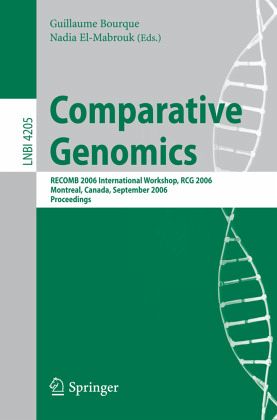
 Comparative Genomics39,99 €
 Comparative Genomics38,99 €
 Regulatory Genomics39,99 €
 Systems Biology and Regulatory Genomics39,99 €
 Systems Biology and Computational Proteomics38,99 €
 Algorithms in Bioinformatics77,99 €
 Algorithms in Bioinformatics77,99 €
Reconstructing Domain Compositions of Ancestral Multi-domain Proteins.- Domain Architecture in Homolog Identification.- Inferring Positional Homologs with Common Intervals of Sequences.- On Genome Evolution with Accumulated Change and Innovation.- Paths and Cycles in Breakpoint Graphs of Random Multichromosomal Genomes.- Common Intervals and Symmetric Difference in a Model-Free Phylogenomics, with an Application to Streptophyte Evolution.- How Pseudo-boolean Programming Can Help Genome Rearrangement Distance Computation.- Sorting by Translocations Via Reversals Theory.- Inferring Gene Orders from Gene Maps Using the Breakpoint Distance.- Ordering Partially Assembled Genomes Using Gene Arrangements.- Evolution of Tandemly Repeated Sequences Through Duplication and Inversion.- A PQ Framework for Reconstructions of Common Ancestors and Phylogeny.- Intron Loss Dynamics in Mammals.- Finding Maximum Likelihood Indel Scenarios.- Conservation Patterns in cis-Elements Reveal Compensatory Mutations.- Transcription Factor Centric Discovery of Regulatory Elements in Mammalian Genomes Using Alignment-Independent Conservation Maps.- Identifiability Issues in Phylogeny-Based Detection of Horizontal Gene Transfer.
From the reviews:
"Comparative genomics is an exciting new field of bioinformatics dealing with problems of vital importance for many areas in biology. ... This volume contains the 17 fully refereed papers presented at the fourth meeting, held in Montreal in September 2006. ... I consider this book essential for libraries aiming to support research in any field of bioinformatics." (N. Sapidis, ACM Computing Reviews, Vol. 49 (4), April, 2008)
"Comparative genomics is an exciting new field of bioinformatics dealing with problems of vital importance for many areas in biology. ... This volume contains the 17 fully refereed papers presented at the fourth meeting, held in Montreal in September 2006. ... I consider this book essential for libraries aiming to support research in any field of bioinformatics." (N. Sapidis, ACM Computing Reviews, Vol. 49 (4), April, 2008)