
Andere Kunden interessierten sich auch für
 An Introduction to Classical Complex Analysis39,99 €
 An Introduction to Classical Complex Analysis53,49 €
 Linear and Complex Analysis Problem Book 339,99 €
 Complex Analysis27,99 €
 Complex Analysis I77,99 €
 Complex Analysis46,99 €
 Complex Analysis46,99 €
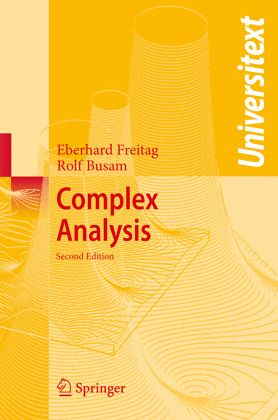
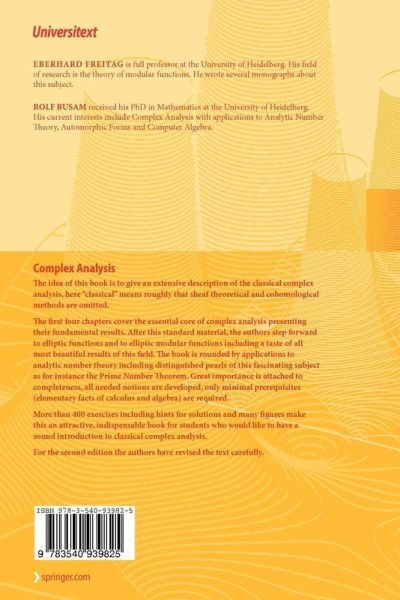
This book offers an extensive description of the classical complex analysis, roughly meaning that sheaf theoretical and cohomological methods are omitted. Over 400 exercises are included, and the text has been heavily revised for this new edition.
This indispensable book provides an extensive description of classical complex analysis. The authors begin with an introduction to complex analysis that presents the fundamental results, followed by elliptic functions and elliptic modular functions. The book is rounded by excursions to analytic number theory. Great importance is attached to completeness in the sense that all needed notions are developed. More than 400 exercises with hints for solutions are included.
This indispensable book provides an extensive description of classical complex analysis. The authors begin with an introduction to complex analysis that presents the fundamental results, followed by elliptic functions and elliptic modular functions. The book is rounded by excursions to analytic number theory. Great importance is attached to completeness in the sense that all needed notions are developed. More than 400 exercises with hints for solutions are included.
From the reviews:
"The guiding principle of the presentation of classical complex analysis is to proceed as quickly as possible to the central results while using a small number of notions and concepts from other fields. Thus the prerequisites for understanding this book are minimal; only elementary facts of calculus and algebra are required. ... Motivating introductions, more than four hundred exercises of all levels of difficulty with hints or solutions, historical annotations, and over 120 figures make the overall presentation very attractive." (L'Enseignement Mathematique, Vol. 52 (2), 2006)
"The first four chapters cover the essential core of complex analysis ... . The second part of the book is devoted to an extensive representation of the theory of elliptic functions ... . Interesting introductions, over four hundred exercises with hints or solutions, historical remarks, and over 120 figures make this book very appropriate and attractive for students at all levels." (F. Haslinger, Monatshefte für Mathematik, Vol. 149 (3), 2006)
"It is, in fact, a massive introduction to complex analysis, covering a very wide range of topics. ... This is the material that I like to cover in an undergraduate course. ... Theorems and proofs are clearly delimited, which many students find helpful. ... There are problems at the end of each section, and sketches of solutions are given ... . Overall, this is quite an attractive book." (Fernando Q. Gouvêa, MathDL, February, 2006)
From the reviews of the second edition:
"This introduction to complex analysis is fairly special, and ... unique within the existing related textbook literature. ... The authors present, apart from the standard material, a wide range of topics that are usually not covered by introductory texts ... . No doubt, this excellent, comprehensive, and nearly self-contained textbook on complex analysis deserves a wide international audience of readers, who willprofit a great deal from studying it." (Werner Kleinert, Zentralblatt MATH, Vol. 1167, 2009)
"The guiding principle of the presentation of classical complex analysis is to proceed as quickly as possible to the central results while using a small number of notions and concepts from other fields. Thus the prerequisites for understanding this book are minimal; only elementary facts of calculus and algebra are required. ... Motivating introductions, more than four hundred exercises of all levels of difficulty with hints or solutions, historical annotations, and over 120 figures make the overall presentation very attractive." (L'Enseignement Mathematique, Vol. 52 (2), 2006)
"The first four chapters cover the essential core of complex analysis ... . The second part of the book is devoted to an extensive representation of the theory of elliptic functions ... . Interesting introductions, over four hundred exercises with hints or solutions, historical remarks, and over 120 figures make this book very appropriate and attractive for students at all levels." (F. Haslinger, Monatshefte für Mathematik, Vol. 149 (3), 2006)
"It is, in fact, a massive introduction to complex analysis, covering a very wide range of topics. ... This is the material that I like to cover in an undergraduate course. ... Theorems and proofs are clearly delimited, which many students find helpful. ... There are problems at the end of each section, and sketches of solutions are given ... . Overall, this is quite an attractive book." (Fernando Q. Gouvêa, MathDL, February, 2006)
From the reviews of the second edition:
"This introduction to complex analysis is fairly special, and ... unique within the existing related textbook literature. ... The authors present, apart from the standard material, a wide range of topics that are usually not covered by introductory texts ... . No doubt, this excellent, comprehensive, and nearly self-contained textbook on complex analysis deserves a wide international audience of readers, who willprofit a great deal from studying it." (Werner Kleinert, Zentralblatt MATH, Vol. 1167, 2009)