Currently, population health science is an integral part of global academic curricula. For over a century, the principles of the reductionist paradigm have guided population health curricula, training, research, and action. Researchers continue to draw upon these principles when theorizing, conceptualizing, designing studies, analyzing, and devising interventions to tackle complex population health problems. However, unresolved impasses in addressing pressing population health challenges have catalyzed calls for the integration of complex-systems-science-grounded approaches into population…mehr
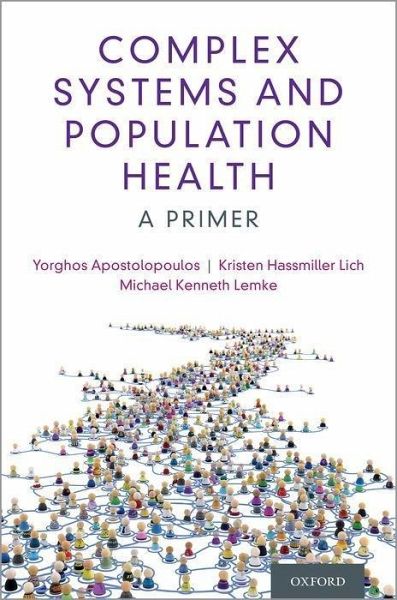
Currently, population health science is an integral part of global academic curricula. For over a century, the principles of the reductionist paradigm have guided population health curricula, training, research, and action. Researchers continue to draw upon these principles when theorizing, conceptualizing, designing studies, analyzing, and devising interventions to tackle complex population health problems. However, unresolved impasses in addressing pressing population health challenges have catalyzed calls for the integration of complex-systems-science-grounded approaches into population health science. Mounting evidence denotes that a complex systems paradigm can bring about dramatic, multipronged changes for education and training, and lead to innovative research, interventions, and policies. Despite the large and untapped promise of complex systems, the haphazard knowledge base from which academics, researchers, students, policymakers, and practitioners can draw has slowed their integration into the population health sciences. This volume fulfils this growing need by providing the knowledge base necessary to introduce a holistic complex systems paradigm in population health science. As such, it is the first comprehensive book in population health science that meaningfully integrates complex systems theory, methodology, modeling, computational simulation, and real-world applications, while incorporating current population health theoretical, methodological and analytical perspectives. It is intended as a programmatic primer across a broad spectrum of population health stakeholders: from university professors and graduate students, to researchers, policymakers, and practitioners.
Yorghos Apostolopoulos is Associate Professor of Population Health and Founding Director of the Complexity & Computational Population Health Group at Texas A&M University. Kristen Hassmiller Lich is an Associate Professor in the Department of Health Policy and Management at the University of North Carolina at Chapel Hill. Michael Kenneth Lemke is Assistant Professor of Health and Behavioral Sciences at the University of Houston-Downtown in Houston, Texas, and Associate Director of the Complexity & Computational Population Health Group at Texas A&M University in College Station, Texas.
Inhaltsangabe
* TABLE OF CONTENTS * PART I: POPULATION HEALTH SCIENCE IN A COMPLEX WORLD * Prologue * Yorghos Apostolopoulos * Chapter 1 * Bridging the divide: Where complex systems science meets population health science * Yorghos Apostolopoulos * PART II: COMPLEX SYSTEMS AND THEORY IN POPULATION HEALTH SCIENCE * Introductory Material: Preview and Objectives * Chapter 2 * Complex systems in a nutshell: Foundational concepts for population health * Megan S. Patterson, Michael K. Lemke, and Jordan Nelon * Chapter 3 * Population health as a complex adaptive system of systems * Scott E. Page and Jon Zelner * Chapter 4 * Complex network dynamics in population health * James Moody and Dana K. Pasquale * Chapter 5 * Phase transitions and resilience in physical and psychological health * Marcel G.M. Olde Rikkert, Noemi Schuurman, and Rene J.F. Melis * Chapter 6 * How complex systems science can revolutionize population health theory * Patricia Goodson * Take-Home Messages * Resources for Further Reading * PART III: COMPLEX SYSTEMS AND METHODOLOGY IN POPULATION HEALTH SCIENCE * Introductory Material: Preview and Objectives * Chapter 7 * Designing population health research grounded in complex systems science * Leah Frerichs and Natalie Smith * Chapter 8 * Model thinking and formal modeling to improve our mental models in population health research and action * Michael K. Lemke * Chapter 9 * Engaging stakeholders in mapping and modeling complex system structure to inform population health research and action * Kristen Hassmiller Lich and Jill Kuhlberg * Chapter 10 * Is it time to rethink "normal" in population health research? * Neal Dawson and Pierpaolo Andriani * Take-Home Messages * Resources for Further Reading * PART IV: COMPLEX SYSTEMS AND ANALYTICAL TECHNIQUES IN POPULATION HEALTH SCIENCE * Introductory Material: Preview and Objectives * Chapter 11 * Mathematical modeling in population health research * Karen Hicklin and Kristen Hassmiller Lich * Chapter 12 * Computational simulation modeling in population health research and policy * Nathaniel Osgood * Chapter 13 * System dynamics modeling to rethink health system reform * Jack Homer, Bobby Milstein, and Gary B. Hirsch * Chapter 14 * Agent-based modeling to delineate opioid and other drug use epidemics * Georgiy Bobashev, Lee D. Hoffer, and Francois R. Lamy * Chapter 15 * Hybrid simulation modeling in population health * Sally C. Brailsford, Dave C. Evenden, and Joe Viana * Chapter 16 * Validation of microsimulation models used for population health policy * Fernando Alarid-Escudero, Roman Gulati, and Carolyn M. Rutter * Chapter 17 * Computational simulation modeling: A tale of five models for health policy analysis * Michael C. Wolfson * Chapter 18 * Physical sciences for non-physical problems: Understanding and controlling human disease * Lazaros Gallos * Take-Home Messages * Resources for Further Reading * PART V: TOWARD A NEW POPULATION HEALTH SCIENCE * Introductory Material: Preview and Objectives * Chapter 19 * Making the global complexity turn in population health * Brian Castellani * Chapter 20 * Harnessing complex systems: An emerging paradigm for a new population health science * Yorghos Apostolopoulos * Take-Home Messages * Resources for Further Reading * GLOSSARY OF TERMS * INDEX
* TABLE OF CONTENTS * PART I: POPULATION HEALTH SCIENCE IN A COMPLEX WORLD * Prologue * Yorghos Apostolopoulos * Chapter 1 * Bridging the divide: Where complex systems science meets population health science * Yorghos Apostolopoulos * PART II: COMPLEX SYSTEMS AND THEORY IN POPULATION HEALTH SCIENCE * Introductory Material: Preview and Objectives * Chapter 2 * Complex systems in a nutshell: Foundational concepts for population health * Megan S. Patterson, Michael K. Lemke, and Jordan Nelon * Chapter 3 * Population health as a complex adaptive system of systems * Scott E. Page and Jon Zelner * Chapter 4 * Complex network dynamics in population health * James Moody and Dana K. Pasquale * Chapter 5 * Phase transitions and resilience in physical and psychological health * Marcel G.M. Olde Rikkert, Noemi Schuurman, and Rene J.F. Melis * Chapter 6 * How complex systems science can revolutionize population health theory * Patricia Goodson * Take-Home Messages * Resources for Further Reading * PART III: COMPLEX SYSTEMS AND METHODOLOGY IN POPULATION HEALTH SCIENCE * Introductory Material: Preview and Objectives * Chapter 7 * Designing population health research grounded in complex systems science * Leah Frerichs and Natalie Smith * Chapter 8 * Model thinking and formal modeling to improve our mental models in population health research and action * Michael K. Lemke * Chapter 9 * Engaging stakeholders in mapping and modeling complex system structure to inform population health research and action * Kristen Hassmiller Lich and Jill Kuhlberg * Chapter 10 * Is it time to rethink "normal" in population health research? * Neal Dawson and Pierpaolo Andriani * Take-Home Messages * Resources for Further Reading * PART IV: COMPLEX SYSTEMS AND ANALYTICAL TECHNIQUES IN POPULATION HEALTH SCIENCE * Introductory Material: Preview and Objectives * Chapter 11 * Mathematical modeling in population health research * Karen Hicklin and Kristen Hassmiller Lich * Chapter 12 * Computational simulation modeling in population health research and policy * Nathaniel Osgood * Chapter 13 * System dynamics modeling to rethink health system reform * Jack Homer, Bobby Milstein, and Gary B. Hirsch * Chapter 14 * Agent-based modeling to delineate opioid and other drug use epidemics * Georgiy Bobashev, Lee D. Hoffer, and Francois R. Lamy * Chapter 15 * Hybrid simulation modeling in population health * Sally C. Brailsford, Dave C. Evenden, and Joe Viana * Chapter 16 * Validation of microsimulation models used for population health policy * Fernando Alarid-Escudero, Roman Gulati, and Carolyn M. Rutter * Chapter 17 * Computational simulation modeling: A tale of five models for health policy analysis * Michael C. Wolfson * Chapter 18 * Physical sciences for non-physical problems: Understanding and controlling human disease * Lazaros Gallos * Take-Home Messages * Resources for Further Reading * PART V: TOWARD A NEW POPULATION HEALTH SCIENCE * Introductory Material: Preview and Objectives * Chapter 19 * Making the global complexity turn in population health * Brian Castellani * Chapter 20 * Harnessing complex systems: An emerging paradigm for a new population health science * Yorghos Apostolopoulos * Take-Home Messages * Resources for Further Reading * GLOSSARY OF TERMS * INDEX
Es gelten unsere Allgemeinen Geschäftsbedingungen: www.buecher.de/agb
Impressum
www.buecher.de ist ein Internetauftritt der buecher.de internetstores GmbH
Geschäftsführung: Monica Sawhney | Roland Kölbl | Günter Hilger
Sitz der Gesellschaft: Batheyer Straße 115 - 117, 58099 Hagen
Postanschrift: Bürgermeister-Wegele-Str. 12, 86167 Augsburg
Amtsgericht Hagen HRB 13257
Steuernummer: 321/5800/1497
USt-IdNr: DE450055826