In Complexity Economics for Environmental Governance, Jean-François Mercure reframes environmental policy and provides a rigorous methodology necessary to tackle the complexity of environmental policy and the transition to sustainability. The book offers a detailed account of the deficiencies of environmental economics and then develops a theory of innovation and macroeconomics based on complexity theory. It also develops a new foundation for evidence-based policy-making using a Risk-Opportunity Analysis applied to the sustainability transition. This multidisciplinary work was developed in…mehr
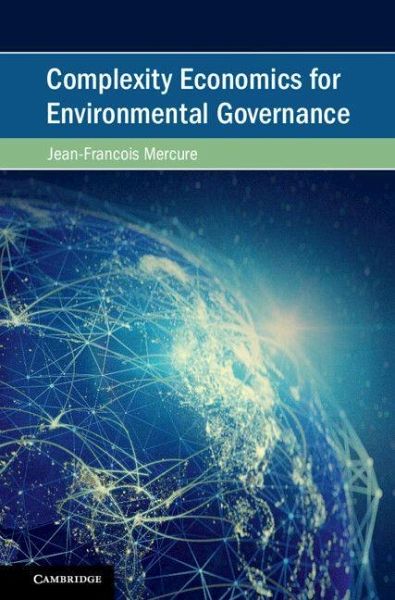
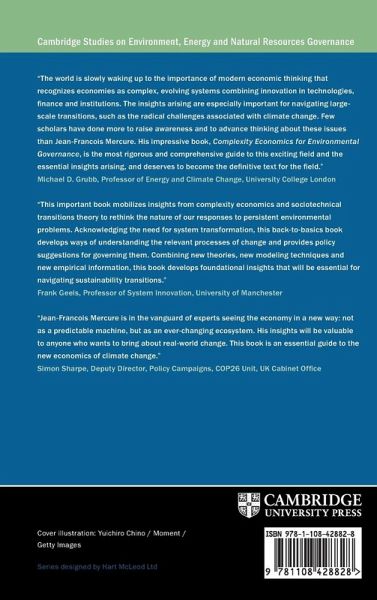
In Complexity Economics for Environmental Governance, Jean-François Mercure reframes environmental policy and provides a rigorous methodology necessary to tackle the complexity of environmental policy and the transition to sustainability. The book offers a detailed account of the deficiencies of environmental economics and then develops a theory of innovation and macroeconomics based on complexity theory. It also develops a new foundation for evidence-based policy-making using a Risk-Opportunity Analysis applied to the sustainability transition. This multidisciplinary work was developed in partnership with prominent natural scientists and economists as well as active policy-makers with the aim to revolutionize thinking in the face of the full complexity of the sustainability transition, and to show how it can best be governed to minimize its distributional impacts. The book should be read by academics and policy-makers seeking new ways to think about environmental policy-making.
Dr Jean-François Mercure is Associate Professor in Climate Change Policy at the University of Exeter, UK. His research focuses on developing models and methods for public policy appraisal in low-carbon innovation based on complexity science, and for assessing the macroeconomic impacts of diverse types of low-carbon, energy and climate policies. Jean-François Mercure has worked at several universities including the University of Cambridge, where he was Deputy Director of the Cambridge Centre for Climate Change Mitigation Research, and remains now fellow of the Cambridge Centre for Energy, Environment and Natural Resource Governance (C-EERNG), as well as Hughes Hall. He regularly engages with policy-makers from across UK government, the European Commission and other governments internationally.
Inhaltsangabe
Part I. The Current State of Knowledge: 1. Introducing Complex Environmental Economics 2. Complexity Heterogeneity, and Uncertainty 3. Equilibrium and Non-Equilibrium Paradigms 4. Philosophies of Science and the Policy Cycle Part II. A Positive Theory for Complexity Economics: 5. Concepts of Complexity for Economics 6. Fundamental Uncertainty 7. Micro-Foundations for Consumer Theory 8. Micro-foundations for a Theory of Innovation 9. The Nature of Money 10. Micro-Foundations for Credit Creation 11. A Model for Growth and Creative Destruction Part III. Applied Complexity Economics for Environmental Governance: 12. Risk-Opportunity Analysis 13. Science & Policy for the Energy-Water-Food Nexus 14. Technology Dynamics in a Low-Carbon Transition 15. Structural Change in a Low-Carbon Transition 16. Conclusion and Outlook.
Es gelten unsere Allgemeinen Geschäftsbedingungen: www.buecher.de/agb
Impressum
www.buecher.de ist ein Internetauftritt der buecher.de internetstores GmbH
Geschäftsführung: Monica Sawhney | Roland Kölbl | Günter Hilger
Sitz der Gesellschaft: Batheyer Straße 115 - 117, 58099 Hagen
Postanschrift: Bürgermeister-Wegele-Str. 12, 86167 Augsburg
Amtsgericht Hagen HRB 13257
Steuernummer: 321/5800/1497
USt-IdNr: DE450055826