
Andere Kunden interessierten sich auch für
 Computational Logic in Multi-Agent Systems54,99 €
 Computational Logic in Multi-Agent Systems38,99 €
 Declarative Agent Languages and Technologies II39,99 €
 Foundations and Applications of Multi-Agent Systems39,99 €
 Intelligent Agents and Multi-Agent Systems39,99 €
 Engineering Societies in the Agents World VI39,99 €
 Engineering Societies in the Agents World III39,99 €


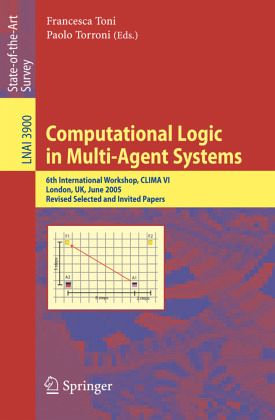
The Logical Way to Be Artificially Intelligent.- The Logical Way to Be Artificially Intelligent.- Foundational Aspects of Agency.- Ability in a Multi-agent Context: A Model in the Situation Calculus.- Reasoning About Epistemic States of Agents by Modal Logic Programming.- Strongly Complete Axiomatizations of "Knowing at Most" in Syntactic Structures.- Logical Spaces in Multi-agent Only Knowing Systems.- Trustworthiness by Default.- Decision Procedure for a Fragment of Mutual Belief Logic with Quantified Agent Variables.- Agent Programming.- Implementing Temporal Logics: Tools for Execution and Proof.- BDI Agent Programming in AgentSpeak Using Jason.- Using the KGP Model of Agency to Design Applications.- Multi-threaded Communicating Agents in Qu-Prolog.- Variety of Behaviours Through Profiles in Logic-Based Agents.- Contract-Related Agents.- Agent Interaction and Normative Systems.- Specification and Verification of Agent Interaction Using Abductive Reasoning.- Verification of Protocol Conformance and Agent Interoperability.- Contextual Terminologies.- Constitutive Norms in the Design of Normative Multiagent Systems.- Combining Answer Sets of Nonmonotonic Logic Programs.- Speculative Constraint Processing with Iterative Revision for Disjunctive Answers.- Intention Recognition in the Situation Calculus and Probability Theory Frameworks.- The First CLIMA Contest.- The First Contest on Multi-agent Systems Based on Computational Logic.- Implementing Pheromone-Based, Negotiating Forager Agents.- Extending Tropos for a Prolog Implementation: A Case Study Using the Food Collecting Agent Problem.- Reactive Food Gathering.- Strategies for Multi-agent Coordination in a Grid World Using Petri Nets.- Project Report.- Multi-agent Systems in Computational Logic: Challenges andOutcomes of the SOCS Project.