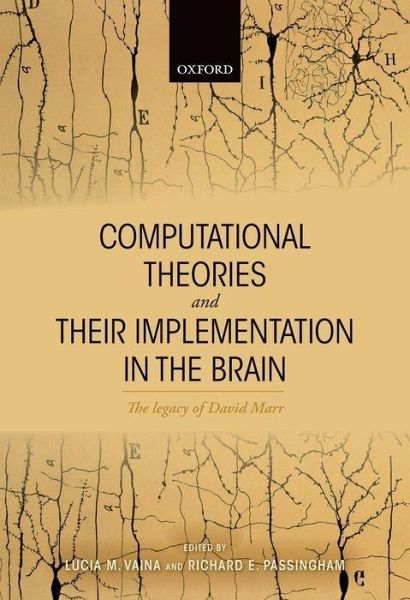
In the late 196s and early 197s David Marr produced three astonishing papers in which he gave a detailed account of how the fine structure and known cell types of the cerebellum, hippocampus and neocortex perform the functions that they do. Marr went on to become one of the main founders of Computational Neuroscience. In his classic work 'Vision' he distinguished between the computational, algorithmic, and implementational levels, and the three early theories concerned implementation. However, they were produced when Neuroscience was in its infancy. Now that so much more is known, it is timely…mehr
In the late 196s and early 197s David Marr produced three astonishing papers in which he gave a detailed account of how the fine structure and known cell types of the cerebellum, hippocampus and neocortex perform the functions that they do. Marr went on to become one of the main founders of Computational Neuroscience. In his classic work 'Vision' he distinguished between the computational, algorithmic, and implementational levels, and the three early theories concerned implementation. However, they were produced when Neuroscience was in its infancy. Now that so much more is known, it is timely to revisit these early theories to see to what extent they are still valid and what needs to be altered to produce viable theories that stand up to current evidence. This book brings together some of the most distinguished scientists in their fields to evaluate Marr's legacy. After a general introduction there are three chapters on the cerebellum, three on the hippocampus and two on the neocortex. The book ends with an appreciation of the life of David Marr by Lucia Vaina.
Professor Lucia M. Vaina received an MS in mathematics from University of Timisoara and Pavia, PhD in mathematical logic from the Sorbonne and MD PhD (neuroscience) from the University of Toulouse. Her postdoctoral training was at UC Berkeley, Stanford and MIT. She joined the faculty of Boston University and Harvard Medical School in 1986 and in 1995 she was promoted to tenured Professor of Biomedical Engineering at Boston University. She is among the first visual neuroscientists that studied the effects of lesions on visual motion perception in humans, by using psychophysics, biologically constrained computational modeling, and MRI, fMRI and MEG. She characterized the cortical mechanisms underlying visual motion tasks, and alternate mechanisms used by motion impaired patients. She studied psychophysically&computationally aspects of perceptual learning of motion discrimination and used fMRI to elucidate their neural substrate Professor Richard E. Passingham received his BA from the University of Oxford and his Ph.D in Psychology from the University of London. He returned to Oxford in 1970 and was made a University Lecturer and Fellow of Wadham College in 1976. He was amongst the first to use brain imaging to study human cognition, starting in 1988 at the MRC Cyclotron Unit at the Hammersmith Hospital where he was an Honorary Senior Lecturer. In 1996 he moved to the newly founded Wellcome Centre for NeuroImaging at the University of London where he was an Honorary Principal. He was made Professor of Cognitive Neuroscience at Oxford in 1997.
Inhaltsangabe
* Introduction * Marr's views on the functions of the cerebellum, neocortex and archicortex * Section 1: A Theory of Cerebellar Cortex * 1: Takeru Honda and Masao Ito: Development from Marr's theory of the cerebellum * 2: Egidio D'Angelo: Challenging Marr's theory of cerebellum * 3: Paul Dean and John Porrill: The importance of Marr's three levels of analysis for understanding cerebellar function * Section 2: Simple Memory: A Theory for Archicortex * 4: Alessandro Treves: The dentate gyrus, defining a new memory of David Marr * 5: Michael E. Hasselmo: Marr's influence on the standard model of hippocampus, and the need for more theoretical advances * 6: Suzanna Becker: Marr's simple memory theory of archicortex, then and now: four decades later, things are not quite as simple * Section 3: A theory of Neocortex * 7: Rodney Douglas and Kevan Martin: Visions of the neocortex * 8: David Willshaw and Peter Dayan: Unsupervized yearning: Marr's theory of the neocortex * David Marr * 10: Lucia M Vaina: David Marr 1945-1980
* Introduction * Marr's views on the functions of the cerebellum, neocortex and archicortex * Section 1: A Theory of Cerebellar Cortex * 1: Takeru Honda and Masao Ito: Development from Marr's theory of the cerebellum * 2: Egidio D'Angelo: Challenging Marr's theory of cerebellum * 3: Paul Dean and John Porrill: The importance of Marr's three levels of analysis for understanding cerebellar function * Section 2: Simple Memory: A Theory for Archicortex * 4: Alessandro Treves: The dentate gyrus, defining a new memory of David Marr * 5: Michael E. Hasselmo: Marr's influence on the standard model of hippocampus, and the need for more theoretical advances * 6: Suzanna Becker: Marr's simple memory theory of archicortex, then and now: four decades later, things are not quite as simple * Section 3: A theory of Neocortex * 7: Rodney Douglas and Kevan Martin: Visions of the neocortex * 8: David Willshaw and Peter Dayan: Unsupervized yearning: Marr's theory of the neocortex * David Marr * 10: Lucia M Vaina: David Marr 1945-1980
Es gelten unsere Allgemeinen Geschäftsbedingungen: www.buecher.de/agb
Impressum
www.buecher.de ist ein Internetauftritt der buecher.de internetstores GmbH
Geschäftsführung: Monica Sawhney | Roland Kölbl | Günter Hilger
Sitz der Gesellschaft: Batheyer Straße 115 - 117, 58099 Hagen
Postanschrift: Bürgermeister-Wegele-Str. 12, 86167 Augsburg
Amtsgericht Hagen HRB 13257
Steuernummer: 321/5800/1497
USt-IdNr: DE450055826