
C. P. Hong
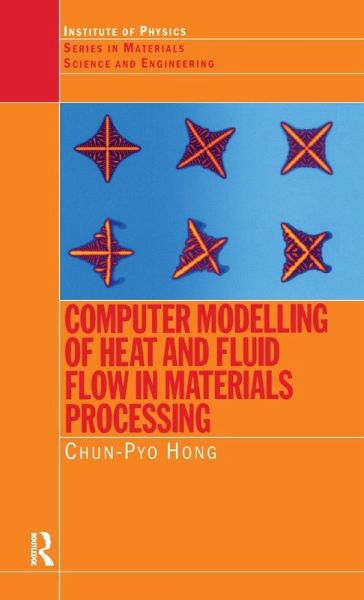
Computer Modelling of Heat and Fluid Flow in Materials Processing
C. P. Hong
Computer Modelling of Heat and Fluid Flow in Materials Processing
- Gebundenes Buch
- Merkliste
- Auf die Merkliste
- Bewerten Bewerten
- Teilen
- Produkt teilen
- Produkterinnerung
- Produkterinnerung
The understanding and control of transport phenomena in materials processing play an important role in the improvement of conventional processes and in the development of new techniques. This book addresses the understanding of these phenomena in materials processing situations.
Andere Kunden interessierten sich auch für
 Diverse Quasiparticle Properties of Emerging Materials226,99 €
 J. DonekerDefect Recognition and Image Processing in Semiconductors 1997377,99 €
 Electroactive Polymeric Materials236,99 €
 Defects in Microelectronic Materials and Devices79,99 €
 David JilesIntroduction to Magnetism and Magnetic Materials233,99 €
 Praveen ChaddahFirst Order Phase Transitions of Magnetic Materials139,99 €
 Pradeep FulayElectronic, Magnetic, and Optical Materials184,99 €
-
-
-






The understanding and control of transport phenomena in materials processing play an important role in the improvement of conventional processes and in the development of new techniques. This book addresses the understanding of these phenomena in materials processing situations.
Produktdetails
- Produktdetails
- Verlag: CRC Press
- Seitenzahl: 272
- Erscheinungstermin: 7. Juni 2019
- Englisch
- Abmessung: 222mm x 145mm x 18mm
- Gewicht: 477g
- ISBN-13: 9781138414150
- ISBN-10: 1138414158
- Artikelnr.: 57050646
- Herstellerkennzeichnung
- Libri GmbH
- Europaallee 1
- 36244 Bad Hersfeld
- gpsr@libri.de
- Verlag: CRC Press
- Seitenzahl: 272
- Erscheinungstermin: 7. Juni 2019
- Englisch
- Abmessung: 222mm x 145mm x 18mm
- Gewicht: 477g
- ISBN-13: 9781138414150
- ISBN-10: 1138414158
- Artikelnr.: 57050646
- Herstellerkennzeichnung
- Libri GmbH
- Europaallee 1
- 36244 Bad Hersfeld
- gpsr@libri.de
Chun-Pyo Hong Yonsei University, Korea
Preface
1 Mechanisms of transport phenomena
1.1 Heat transfer
1.1.1 Conduction-Fourier's Law of Conduction
1.1.2 Convection
1.1.3 Radiation
1.2 Mass transfer
1.2.1 Diffusion-Fick's Law of Diffusion
1.2.2 Convective mass transfer
1.3 Momentum transfer
1.3.1 Viscous momentum transfer-Newton's Law of Viscosity
1.3.2 Convective momentum transfer
Reference
2 Governing equations for transport phenomena
2.1 Governing equations for mass transfer
2.1.1 Integral form of mass balance equation
2.1.2 Differential form of mass balance equation-equation of continuity
2.2 Governing equations for momentum transfer
2.2.1 Integral form of momentum balance equation
2.2.2 Differential form of momentum balance equation-equation of motion
2.2.3 Boundary conditions
2.3 Governing equations for energy transfer
2.3.1 Integral form of energy balance equation
2.3.2 Differential form of energy balance equation
2.3.3 Initial and boundary conditions
2.4 Governing equations for species transfer
2.4.1 Integral form of mass balance equation for species A
2.4.2 Differential form of mass balance equation for species A
2.4.3 Initial and boundary conditions
References
3 Similarities among three types of transport phenomena
3.1 Basic flux laws
3.1.1 Heat transfer (Fourier's law of conduction)
3.1.2 Mass transfer (Fick's law of diffusion)
3.1.3 Momentum transfer (Newton's law of viscosity)
3.2 Convective transfer
3.3 Governing equations
Further readings for chapters 1 through 3
4 Basics of finite difference methods
4.1 Introduction
4.2 Finite difference methods
4.2.1 Taylor-series formulation
4.2.2 Integral method
4.2.3 Finite volume method-control volume approach
References
5 Steady state heat conduction
5.1 Mathematical formulation
5.1.1 Governing equation
5.1.2 Boundary conditions
5.2 Finite volume approach for steady state problems
5.2.1 Computational grids
5.2.2 Derivation of finite difference equations
5.2.3 Solution of linear algebraic equations
5.3 One-dimensional cylindrical and spherical coordinates
5.3.1 Control volumes inside a domain
5.3.2 Control volumes on the outer boundary of a domain
5.4 Multi-dimensional problems
5.4.1 Two-dimensional problems
5.4.2 Three-dimensional problems
5.5 Worked examples
5.5.1 Example 5.1
5.5.2 Example 5.2
5.5.3 Example 5.3
5.6 Case study: one-dimensional steady state heat conduction problems
5.6.1 Description of the problem
5.6.2 Glossary of FORTRAN notation
5.6.3 Simulations
5.6.4 Program list
6 Transient heat conduction
6.1 Mathematical formulation
6.1.1 Governing equation
6.1.2 Initial and boundary conditions
6.2 Finite volume approach for transient problems
6.2.1 Computational grids
6.2.2 Derivation of finite difference equations
6.3 Solving schemes
6.3.1 Fully explicit method
6.3.2 Fully implicit method
6.3.3 Crank-Nicolson method
6.4 Stability analysis-von Neumann stability analysis
6.5 Multi-dimensional problems
6.6 Worked examples
6.6.1 Example 6.1
6.6.2 Example 6.2
6.6.3 Example 6.3
6.7 Case study: one-dimensional transient heat conduction problems
6.7.1 Description of the problem
6.7.2 Glossary of FORTRAN notation
6.7.3 Simulations
6.7.4 Program list
References
7 Phase change problems
7.1 Introduction
7.2 Methods of solution for phase change
7.2.1 Numerical methods
7.2.2 Alloy solidification
7.3 Case study: one-dimensional phase change problems
7.3.1 Description of the problem
7.3.2. Glossary of FORTRAN notation
7.3.3 Simulation
7.3.4 Program List
References
8 Discretization schemes for convection and diffusion terms
8.1 Introduction
8.2 Steady one-dimensional convection and diffusion
8.2.1 Governing equations
8.2.2 The analytical solution
8.2.3 A control volume approach
8.2.4 The central difference scheme
8.2.5 The upwind difference scheme
8.2.6 The hybrid difference scheme
8.2.7 The power-law scheme
8.3 Comparison among difference schemes
References
9 Solution algorithms for fluid flow analysis
9.1 Governing equations
9.2 Solving schemes
9.2.1 Vorticity-stream function approach
9.2.2 Primitive variable approaches
9.3 Summary
References
10 Fluid flow analysis using the SIMPLE method based on the Cartesian coordinate system
10.1 Governing equations
10.2 Staggered and non-staggered grids
10.3 Discretization method
10.3.1 Discretization of the integral form of transport equation
10.3.2 Discretization of momentum equations
10.3.3 The SIMPLE algorithm
10.4 Treatment of free surfaces
10.4.1 The MAC method
10.4.2 The VOF (volume of fluid) method
10.5 Boundary conditions
10.6 Turbulent flow
10.7 Case studies
10.7.1 Flow over a semi-circular core between two plates
10.7.2 Internal flow in a U-tube
References
11 Fluid flow analysis using the SIMPLE method based on the body-fitted coordinate system
11.1 Introduction
11.2 Transformation of coordinate systems
11.3 Transformation of basic equations
11.4 Discretization method
11.4.1 Discretization of the integral form of transport equation
11.4.2 Discretization of momentum equations
11.4.3 The SIMPLE algorithm
11.5 The VOF method in the body-fitted coordinate system
11.6 Treatment of a surface cell
11.6.1 Momentum equations
11.6.2. Pressure at a surface cell
11.6.3 Contravariant velocity
11.6.4 Determination of the direction normal to a free surface
11.7 Case studies
11.7.1 Flow over a semi-circular core between two plates
11.7.2 Internal flow in a U-tube
References
12 Modelling of mould filling
12.1 Introduction
12.2 Numerical analysis of filling process
12.2.1 Governing equations
12.2.2 Free surface tracking in mould filling
12.2.3 Algorithms for free surface tracking in the SIMPLE method
12.3 Examples of mould filling simulation
12.3.1 Filling in a mould cavity with a straight and tapered gating system using the SIMPLE-VOF method
12.3.2 Filling in a mould cavity with a curved gating system using the SIMPLE-BFC-VOF method
12.3.3 Comparison of the standard SIMPLE-VOF and the SIMPLE-BFC-VOF methods
12.4 Case studies
12.4.1 Filling in a rectangular cavity with a semicircular core on the bottom plate
References
13 Modelling of microstructure evolution
13.1 Introduction
13.2 Nucleation and growth kinetics
13.2.1 Nucleation
13.2.2 Growth kinetics
13.3 Classical cellular automaton models
13.3.1 Model description
13.3.2 Nucleation and growth algorithm implemented into CA
13.3.3 Coupling the macroscopic heat flow calculation with CA models
13.3.4 Examples of classical CA simulation
13.4 Modified cellular automaton models
13.4.1 Model description
13.4.2 Growth
13.4.3 Coupling the continuum model with a modified CA model
13.4.4 Examples of modified CA simulation
13.5 Case studies
13.5.1 Simulation of solidification grain structures by classical cellular automaton models
13.5.2 Simulation of dendritic growth by modified cellular automaton models
References
Index
1 Mechanisms of transport phenomena
1.1 Heat transfer
1.1.1 Conduction-Fourier's Law of Conduction
1.1.2 Convection
1.1.3 Radiation
1.2 Mass transfer
1.2.1 Diffusion-Fick's Law of Diffusion
1.2.2 Convective mass transfer
1.3 Momentum transfer
1.3.1 Viscous momentum transfer-Newton's Law of Viscosity
1.3.2 Convective momentum transfer
Reference
2 Governing equations for transport phenomena
2.1 Governing equations for mass transfer
2.1.1 Integral form of mass balance equation
2.1.2 Differential form of mass balance equation-equation of continuity
2.2 Governing equations for momentum transfer
2.2.1 Integral form of momentum balance equation
2.2.2 Differential form of momentum balance equation-equation of motion
2.2.3 Boundary conditions
2.3 Governing equations for energy transfer
2.3.1 Integral form of energy balance equation
2.3.2 Differential form of energy balance equation
2.3.3 Initial and boundary conditions
2.4 Governing equations for species transfer
2.4.1 Integral form of mass balance equation for species A
2.4.2 Differential form of mass balance equation for species A
2.4.3 Initial and boundary conditions
References
3 Similarities among three types of transport phenomena
3.1 Basic flux laws
3.1.1 Heat transfer (Fourier's law of conduction)
3.1.2 Mass transfer (Fick's law of diffusion)
3.1.3 Momentum transfer (Newton's law of viscosity)
3.2 Convective transfer
3.3 Governing equations
Further readings for chapters 1 through 3
4 Basics of finite difference methods
4.1 Introduction
4.2 Finite difference methods
4.2.1 Taylor-series formulation
4.2.2 Integral method
4.2.3 Finite volume method-control volume approach
References
5 Steady state heat conduction
5.1 Mathematical formulation
5.1.1 Governing equation
5.1.2 Boundary conditions
5.2 Finite volume approach for steady state problems
5.2.1 Computational grids
5.2.2 Derivation of finite difference equations
5.2.3 Solution of linear algebraic equations
5.3 One-dimensional cylindrical and spherical coordinates
5.3.1 Control volumes inside a domain
5.3.2 Control volumes on the outer boundary of a domain
5.4 Multi-dimensional problems
5.4.1 Two-dimensional problems
5.4.2 Three-dimensional problems
5.5 Worked examples
5.5.1 Example 5.1
5.5.2 Example 5.2
5.5.3 Example 5.3
5.6 Case study: one-dimensional steady state heat conduction problems
5.6.1 Description of the problem
5.6.2 Glossary of FORTRAN notation
5.6.3 Simulations
5.6.4 Program list
6 Transient heat conduction
6.1 Mathematical formulation
6.1.1 Governing equation
6.1.2 Initial and boundary conditions
6.2 Finite volume approach for transient problems
6.2.1 Computational grids
6.2.2 Derivation of finite difference equations
6.3 Solving schemes
6.3.1 Fully explicit method
6.3.2 Fully implicit method
6.3.3 Crank-Nicolson method
6.4 Stability analysis-von Neumann stability analysis
6.5 Multi-dimensional problems
6.6 Worked examples
6.6.1 Example 6.1
6.6.2 Example 6.2
6.6.3 Example 6.3
6.7 Case study: one-dimensional transient heat conduction problems
6.7.1 Description of the problem
6.7.2 Glossary of FORTRAN notation
6.7.3 Simulations
6.7.4 Program list
References
7 Phase change problems
7.1 Introduction
7.2 Methods of solution for phase change
7.2.1 Numerical methods
7.2.2 Alloy solidification
7.3 Case study: one-dimensional phase change problems
7.3.1 Description of the problem
7.3.2. Glossary of FORTRAN notation
7.3.3 Simulation
7.3.4 Program List
References
8 Discretization schemes for convection and diffusion terms
8.1 Introduction
8.2 Steady one-dimensional convection and diffusion
8.2.1 Governing equations
8.2.2 The analytical solution
8.2.3 A control volume approach
8.2.4 The central difference scheme
8.2.5 The upwind difference scheme
8.2.6 The hybrid difference scheme
8.2.7 The power-law scheme
8.3 Comparison among difference schemes
References
9 Solution algorithms for fluid flow analysis
9.1 Governing equations
9.2 Solving schemes
9.2.1 Vorticity-stream function approach
9.2.2 Primitive variable approaches
9.3 Summary
References
10 Fluid flow analysis using the SIMPLE method based on the Cartesian coordinate system
10.1 Governing equations
10.2 Staggered and non-staggered grids
10.3 Discretization method
10.3.1 Discretization of the integral form of transport equation
10.3.2 Discretization of momentum equations
10.3.3 The SIMPLE algorithm
10.4 Treatment of free surfaces
10.4.1 The MAC method
10.4.2 The VOF (volume of fluid) method
10.5 Boundary conditions
10.6 Turbulent flow
10.7 Case studies
10.7.1 Flow over a semi-circular core between two plates
10.7.2 Internal flow in a U-tube
References
11 Fluid flow analysis using the SIMPLE method based on the body-fitted coordinate system
11.1 Introduction
11.2 Transformation of coordinate systems
11.3 Transformation of basic equations
11.4 Discretization method
11.4.1 Discretization of the integral form of transport equation
11.4.2 Discretization of momentum equations
11.4.3 The SIMPLE algorithm
11.5 The VOF method in the body-fitted coordinate system
11.6 Treatment of a surface cell
11.6.1 Momentum equations
11.6.2. Pressure at a surface cell
11.6.3 Contravariant velocity
11.6.4 Determination of the direction normal to a free surface
11.7 Case studies
11.7.1 Flow over a semi-circular core between two plates
11.7.2 Internal flow in a U-tube
References
12 Modelling of mould filling
12.1 Introduction
12.2 Numerical analysis of filling process
12.2.1 Governing equations
12.2.2 Free surface tracking in mould filling
12.2.3 Algorithms for free surface tracking in the SIMPLE method
12.3 Examples of mould filling simulation
12.3.1 Filling in a mould cavity with a straight and tapered gating system using the SIMPLE-VOF method
12.3.2 Filling in a mould cavity with a curved gating system using the SIMPLE-BFC-VOF method
12.3.3 Comparison of the standard SIMPLE-VOF and the SIMPLE-BFC-VOF methods
12.4 Case studies
12.4.1 Filling in a rectangular cavity with a semicircular core on the bottom plate
References
13 Modelling of microstructure evolution
13.1 Introduction
13.2 Nucleation and growth kinetics
13.2.1 Nucleation
13.2.2 Growth kinetics
13.3 Classical cellular automaton models
13.3.1 Model description
13.3.2 Nucleation and growth algorithm implemented into CA
13.3.3 Coupling the macroscopic heat flow calculation with CA models
13.3.4 Examples of classical CA simulation
13.4 Modified cellular automaton models
13.4.1 Model description
13.4.2 Growth
13.4.3 Coupling the continuum model with a modified CA model
13.4.4 Examples of modified CA simulation
13.5 Case studies
13.5.1 Simulation of solidification grain structures by classical cellular automaton models
13.5.2 Simulation of dendritic growth by modified cellular automaton models
References
Index
Preface
1 Mechanisms of transport phenomena
1.1 Heat transfer
1.1.1 Conduction-Fourier's Law of Conduction
1.1.2 Convection
1.1.3 Radiation
1.2 Mass transfer
1.2.1 Diffusion-Fick's Law of Diffusion
1.2.2 Convective mass transfer
1.3 Momentum transfer
1.3.1 Viscous momentum transfer-Newton's Law of Viscosity
1.3.2 Convective momentum transfer
Reference
2 Governing equations for transport phenomena
2.1 Governing equations for mass transfer
2.1.1 Integral form of mass balance equation
2.1.2 Differential form of mass balance equation-equation of continuity
2.2 Governing equations for momentum transfer
2.2.1 Integral form of momentum balance equation
2.2.2 Differential form of momentum balance equation-equation of motion
2.2.3 Boundary conditions
2.3 Governing equations for energy transfer
2.3.1 Integral form of energy balance equation
2.3.2 Differential form of energy balance equation
2.3.3 Initial and boundary conditions
2.4 Governing equations for species transfer
2.4.1 Integral form of mass balance equation for species A
2.4.2 Differential form of mass balance equation for species A
2.4.3 Initial and boundary conditions
References
3 Similarities among three types of transport phenomena
3.1 Basic flux laws
3.1.1 Heat transfer (Fourier's law of conduction)
3.1.2 Mass transfer (Fick's law of diffusion)
3.1.3 Momentum transfer (Newton's law of viscosity)
3.2 Convective transfer
3.3 Governing equations
Further readings for chapters 1 through 3
4 Basics of finite difference methods
4.1 Introduction
4.2 Finite difference methods
4.2.1 Taylor-series formulation
4.2.2 Integral method
4.2.3 Finite volume method-control volume approach
References
5 Steady state heat conduction
5.1 Mathematical formulation
5.1.1 Governing equation
5.1.2 Boundary conditions
5.2 Finite volume approach for steady state problems
5.2.1 Computational grids
5.2.2 Derivation of finite difference equations
5.2.3 Solution of linear algebraic equations
5.3 One-dimensional cylindrical and spherical coordinates
5.3.1 Control volumes inside a domain
5.3.2 Control volumes on the outer boundary of a domain
5.4 Multi-dimensional problems
5.4.1 Two-dimensional problems
5.4.2 Three-dimensional problems
5.5 Worked examples
5.5.1 Example 5.1
5.5.2 Example 5.2
5.5.3 Example 5.3
5.6 Case study: one-dimensional steady state heat conduction problems
5.6.1 Description of the problem
5.6.2 Glossary of FORTRAN notation
5.6.3 Simulations
5.6.4 Program list
6 Transient heat conduction
6.1 Mathematical formulation
6.1.1 Governing equation
6.1.2 Initial and boundary conditions
6.2 Finite volume approach for transient problems
6.2.1 Computational grids
6.2.2 Derivation of finite difference equations
6.3 Solving schemes
6.3.1 Fully explicit method
6.3.2 Fully implicit method
6.3.3 Crank-Nicolson method
6.4 Stability analysis-von Neumann stability analysis
6.5 Multi-dimensional problems
6.6 Worked examples
6.6.1 Example 6.1
6.6.2 Example 6.2
6.6.3 Example 6.3
6.7 Case study: one-dimensional transient heat conduction problems
6.7.1 Description of the problem
6.7.2 Glossary of FORTRAN notation
6.7.3 Simulations
6.7.4 Program list
References
7 Phase change problems
7.1 Introduction
7.2 Methods of solution for phase change
7.2.1 Numerical methods
7.2.2 Alloy solidification
7.3 Case study: one-dimensional phase change problems
7.3.1 Description of the problem
7.3.2. Glossary of FORTRAN notation
7.3.3 Simulation
7.3.4 Program List
References
8 Discretization schemes for convection and diffusion terms
8.1 Introduction
8.2 Steady one-dimensional convection and diffusion
8.2.1 Governing equations
8.2.2 The analytical solution
8.2.3 A control volume approach
8.2.4 The central difference scheme
8.2.5 The upwind difference scheme
8.2.6 The hybrid difference scheme
8.2.7 The power-law scheme
8.3 Comparison among difference schemes
References
9 Solution algorithms for fluid flow analysis
9.1 Governing equations
9.2 Solving schemes
9.2.1 Vorticity-stream function approach
9.2.2 Primitive variable approaches
9.3 Summary
References
10 Fluid flow analysis using the SIMPLE method based on the Cartesian coordinate system
10.1 Governing equations
10.2 Staggered and non-staggered grids
10.3 Discretization method
10.3.1 Discretization of the integral form of transport equation
10.3.2 Discretization of momentum equations
10.3.3 The SIMPLE algorithm
10.4 Treatment of free surfaces
10.4.1 The MAC method
10.4.2 The VOF (volume of fluid) method
10.5 Boundary conditions
10.6 Turbulent flow
10.7 Case studies
10.7.1 Flow over a semi-circular core between two plates
10.7.2 Internal flow in a U-tube
References
11 Fluid flow analysis using the SIMPLE method based on the body-fitted coordinate system
11.1 Introduction
11.2 Transformation of coordinate systems
11.3 Transformation of basic equations
11.4 Discretization method
11.4.1 Discretization of the integral form of transport equation
11.4.2 Discretization of momentum equations
11.4.3 The SIMPLE algorithm
11.5 The VOF method in the body-fitted coordinate system
11.6 Treatment of a surface cell
11.6.1 Momentum equations
11.6.2. Pressure at a surface cell
11.6.3 Contravariant velocity
11.6.4 Determination of the direction normal to a free surface
11.7 Case studies
11.7.1 Flow over a semi-circular core between two plates
11.7.2 Internal flow in a U-tube
References
12 Modelling of mould filling
12.1 Introduction
12.2 Numerical analysis of filling process
12.2.1 Governing equations
12.2.2 Free surface tracking in mould filling
12.2.3 Algorithms for free surface tracking in the SIMPLE method
12.3 Examples of mould filling simulation
12.3.1 Filling in a mould cavity with a straight and tapered gating system using the SIMPLE-VOF method
12.3.2 Filling in a mould cavity with a curved gating system using the SIMPLE-BFC-VOF method
12.3.3 Comparison of the standard SIMPLE-VOF and the SIMPLE-BFC-VOF methods
12.4 Case studies
12.4.1 Filling in a rectangular cavity with a semicircular core on the bottom plate
References
13 Modelling of microstructure evolution
13.1 Introduction
13.2 Nucleation and growth kinetics
13.2.1 Nucleation
13.2.2 Growth kinetics
13.3 Classical cellular automaton models
13.3.1 Model description
13.3.2 Nucleation and growth algorithm implemented into CA
13.3.3 Coupling the macroscopic heat flow calculation with CA models
13.3.4 Examples of classical CA simulation
13.4 Modified cellular automaton models
13.4.1 Model description
13.4.2 Growth
13.4.3 Coupling the continuum model with a modified CA model
13.4.4 Examples of modified CA simulation
13.5 Case studies
13.5.1 Simulation of solidification grain structures by classical cellular automaton models
13.5.2 Simulation of dendritic growth by modified cellular automaton models
References
Index
1 Mechanisms of transport phenomena
1.1 Heat transfer
1.1.1 Conduction-Fourier's Law of Conduction
1.1.2 Convection
1.1.3 Radiation
1.2 Mass transfer
1.2.1 Diffusion-Fick's Law of Diffusion
1.2.2 Convective mass transfer
1.3 Momentum transfer
1.3.1 Viscous momentum transfer-Newton's Law of Viscosity
1.3.2 Convective momentum transfer
Reference
2 Governing equations for transport phenomena
2.1 Governing equations for mass transfer
2.1.1 Integral form of mass balance equation
2.1.2 Differential form of mass balance equation-equation of continuity
2.2 Governing equations for momentum transfer
2.2.1 Integral form of momentum balance equation
2.2.2 Differential form of momentum balance equation-equation of motion
2.2.3 Boundary conditions
2.3 Governing equations for energy transfer
2.3.1 Integral form of energy balance equation
2.3.2 Differential form of energy balance equation
2.3.3 Initial and boundary conditions
2.4 Governing equations for species transfer
2.4.1 Integral form of mass balance equation for species A
2.4.2 Differential form of mass balance equation for species A
2.4.3 Initial and boundary conditions
References
3 Similarities among three types of transport phenomena
3.1 Basic flux laws
3.1.1 Heat transfer (Fourier's law of conduction)
3.1.2 Mass transfer (Fick's law of diffusion)
3.1.3 Momentum transfer (Newton's law of viscosity)
3.2 Convective transfer
3.3 Governing equations
Further readings for chapters 1 through 3
4 Basics of finite difference methods
4.1 Introduction
4.2 Finite difference methods
4.2.1 Taylor-series formulation
4.2.2 Integral method
4.2.3 Finite volume method-control volume approach
References
5 Steady state heat conduction
5.1 Mathematical formulation
5.1.1 Governing equation
5.1.2 Boundary conditions
5.2 Finite volume approach for steady state problems
5.2.1 Computational grids
5.2.2 Derivation of finite difference equations
5.2.3 Solution of linear algebraic equations
5.3 One-dimensional cylindrical and spherical coordinates
5.3.1 Control volumes inside a domain
5.3.2 Control volumes on the outer boundary of a domain
5.4 Multi-dimensional problems
5.4.1 Two-dimensional problems
5.4.2 Three-dimensional problems
5.5 Worked examples
5.5.1 Example 5.1
5.5.2 Example 5.2
5.5.3 Example 5.3
5.6 Case study: one-dimensional steady state heat conduction problems
5.6.1 Description of the problem
5.6.2 Glossary of FORTRAN notation
5.6.3 Simulations
5.6.4 Program list
6 Transient heat conduction
6.1 Mathematical formulation
6.1.1 Governing equation
6.1.2 Initial and boundary conditions
6.2 Finite volume approach for transient problems
6.2.1 Computational grids
6.2.2 Derivation of finite difference equations
6.3 Solving schemes
6.3.1 Fully explicit method
6.3.2 Fully implicit method
6.3.3 Crank-Nicolson method
6.4 Stability analysis-von Neumann stability analysis
6.5 Multi-dimensional problems
6.6 Worked examples
6.6.1 Example 6.1
6.6.2 Example 6.2
6.6.3 Example 6.3
6.7 Case study: one-dimensional transient heat conduction problems
6.7.1 Description of the problem
6.7.2 Glossary of FORTRAN notation
6.7.3 Simulations
6.7.4 Program list
References
7 Phase change problems
7.1 Introduction
7.2 Methods of solution for phase change
7.2.1 Numerical methods
7.2.2 Alloy solidification
7.3 Case study: one-dimensional phase change problems
7.3.1 Description of the problem
7.3.2. Glossary of FORTRAN notation
7.3.3 Simulation
7.3.4 Program List
References
8 Discretization schemes for convection and diffusion terms
8.1 Introduction
8.2 Steady one-dimensional convection and diffusion
8.2.1 Governing equations
8.2.2 The analytical solution
8.2.3 A control volume approach
8.2.4 The central difference scheme
8.2.5 The upwind difference scheme
8.2.6 The hybrid difference scheme
8.2.7 The power-law scheme
8.3 Comparison among difference schemes
References
9 Solution algorithms for fluid flow analysis
9.1 Governing equations
9.2 Solving schemes
9.2.1 Vorticity-stream function approach
9.2.2 Primitive variable approaches
9.3 Summary
References
10 Fluid flow analysis using the SIMPLE method based on the Cartesian coordinate system
10.1 Governing equations
10.2 Staggered and non-staggered grids
10.3 Discretization method
10.3.1 Discretization of the integral form of transport equation
10.3.2 Discretization of momentum equations
10.3.3 The SIMPLE algorithm
10.4 Treatment of free surfaces
10.4.1 The MAC method
10.4.2 The VOF (volume of fluid) method
10.5 Boundary conditions
10.6 Turbulent flow
10.7 Case studies
10.7.1 Flow over a semi-circular core between two plates
10.7.2 Internal flow in a U-tube
References
11 Fluid flow analysis using the SIMPLE method based on the body-fitted coordinate system
11.1 Introduction
11.2 Transformation of coordinate systems
11.3 Transformation of basic equations
11.4 Discretization method
11.4.1 Discretization of the integral form of transport equation
11.4.2 Discretization of momentum equations
11.4.3 The SIMPLE algorithm
11.5 The VOF method in the body-fitted coordinate system
11.6 Treatment of a surface cell
11.6.1 Momentum equations
11.6.2. Pressure at a surface cell
11.6.3 Contravariant velocity
11.6.4 Determination of the direction normal to a free surface
11.7 Case studies
11.7.1 Flow over a semi-circular core between two plates
11.7.2 Internal flow in a U-tube
References
12 Modelling of mould filling
12.1 Introduction
12.2 Numerical analysis of filling process
12.2.1 Governing equations
12.2.2 Free surface tracking in mould filling
12.2.3 Algorithms for free surface tracking in the SIMPLE method
12.3 Examples of mould filling simulation
12.3.1 Filling in a mould cavity with a straight and tapered gating system using the SIMPLE-VOF method
12.3.2 Filling in a mould cavity with a curved gating system using the SIMPLE-BFC-VOF method
12.3.3 Comparison of the standard SIMPLE-VOF and the SIMPLE-BFC-VOF methods
12.4 Case studies
12.4.1 Filling in a rectangular cavity with a semicircular core on the bottom plate
References
13 Modelling of microstructure evolution
13.1 Introduction
13.2 Nucleation and growth kinetics
13.2.1 Nucleation
13.2.2 Growth kinetics
13.3 Classical cellular automaton models
13.3.1 Model description
13.3.2 Nucleation and growth algorithm implemented into CA
13.3.3 Coupling the macroscopic heat flow calculation with CA models
13.3.4 Examples of classical CA simulation
13.4 Modified cellular automaton models
13.4.1 Model description
13.4.2 Growth
13.4.3 Coupling the continuum model with a modified CA model
13.4.4 Examples of modified CA simulation
13.5 Case studies
13.5.1 Simulation of solidification grain structures by classical cellular automaton models
13.5.2 Simulation of dendritic growth by modified cellular automaton models
References
Index