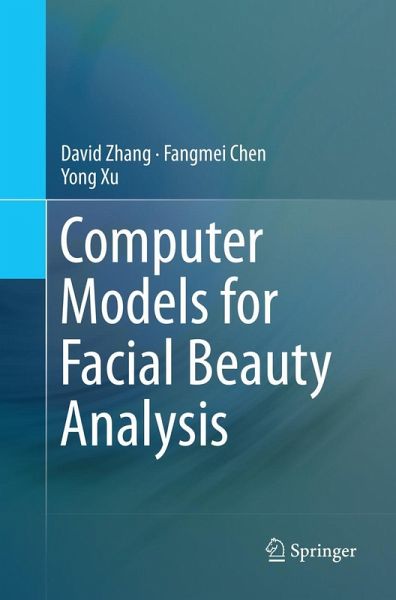
This book covers the key advances in computerized facial beauty analysis, with an emphasis on data-driven research and the results of quantitative experiments. It takes a big step toward practical facial beauty analysis, proposes more reliable and stable facial features for beauty analysis and designs new models, methods, algorithms and schemes while implementing a facial beauty analysis and beautification system. This book also tests some previous putative rules and models for facial beauty analysis by using computationally efficient mathematical models and algorithms, especially large scale…mehr
This book covers the key advances in computerized facial beauty analysis, with an emphasis on data-driven research and the results of quantitative experiments. It takes a big step toward practical facial beauty analysis, proposes more reliable and stable facial features for beauty analysis and designs new models, methods, algorithms and schemes while implementing a facial beauty analysis and beautification system. This book also tests some previous putative rules and models for facial beauty analysis by using computationally efficient mathematical models and algorithms, especially large scale database-based and repeatable experiments.The first section of this book provides an overview of facial beauty analysis. The base of facial beauty analysis, i.e., facial beauty features, is presented in part two. Part three describes hypotheses on facial beauty, while part four defines data-driven facial beauty analysis models. This book concludes with the authors explaining how toimplement their new facial beauty analysis system.This book is designed for researchers, professionals and post graduate students working in the field of facial beauty analysis, computer vision, human-machine interface, pattern recognition and biometrics. Those involved in interdisciplinary fields with also find the contents useful. The ideas, means and conclusions for beauty analysis are valuable for researchers and the system design and implementation can be used as models for practitioners and engineers.
David Zhang (Life Fellow, IEEE) graduated from Peking University, Beijing, China, in 1974, and received the first Ph.D. degree in computer science from Harbin Institute of Technology, Harbin, China, in 1985, and the second Ph.D. degree in electrical and computer engineering from the University of Waterloo, Waterloo, ON, Canada, in 1994. He has been a Chair Professor at The Hong Kong Polytechnic University, Hong Kong, where he was the Founding Director of the Biometrics Research Centre (UGC/CRC), supported by the Hong Kong SAR Government since 1998. He is currently a Distinguished Presidential Chair Professor at The Chinese University of Hong Kong (CUHK-Shenzhen), Shenzhen, China. He has been working on pattern recognition, image processing, and biometrics, creating various famous directions, including medical biometrics and computerized TCM. Prof. Zhang has been selected as a fellow of the Royal Society of Canada (RSC) and the Canadian Academy of Engineering (CAE). He is also a Croucher Senior Research Fellow, a Distinguished Speaker of the IEEE Computer Society, and an IAPR and AAIA Fellow. He has been listed as a Global Highly Cited Researcher in Engineering by Clarivate Analytics for eight years. He is also ranked 70th with H-Index 133 in the Top 1000 Scientists for International Computer Science in 2023. Dandan Fan received the B.S. degree in mechanical design and manufacturing and automation from Southwest Jiaotong University, Cheng Du, in 2013, the M.S. degree in software engineering from Xi’an Jiaotong University, Xi’an, in 2019. She is currently pursuing the Ph.D. degree with School of Data Science, the Chinese University of Hong Kong (Shenzhen), Shenzhen. Her current research interests include biometrics and computer vision. Xu Liang received the B.S. degree in communication engineering from China University of Geosciences, Wu Han, in 2012, the M.S. and Ph.D. degrees in computer science and technology from Harbin Institute of Technology, Shenzhen, China, in 2016 and 2023, respectively. From 2016 to 2017, he was a Research Assistant with the Biometrics Research Centre, Hong Kong Polytechnic University. He is currently an Associate Professor with the School of Software, Northwestern Polytechnical University, Xi'an, China. His research interests include biometrics and computer vision. Bob Zhang (Senior Member, IEEE) received the Ph.D. degree in electrical and computer engineering from the University of Waterloo, Waterloo, ON, Canada, in 2011. After graduating from the University of Waterloo, he remained with the Center for Pattern Recognition and Machine Intelligence, and later he was a Postdoctoral Researcher with the Department of Electrical and Computer Engineering, Carnegie Mellon University, Pittsburgh, PA, USA. He is currently an Associate Professor with the Department of Computer and Information Science, University of Macau, Macau. His research interests include biometrics, pattern recognition, and image processing. He is a Technical Committee Member of the IEEE Systems, Man, and Cybernetics Society and Associate Editors of IEEE Transactions on Image Processing, IEEE Transactions on Systems, Man, and Cybernetics: Systems, IEEE Transactions on Neural Networks and Learning Systems, and Artificial Intelligence Review.
Inhaltsangabe
Overview.- Typical Facial Beauty Analysis.- Facial Landmark Model Designs.- Geometrics Facial Beauty Study.- Putative Ratio Rules for Facial Beauty.- Beauty Analysis Fusion Model of Texture and Geometric Features.- Optimal Feature Set for Facial Beauty Analysis.- Examination of Averageness Hypothesis on Large Database.- A New Hypothesis on Facial Beauty Perception.- Beauty Analysis by Learning Machine and Subspace Extension.- Combining a Causal Effect Criterion for Evaluation of Facial Beauty Models.- Data-Driven Facial Beauty Analysis: Prediction, Retrieval and Manipulation.- A Facial Beauty Analysis Simulation System.- Book Review and Future Work.
Overview.- Typical Facial Beauty Analysis.- Facial Landmark Model Designs.- Geometrics Facial Beauty Study.- Putative Ratio Rules for Facial Beauty.- Beauty Analysis Fusion Model of Texture and Geometric Features.- Optimal Feature Set for Facial Beauty Analysis.- Examination of Averageness Hypothesis on Large Database.- A New Hypothesis on Facial Beauty Perception.- Beauty Analysis by Learning Machine and Subspace Extension.- Combining a Causal Effect Criterion for Evaluation of Facial Beauty Models.- Data-Driven Facial Beauty Analysis: Prediction, Retrieval and Manipulation.- A Facial Beauty Analysis Simulation System.- Book Review and Future Work.
Es gelten unsere Allgemeinen Geschäftsbedingungen: www.buecher.de/agb
Impressum
www.buecher.de ist ein Internetauftritt der buecher.de internetstores GmbH
Geschäftsführung: Monica Sawhney | Roland Kölbl | Günter Hilger
Sitz der Gesellschaft: Batheyer Straße 115 - 117, 58099 Hagen
Postanschrift: Bürgermeister-Wegele-Str. 12, 86167 Augsburg
Amtsgericht Hagen HRB 13257
Steuernummer: 321/5800/1497
USt-IdNr: DE450055826