Jonathan Hill / Barbara Maughan (eds.)
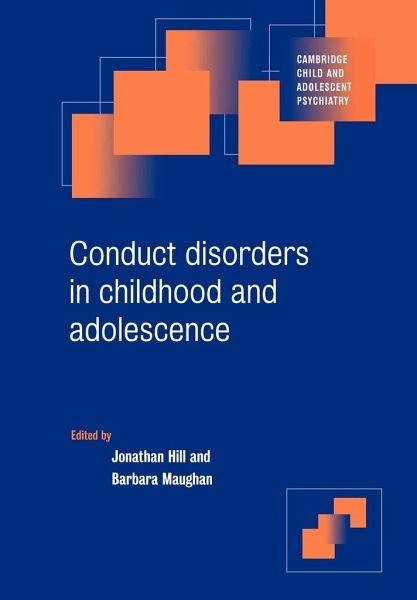
Conduct Disorders in Childhood and Adolescence
Herausgeber: Hill, Jonathan; Goodyer, Ian M.; Maughan, Barbara
Jonathan Hill / Barbara Maughan (eds.)
Conduct Disorders in Childhood and Adolescence
Herausgeber: Hill, Jonathan; Goodyer, Ian M.; Maughan, Barbara
- Broschiertes Buch
- Merkliste
- Auf die Merkliste
- Bewerten Bewerten
- Teilen
- Produkt teilen
- Produkterinnerung
- Produkterinnerung
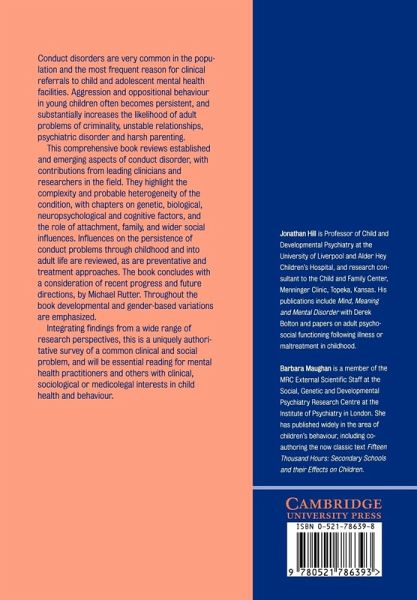
Uniquely authoritative, comprehensive and multidisciplinary, this survey is essential reading for all clinicians and professionals working in child health.
Andere Kunden interessierten sich auch für
Graeme J. TaylorDisorders of Affect Regulation114,99 €
M. Hodapp / A. Burack / Edward Zigler (eds.)Issues in the Developmental Approach to Mental Retardation119,99 €
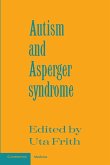
Uta Frith (ed.)Autism and Asperger Syndrome90,99 €
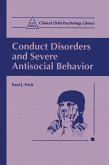
Paul J FrickConduct Disorders and Severe Antisocial Behavior92,99 €
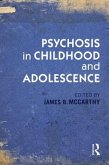
Psychosis in Childhood and Adolescence47,99 €
Regina Morantz-SanchezConduct Unbecoming a Woman51,99 €
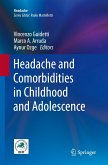
Headache and Comorbidities in Childhood and Adolescence83,99 €-
-
-
Uniquely authoritative, comprehensive and multidisciplinary, this survey is essential reading for all clinicians and professionals working in child health.
Produktdetails
- Produktdetails
- Verlag: Cambridge University Press
- Seitenzahl: 596
- Erscheinungstermin: 31. März 2006
- Englisch
- Abmessung: 244mm x 170mm x 32mm
- Gewicht: 1014g
- ISBN-13: 9780521786393
- ISBN-10: 0521786398
- Artikelnr.: 21602786
- Herstellerkennzeichnung
- Libri GmbH
- Europaallee 1
- 36244 Bad Hersfeld
- gpsr@libri.de
- Verlag: Cambridge University Press
- Seitenzahl: 596
- Erscheinungstermin: 31. März 2006
- Englisch
- Abmessung: 244mm x 170mm x 32mm
- Gewicht: 1014g
- ISBN-13: 9780521786393
- ISBN-10: 0521786398
- Artikelnr.: 21602786
- Herstellerkennzeichnung
- Libri GmbH
- Europaallee 1
- 36244 Bad Hersfeld
- gpsr@libri.de
List of contributors; Preface; 1. Bad behaviour: an historical perspective
on disorders of conduct E. Jane Costello and Adrian Angold; 2. Can the
study of 'normal' behaviour contribute to an understanding of conduct
disorder? Robert A. Hinde; 3. The development of children's conflict and
prosocial behaviour: lessons from research on social understanding and
gender Judy Dunn; 4. Neural mechanisms underlying aggressive behaviour Joe
Herbert and Manuela Martinez; 5. Biosocial influences on antisocial
behaviours in childhood and adolescence Jonathan Hill; 6. The epidemiology
of disorders of conduct: nosological issues and comorbidity Adrian Angold
and E. Jane Costello; 7. Conduct disorder in context Barbara Maughan; 8.
Genetic influences on conduct disorder Emily Simonoff; 9. The role of
neuropsychological deficits in conduct disorders Donald R. Lynam and Bill
Henry; 10. A reinforcement model of conduct problems in children and
adolescents: advances in theory and intervention Jeff Keisner, Thomas J.
Dishion and François Poulin; 11. Perceptual and attributional processes in
aggression and conduct problems Gregory S. Pettit, Jodi A. Polaha and
Jacquelyn Mize; 12. Attachment and conduct disorder Michelle DeKlyen and
Matthew L. Speltz; 13. Friends, friendships and conduct disorders Frank
Vitaro, Richard E. Tremblay and William Bukowski; 14. Discontinuities of
development, with particular emphasis on emotional and cognitive components
of disruptive behaviour Rolf Loeber and John Coie; 15. Treatment of conduct
disorders Alan E. Kazdin; 16. The prevention of conduct disorder: a review
of successful and unsuccessful experiments David LeMarquand, Richard E.
Tremblay and Frank Vitaro; 17. Economic evaluation and conduct disorders
Martin Knapp; 18. Antisocial children grown up Barbara Maughan and Michael
Rutter; 19. Conduct disorder: future directions. An afterword Michael
Rutter; Index.
on disorders of conduct E. Jane Costello and Adrian Angold; 2. Can the
study of 'normal' behaviour contribute to an understanding of conduct
disorder? Robert A. Hinde; 3. The development of children's conflict and
prosocial behaviour: lessons from research on social understanding and
gender Judy Dunn; 4. Neural mechanisms underlying aggressive behaviour Joe
Herbert and Manuela Martinez; 5. Biosocial influences on antisocial
behaviours in childhood and adolescence Jonathan Hill; 6. The epidemiology
of disorders of conduct: nosological issues and comorbidity Adrian Angold
and E. Jane Costello; 7. Conduct disorder in context Barbara Maughan; 8.
Genetic influences on conduct disorder Emily Simonoff; 9. The role of
neuropsychological deficits in conduct disorders Donald R. Lynam and Bill
Henry; 10. A reinforcement model of conduct problems in children and
adolescents: advances in theory and intervention Jeff Keisner, Thomas J.
Dishion and François Poulin; 11. Perceptual and attributional processes in
aggression and conduct problems Gregory S. Pettit, Jodi A. Polaha and
Jacquelyn Mize; 12. Attachment and conduct disorder Michelle DeKlyen and
Matthew L. Speltz; 13. Friends, friendships and conduct disorders Frank
Vitaro, Richard E. Tremblay and William Bukowski; 14. Discontinuities of
development, with particular emphasis on emotional and cognitive components
of disruptive behaviour Rolf Loeber and John Coie; 15. Treatment of conduct
disorders Alan E. Kazdin; 16. The prevention of conduct disorder: a review
of successful and unsuccessful experiments David LeMarquand, Richard E.
Tremblay and Frank Vitaro; 17. Economic evaluation and conduct disorders
Martin Knapp; 18. Antisocial children grown up Barbara Maughan and Michael
Rutter; 19. Conduct disorder: future directions. An afterword Michael
Rutter; Index.
List of contributors; Preface; 1. Bad behaviour: an historical perspective
on disorders of conduct E. Jane Costello and Adrian Angold; 2. Can the
study of 'normal' behaviour contribute to an understanding of conduct
disorder? Robert A. Hinde; 3. The development of children's conflict and
prosocial behaviour: lessons from research on social understanding and
gender Judy Dunn; 4. Neural mechanisms underlying aggressive behaviour Joe
Herbert and Manuela Martinez; 5. Biosocial influences on antisocial
behaviours in childhood and adolescence Jonathan Hill; 6. The epidemiology
of disorders of conduct: nosological issues and comorbidity Adrian Angold
and E. Jane Costello; 7. Conduct disorder in context Barbara Maughan; 8.
Genetic influences on conduct disorder Emily Simonoff; 9. The role of
neuropsychological deficits in conduct disorders Donald R. Lynam and Bill
Henry; 10. A reinforcement model of conduct problems in children and
adolescents: advances in theory and intervention Jeff Keisner, Thomas J.
Dishion and François Poulin; 11. Perceptual and attributional processes in
aggression and conduct problems Gregory S. Pettit, Jodi A. Polaha and
Jacquelyn Mize; 12. Attachment and conduct disorder Michelle DeKlyen and
Matthew L. Speltz; 13. Friends, friendships and conduct disorders Frank
Vitaro, Richard E. Tremblay and William Bukowski; 14. Discontinuities of
development, with particular emphasis on emotional and cognitive components
of disruptive behaviour Rolf Loeber and John Coie; 15. Treatment of conduct
disorders Alan E. Kazdin; 16. The prevention of conduct disorder: a review
of successful and unsuccessful experiments David LeMarquand, Richard E.
Tremblay and Frank Vitaro; 17. Economic evaluation and conduct disorders
Martin Knapp; 18. Antisocial children grown up Barbara Maughan and Michael
Rutter; 19. Conduct disorder: future directions. An afterword Michael
Rutter; Index.
on disorders of conduct E. Jane Costello and Adrian Angold; 2. Can the
study of 'normal' behaviour contribute to an understanding of conduct
disorder? Robert A. Hinde; 3. The development of children's conflict and
prosocial behaviour: lessons from research on social understanding and
gender Judy Dunn; 4. Neural mechanisms underlying aggressive behaviour Joe
Herbert and Manuela Martinez; 5. Biosocial influences on antisocial
behaviours in childhood and adolescence Jonathan Hill; 6. The epidemiology
of disorders of conduct: nosological issues and comorbidity Adrian Angold
and E. Jane Costello; 7. Conduct disorder in context Barbara Maughan; 8.
Genetic influences on conduct disorder Emily Simonoff; 9. The role of
neuropsychological deficits in conduct disorders Donald R. Lynam and Bill
Henry; 10. A reinforcement model of conduct problems in children and
adolescents: advances in theory and intervention Jeff Keisner, Thomas J.
Dishion and François Poulin; 11. Perceptual and attributional processes in
aggression and conduct problems Gregory S. Pettit, Jodi A. Polaha and
Jacquelyn Mize; 12. Attachment and conduct disorder Michelle DeKlyen and
Matthew L. Speltz; 13. Friends, friendships and conduct disorders Frank
Vitaro, Richard E. Tremblay and William Bukowski; 14. Discontinuities of
development, with particular emphasis on emotional and cognitive components
of disruptive behaviour Rolf Loeber and John Coie; 15. Treatment of conduct
disorders Alan E. Kazdin; 16. The prevention of conduct disorder: a review
of successful and unsuccessful experiments David LeMarquand, Richard E.
Tremblay and Frank Vitaro; 17. Economic evaluation and conduct disorders
Martin Knapp; 18. Antisocial children grown up Barbara Maughan and Michael
Rutter; 19. Conduct disorder: future directions. An afterword Michael
Rutter; Index.