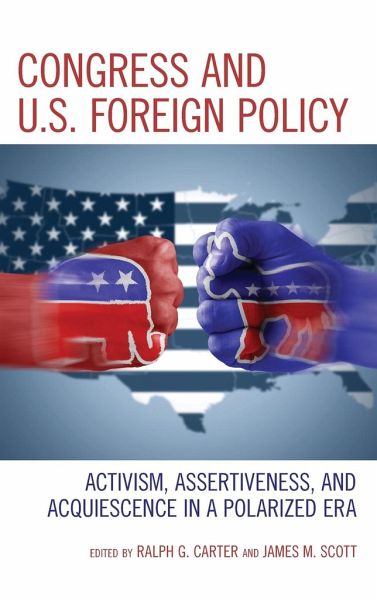
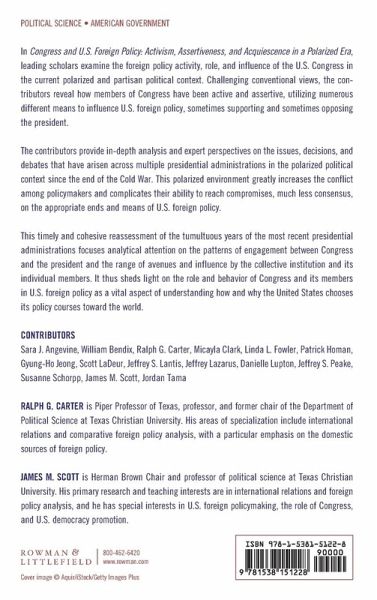
Leading scholars in the study of congress and US foreign policy address congress's vital role in determining how and why the US chooses it's international policy agendas. They address key aspects of congressional activism, assertiveness, and acquiescence in an era of divided government and polarized politics.
Leading scholars in the study of congress and US foreign policy address congress's vital role in determining how and why the US chooses it's international policy agendas. They address key aspects of congressional activism, assertiveness, and acquiescence in an era of divided government and polarized politics.
Ralph G. Carter is Piper Professor of Texas, professor, and former chair of the department of Political Science at Texas Christian University. His areas of specialization include international relations and comparative foreign policy analysis, with a particular emphasis on the domestic sources of foreign policy. James M. Scott is the Herman Brown chair and professor of Political Science at Texas Christian University. His primary research and teaching interests are in international relations and foreign policy analysis, and he has special interests in US foreign policymaking, the role of Congress, and US democracy promotion.
Inhaltsangabe
Introduction: Understanding Congress and Foreign Policy Ralph G. Carter and James M. Scott Chapter 1 - Shifting Constellations of Congressional Foreign Policy During the Trump Era Patrick Homan, Dominican University, and Scott LaDeur, North Central Michigan College Chapter 2 - Anti-Presidential Bipartisanship in Foreign Policy in the Trump Era Jordan Tama, American University Chapter 3 - The Polarization of the Defense and Foreign Policy Committees William Bendix, Keene State College and Gyung-Ho Jeong, University of British Columbia Chapter 4 - The Continued Decline of Congressional Oversight of US Foreign Policy Linda L. Fowler, Dartmouth College Chapter 5 - The Conditional Nature of Congressional Support for the President During Wartime Susanne Schorpp, Jeffrey Lazarus, and Micayla Clark, Georgia State University Chapter 6 - The Congressional Role in US Diplomacy in an Era of Presidential Unilateralism: The End of the Treaty Power Jeffrey S. Peake, Clemson University Chapter 7 - Opening Wi
Introduction: Understanding Congress and Foreign Policy Ralph G. Carter and James M. Scott Chapter 1 - Shifting Constellations of Congressional Foreign Policy During the Trump Era Patrick Homan, Dominican University, and Scott LaDeur, North Central Michigan College Chapter 2 - Anti-Presidential Bipartisanship in Foreign Policy in the Trump Era Jordan Tama, American University Chapter 3 - The Polarization of the Defense and Foreign Policy Committees William Bendix, Keene State College and Gyung-Ho Jeong, University of British Columbia Chapter 4 - The Continued Decline of Congressional Oversight of US Foreign Policy Linda L. Fowler, Dartmouth College Chapter 5 - The Conditional Nature of Congressional Support for the President During Wartime Susanne Schorpp, Jeffrey Lazarus, and Micayla Clark, Georgia State University Chapter 6 - The Congressional Role in US Diplomacy in an Era of Presidential Unilateralism: The End of the Treaty Power Jeffrey S. Peake, Clemson University Chapter 7 - Opening Wi
Es gelten unsere Allgemeinen Geschäftsbedingungen: www.buecher.de/agb
Impressum
www.buecher.de ist ein Internetauftritt der buecher.de internetstores GmbH
Geschäftsführung: Monica Sawhney | Roland Kölbl | Günter Hilger
Sitz der Gesellschaft: Batheyer Straße 115 - 117, 58099 Hagen
Postanschrift: Bürgermeister-Wegele-Str. 12, 86167 Augsburg
Amtsgericht Hagen HRB 13257
Steuernummer: 321/5800/1497
USt-IdNr: DE450055826