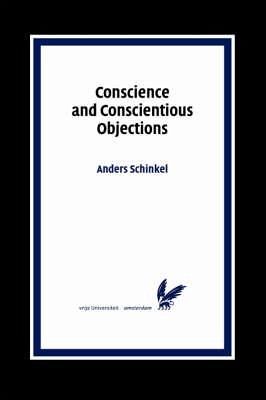
In Western countries conscientious objection is usually accommodated in various ways, at least in certain areas (military conscription, medicine) and to some extent. It appears to be regarded as fundamentally different from other kinds of objection. But why? This study argues that conscientious objection cannot be understood as long as conscience is misunderstood. The author provides a new interpretation of the historical development of expressions of conscience and thought on the subject, and offers a new approach to conscientious objection rooted in the symbol-approach to conscience.
In Western countries conscientious objection is usually accommodated in various ways, at least in certain areas (military conscription, medicine) and to some extent. It appears to be regarded as fundamentally different from other kinds of objection. But why? This study argues that conscientious objection cannot be understood as long as conscience is misunderstood. The author provides a new interpretation of the historical development of expressions of conscience and thought on the subject, and offers a new approach to conscientious objection rooted in the symbol-approach to conscience.
Dr. Anders Schinkel is a historian and philosopher. His publications span the philosophy of history, ethics, and sociology. One of the main foci of his present research lies in the field of animal ethics.
Inhaltsangabe
Preface General Introduction About this book Reality consciousness and language The theory of symbols Method Ch.1: The symbol of conscience Ch. 2: Between symbol and doctrine: the conceptualization of conscience until the early Middle Ages Ch.3: Between symbol and doctrine: differentiation and doctrinalization - the religious conscience before and after the Reformation h. 4: Between symbol and doctrine: the first wave of criticism - the seventeenth century Ch. 5:Between symbol and doctrine: Conscience grounded in Nature and Reason Ch. 6: Between symbol and doctrine: the second wave of criticism - the nineteenth century Ch. 7: Twentieth-century concepts of conscience Ch. 8: A fluid concept of conscience Ch. 9: Conscience and freedom of conscience Ch. 10: The problem of order Ch. 11: Between idealism and pragmatism Ch. 12: Solutions to the problem of order Ch. 13: Identifying conscientious objections Ch. 14: Conscie Ch. 15: Two case studies Ch. 16: Philosophical foundations of conscientious objection Concluding remarks References Samenvatting (Dutch summary)
Preface General Introduction About this book Reality consciousness and language The theory of symbols Method Ch.1: The symbol of conscience Ch. 2: Between symbol and doctrine: the conceptualization of conscience until the early Middle Ages Ch.3: Between symbol and doctrine: differentiation and doctrinalization - the religious conscience before and after the Reformation h. 4: Between symbol and doctrine: the first wave of criticism - the seventeenth century Ch. 5:Between symbol and doctrine: Conscience grounded in Nature and Reason Ch. 6: Between symbol and doctrine: the second wave of criticism - the nineteenth century Ch. 7: Twentieth-century concepts of conscience Ch. 8: A fluid concept of conscience Ch. 9: Conscience and freedom of conscience Ch. 10: The problem of order Ch. 11: Between idealism and pragmatism Ch. 12: Solutions to the problem of order Ch. 13: Identifying conscientious objections Ch. 14: Conscie Ch. 15: Two case studies Ch. 16: Philosophical foundations of conscientious objection Concluding remarks References Samenvatting (Dutch summary)
Es gelten unsere Allgemeinen Geschäftsbedingungen: www.buecher.de/agb
Impressum
www.buecher.de ist ein Internetauftritt der buecher.de internetstores GmbH
Geschäftsführung: Monica Sawhney | Roland Kölbl | Günter Hilger
Sitz der Gesellschaft: Batheyer Straße 115 - 117, 58099 Hagen
Postanschrift: Bürgermeister-Wegele-Str. 12, 86167 Augsburg
Amtsgericht Hagen HRB 13257
Steuernummer: 321/5800/1497
USt-IdNr: DE450055826