Wolfgang Baer (USA Nascent Systems Inc)
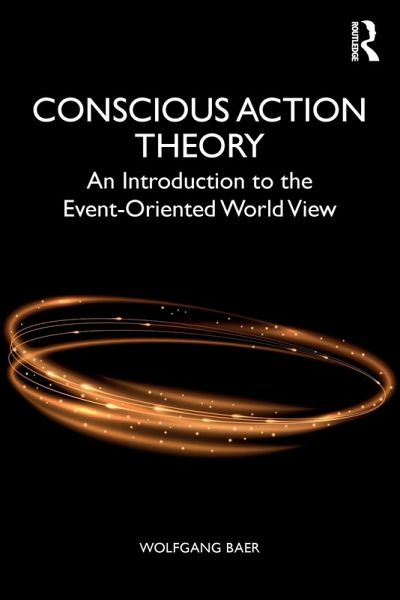
Conscious Action Theory
An Introduction to the Event-Oriented World View
Wolfgang Baer (USA Nascent Systems Inc)
Conscious Action Theory
An Introduction to the Event-Oriented World View
- Broschiertes Buch
- Merkliste
- Auf die Merkliste
- Bewerten Bewerten
- Teilen
- Produkt teilen
- Produkterinnerung
- Produkterinnerung
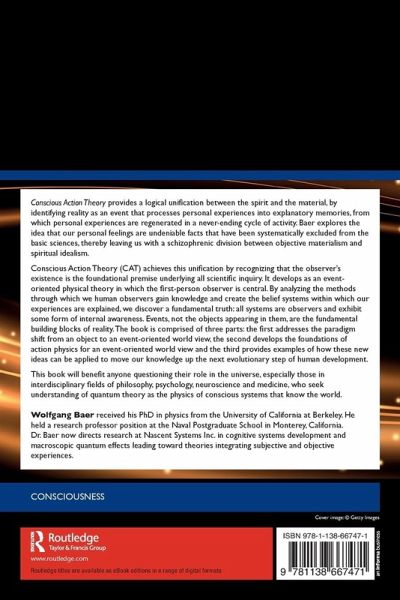
Introduction to Conscious Action Theory presents an original and thought-provoking theory of consciousness.
Andere Kunden interessierten sich auch für
E.J SquiresConscious Mind in the Physical World68,99 €
Conscious and Unconscious Mentality61,99 €
David M. Buss (USA University of Texas at Austin)Evolutionary Psychology322,99 €
David BohmScience, Order and Creativity30,99 €
David BohmThe Undivided Universe56,99 €
Developmental Science130,99 €
David BohmWholeness and the Implicate Order18,99 €-
-
-
Introduction to Conscious Action Theory presents an original and thought-provoking theory of consciousness.
Produktdetails
- Produktdetails
- Verlag: Taylor & Francis Ltd
- Seitenzahl: 366
- Erscheinungstermin: 13. November 2019
- Englisch
- Abmessung: 234mm x 156mm x 20mm
- Gewicht: 554g
- ISBN-13: 9781138667471
- ISBN-10: 1138667471
- Artikelnr.: 58293215
- Herstellerkennzeichnung
- Libri GmbH
- Europaallee 1
- 36244 Bad Hersfeld
- gpsr@libri.de
- Verlag: Taylor & Francis Ltd
- Seitenzahl: 366
- Erscheinungstermin: 13. November 2019
- Englisch
- Abmessung: 234mm x 156mm x 20mm
- Gewicht: 554g
- ISBN-13: 9781138667471
- ISBN-10: 1138667471
- Artikelnr.: 58293215
- Herstellerkennzeichnung
- Libri GmbH
- Europaallee 1
- 36244 Bad Hersfeld
- gpsr@libri.de
Wolfgang Baer received his PhD in physics from the University of California at Berkeley. He held a research professor position at the Naval Postgraduate School in Monterey, California. Dr. Baer now directs research at Nascent Systems Inc. in cognitive systems development and macroscopic quantum effects leading toward theories integrating subjective and objective experiences.
Prologue
PART I - The event-oriented world view
1. Introduction to the event-oriented world view
2. Conscious operations in the 1st-person perspective
PART II - Modeling reality
3. How to build a conscious action model
4. The action model
5. The quantum and classic approximation
PART III - Implications and applications
6. Model of a conscious being
7. Applications in artificial intelligence and neuroscience
8. Philosophy, psychology and religion
9. Future development
APPENDICES
A3.1 - Definition of terms
A4.1 - Applicability of mathematical idealizations in physics
A4.2 - Action theory in isolated systems
A4.3 - Mach's Principle and gravito-inertial and electromagnetic equation
analogy
A5.1 - Simple derivation of the wave equation
A5.2 - Action-flow diagrams in quantum nomenclature
References and Notes
Index

PART I - The event-oriented world view
1. Introduction to the event-oriented world view
2. Conscious operations in the 1st-person perspective
PART II - Modeling reality
3. How to build a conscious action model
4. The action model
5. The quantum and classic approximation
PART III - Implications and applications
6. Model of a conscious being
7. Applications in artificial intelligence and neuroscience
8. Philosophy, psychology and religion
9. Future development
APPENDICES
A3.1 - Definition of terms
A4.1 - Applicability of mathematical idealizations in physics
A4.2 - Action theory in isolated systems
A4.3 - Mach's Principle and gravito-inertial and electromagnetic equation
analogy
A5.1 - Simple derivation of the wave equation
A5.2 - Action-flow diagrams in quantum nomenclature
References and Notes
Index
Prologue
PART I - The event-oriented world view
1. Introduction to the event-oriented world view
2. Conscious operations in the 1st-person perspective
PART II - Modeling reality
3. How to build a conscious action model
4. The action model
5. The quantum and classic approximation
PART III - Implications and applications
6. Model of a conscious being
7. Applications in artificial intelligence and neuroscience
8. Philosophy, psychology and religion
9. Future development
APPENDICES
A3.1 - Definition of terms
A4.1 - Applicability of mathematical idealizations in physics
A4.2 - Action theory in isolated systems
A4.3 - Mach's Principle and gravito-inertial and electromagnetic equation
analogy
A5.1 - Simple derivation of the wave equation
A5.2 - Action-flow diagrams in quantum nomenclature
References and Notes
Index
PART I - The event-oriented world view
1. Introduction to the event-oriented world view
2. Conscious operations in the 1st-person perspective
PART II - Modeling reality
3. How to build a conscious action model
4. The action model
5. The quantum and classic approximation
PART III - Implications and applications
6. Model of a conscious being
7. Applications in artificial intelligence and neuroscience
8. Philosophy, psychology and religion
9. Future development
APPENDICES
A3.1 - Definition of terms
A4.1 - Applicability of mathematical idealizations in physics
A4.2 - Action theory in isolated systems
A4.3 - Mach's Principle and gravito-inertial and electromagnetic equation
analogy
A5.1 - Simple derivation of the wave equation
A5.2 - Action-flow diagrams in quantum nomenclature
References and Notes
Index