
Andere Kunden interessierten sich auch für
 Applications of Remote Sensing to Agrometeorology153,99 €
 Northern Boundary of the United States27,99 €
managing Trans-boundary Resources of the Sesan River, Lower Mekong") Mis)managing Trans-boundary Resources of the Sesan River, Lower Mekong52,99 €
Mis)managing Trans-boundary Resources of the Sesan River, Lower Mekong52,99 € Boundary Layer Climates235,99 €
 Boundary Waters Canoe Area Wilderness26,99 €
 The Benthic Boundary Layer39,99 €
 Remote Sensing38,99 €

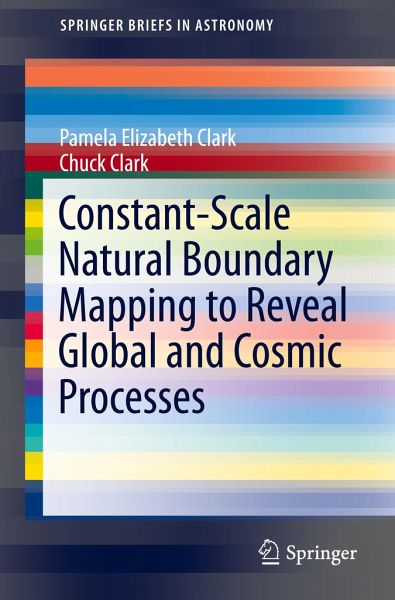
Whereas conventional maps can be expressed as outward-expanding formulae with well-defined central features and relatively poorly defined edges, Constant Scale Natural Boundary (CSNB) maps have well-defined boundaries that result from natural processes and thus allow spatial and dynamic relationships to be observed in a new way useful to understanding these processes. CSNB mapping presents a new approach to visualization that produces maps markedly different from those produced by conventional cartographic methods.
In this approach, any body can be represented by a 3D coordinate system. For a regular body, with its surface relatively smooth on the scale of its size, locations of features can be represented by definite geographic grid (latitude and longitude) and elevation, or deviation from the triaxial ellipsoid defined surface. A continuous surface on this body can be segmented, its distinctive regional terranes enclosed, and their inter-relationships defined, by using selected morphologically identifiable relief features (e.g., continental divides, plate boundaries, river or current systems). In this way, regions of distinction on a large, essentially spherical body can be mapped as two-dimensional 'facets' with their boundaries representing regional to global-scale asymmetries (e.g., continental crust, continental and oceanic crust on the Earth, farside original thicker crust and nearside thinner impact punctuated crust on the Moon). In an analogous manner, an irregular object such as an asteroid, with a surface that is rough on the scale of its size, would be logically segmented along edges of its impact-generated faces.
Bounded faces are imagined with hinges at occasional points along boundaries, resulting in a foldable 'shape model.' Thus, bounded faces grow organically out of the most compelling natural features. Obvious boundaries control the map's extremities, and peripheral regions are not dismembered or grosslydistorted as in conventional map projections. 2D maps and 3D models grow out of an object's most obvious face or terrane 'edges,' instead of arbitrarily by imposing a regular grid system or using regularly shaped facets to represent an irregular surface.
In this approach, any body can be represented by a 3D coordinate system. For a regular body, with its surface relatively smooth on the scale of its size, locations of features can be represented by definite geographic grid (latitude and longitude) and elevation, or deviation from the triaxial ellipsoid defined surface. A continuous surface on this body can be segmented, its distinctive regional terranes enclosed, and their inter-relationships defined, by using selected morphologically identifiable relief features (e.g., continental divides, plate boundaries, river or current systems). In this way, regions of distinction on a large, essentially spherical body can be mapped as two-dimensional 'facets' with their boundaries representing regional to global-scale asymmetries (e.g., continental crust, continental and oceanic crust on the Earth, farside original thicker crust and nearside thinner impact punctuated crust on the Moon). In an analogous manner, an irregular object such as an asteroid, with a surface that is rough on the scale of its size, would be logically segmented along edges of its impact-generated faces.
Bounded faces are imagined with hinges at occasional points along boundaries, resulting in a foldable 'shape model.' Thus, bounded faces grow organically out of the most compelling natural features. Obvious boundaries control the map's extremities, and peripheral regions are not dismembered or grosslydistorted as in conventional map projections. 2D maps and 3D models grow out of an object's most obvious face or terrane 'edges,' instead of arbitrarily by imposing a regular grid system or using regularly shaped facets to represent an irregular surface.