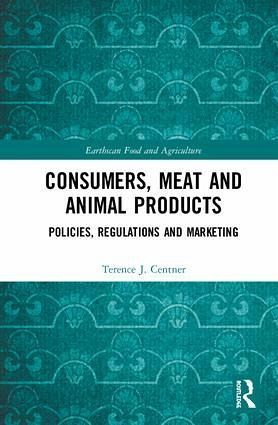
This book addresses the production practices being employed in the production of food animals and animal products, that enable marketers to sell a variety of products to meet consumer demand.
This book addresses the production practices being employed in the production of food animals and animal products, that enable marketers to sell a variety of products to meet consumer demand.
Terence J. Centner is a Professor of Practice in the Institute of Agriculture and Natural Resources and Adjunct Professor in the College of Law at the University of Nebraska, Lincoln, USA. He teaches law courses and engages in research involving issues confronting agriculture and the environment. He is also Professor Emeritus at the University of Georgia, USA. Professor Centner has served as an Alexander von Humboldt Stiftung research fellow at the University of Göttingen, Germany; a Fulbright Scholar at the University of Mannheim, Germany; and a Fulbright-Scotland visiting professor at the University of Aberdeen, UK. He has lectured in 50 countries around the world.
Inhaltsangabe
Part I Safety and the Industry 1. Introduction 2. Providing Safe Products and Food Safety 3. The Meat Industry Part II Concerns about Animal Production Facilities 4. Producing Beef, Dairy, and Pork Products 5. The Production of Chickens 6. Wild and Farm-Raised Seafood 7. The Humane Treatment of Food Animals 8. Providing Animals Sufficient Space Part III Consumer Information on Inputs 9. Objecting to Antibiotics 10. Controversies with Hormones 11. Health Concerns with Beta Agonist Feed Additives 12. Pesticides Used in Animal Production 13. Selective Breeding and Animal Cloning 14. Labeling Genetically Engineered Plants and Animals Part IV Marketing and Social Issues 15. Providing Information on Production Practices and Inputs 16. Organic Products 17. Locally Grown Products 18. Animal Waste Management 19. Nuisances and Product Disparagement 20. Conclusions
Part I Safety and the Industry 1. Introduction 2. Providing Safe Products and Food Safety 3. The Meat Industry Part II Concerns about Animal Production Facilities 4. Producing Beef, Dairy, and Pork Products 5. The Production of Chickens 6. Wild and Farm-Raised Seafood 7. The Humane Treatment of Food Animals 8. Providing Animals Sufficient Space Part III Consumer Information on Inputs 9. Objecting to Antibiotics 10. Controversies with Hormones 11. Health Concerns with Beta Agonist Feed Additives 12. Pesticides Used in Animal Production 13. Selective Breeding and Animal Cloning 14. Labeling Genetically Engineered Plants and Animals Part IV Marketing and Social Issues 15. Providing Information on Production Practices and Inputs 16. Organic Products 17. Locally Grown Products 18. Animal Waste Management 19. Nuisances and Product Disparagement 20. Conclusions
Es gelten unsere Allgemeinen Geschäftsbedingungen: www.buecher.de/agb
Impressum
www.buecher.de ist ein Internetauftritt der buecher.de internetstores GmbH
Geschäftsführung: Monica Sawhney | Roland Kölbl | Günter Hilger
Sitz der Gesellschaft: Batheyer Straße 115 - 117, 58099 Hagen
Postanschrift: Bürgermeister-Wegele-Str. 12, 86167 Augsburg
Amtsgericht Hagen HRB 13257
Steuernummer: 321/5800/1497
USt-IdNr: DE450055826