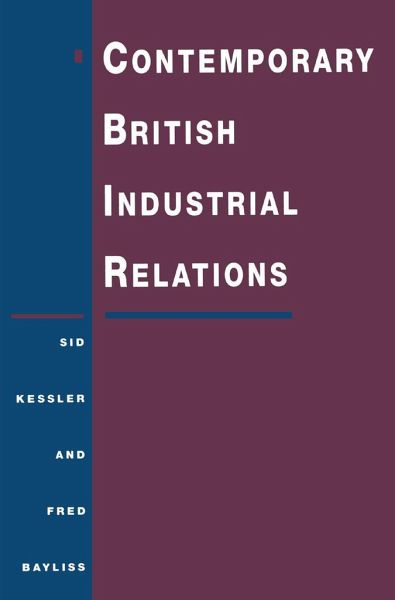
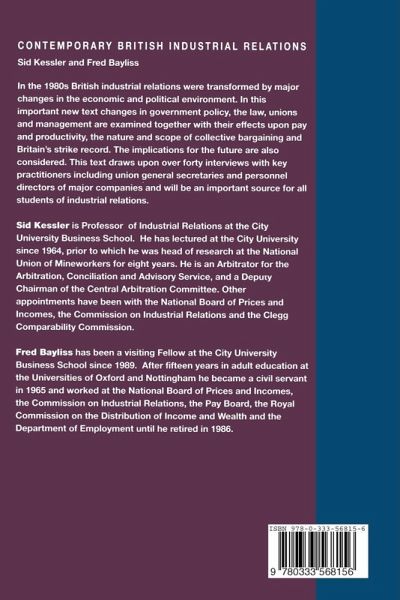
An examination of contemporary British industrial relations from the early post-war decades (1945-70) to the present. The book looks at the relationship between the law and industrial relations and employer and management strategies in the private sector.
An examination of contemporary British industrial relations from the early post-war decades (1945-70) to the present. The book looks at the relationship between the law and industrial relations and employer and management strategies in the private sector.
Part 1 The early post-war decades, 1945-70: the Donovan commission; the commission on industrial relations. Part 2 The 1970s: 1970-74 incomes policy - industrial relations and the law; consequences of the 1971 act; 1974-79 - incomes policy - industrial relations and the law; trade unions and employers. Part 3 The economic background: output and productivity; employment and unemployment; inflation; earnings; labour costs per unit; monetary and fiscal policy; distribution of national income; balance of payments. Part 4 Government values and policies: full employment; inflations; public expenditure and the welfare state; de-regulation; the role of the individual; reducing the public sector; the trade unions; the employers. Part 5 The law and industrial relations: 1980 Employment Act; 1982 Employment Act; 1984 Trade Union Act; 1986 Wages Act; 1986 Sex Discrimination Act; 1988 Employment Act; 1989 Employment Act; 1990 Employment Act; the use of law; secondary action; picketing; balloting; other legal matters. Part 6 Employer and management strategies in the private sector: human resource management and management style; attitudes to unions; collective bargaining; involvement, consultation and participation; flexibility; levels and methods of remuneration. Part 7 Government as employer and quasi-employer: the civil service; local government; teachers; the national health service; the nationalized industries; declining industries - coal, railways, steel; expanding industries - electricity, gas, the post office, British Telecom. Part 8 Trade unions: trade union membership; union mergers; trade union finances and organization; trade unions and their members; trade unions and employers; the TUC; the TUC and affiliated unions; the TUC and government; reaction to legislation; unions and the Labour Party; unions and the European community. Part 9 The institutions of industrial relations: employers' associations; collective bargaining - recognition and bargaining agents, bargaining unit level and scope, productivity bargaining; third party intervention; joint consultation. Part 10 Pay and productivity: government objectives and policy; the growth of earnings; distribution of earnings; earnings by occupation; earnings by industry; public sector pay; regional pay; productivity; labour costs per unit of output. (Part contents).
Part 1 The early post-war decades, 1945-70: the Donovan commission; the commission on industrial relations. Part 2 The 1970s: 1970-74 incomes policy - industrial relations and the law; consequences of the 1971 act; 1974-79 - incomes policy - industrial relations and the law; trade unions and employers. Part 3 The economic background: output and productivity; employment and unemployment; inflation; earnings; labour costs per unit; monetary and fiscal policy; distribution of national income; balance of payments. Part 4 Government values and policies: full employment; inflations; public expenditure and the welfare state; de-regulation; the role of the individual; reducing the public sector; the trade unions; the employers. Part 5 The law and industrial relations: 1980 Employment Act; 1982 Employment Act; 1984 Trade Union Act; 1986 Wages Act; 1986 Sex Discrimination Act; 1988 Employment Act; 1989 Employment Act; 1990 Employment Act; the use of law; secondary action; picketing; balloting; other legal matters. Part 6 Employer and management strategies in the private sector: human resource management and management style; attitudes to unions; collective bargaining; involvement, consultation and participation; flexibility; levels and methods of remuneration. Part 7 Government as employer and quasi-employer: the civil service; local government; teachers; the national health service; the nationalized industries; declining industries - coal, railways, steel; expanding industries - electricity, gas, the post office, British Telecom. Part 8 Trade unions: trade union membership; union mergers; trade union finances and organization; trade unions and their members; trade unions and employers; the TUC; the TUC and affiliated unions; the TUC and government; reaction to legislation; unions and the Labour Party; unions and the European community. Part 9 The institutions of industrial relations: employers' associations; collective bargaining - recognition and bargaining agents, bargaining unit level and scope, productivity bargaining; third party intervention; joint consultation. Part 10 Pay and productivity: government objectives and policy; the growth of earnings; distribution of earnings; earnings by occupation; earnings by industry; public sector pay; regional pay; productivity; labour costs per unit of output. (Part contents).
Es gelten unsere Allgemeinen Geschäftsbedingungen: www.buecher.de/agb
Impressum
www.buecher.de ist ein Internetauftritt der buecher.de internetstores GmbH
Geschäftsführung: Monica Sawhney | Roland Kölbl | Günter Hilger
Sitz der Gesellschaft: Batheyer Straße 115 - 117, 58099 Hagen
Postanschrift: Bürgermeister-Wegele-Str. 12, 86167 Augsburg
Amtsgericht Hagen HRB 13257
Steuernummer: 321/5800/1497
USt-IdNr: DE450055826