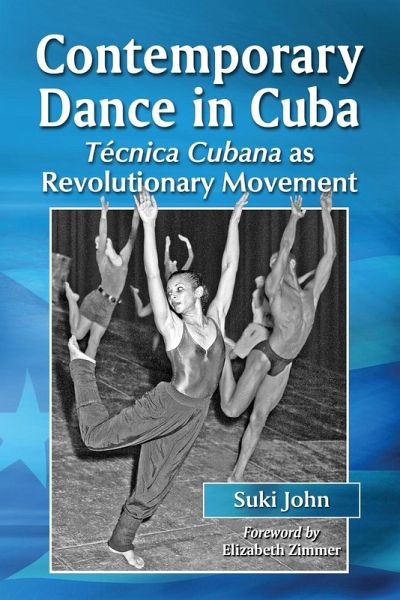
The lens of dance can provide a multifaceted view of the present-day Cuban experience. Cuban contemporary dance, or tecnica cubana as it is known throughout Latin America, is a highly evolved hybrid of ballet, North American modern dance, Afro-Cuban tradition, flamenco and Cuban nightclub cabaret. Unlike most dance forms, tecnica was created intentionally with government backing. For Cuba, a dancing country, it was natural--and highly effective--for the Revolutionary regime to link national image with the visceral power of dance. Written by a dancer who traveled and worked in Cuba from the…mehr
The lens of dance can provide a multifaceted view of the present-day Cuban experience. Cuban contemporary dance, or tecnica cubana as it is known throughout Latin America, is a highly evolved hybrid of ballet, North American modern dance, Afro-Cuban tradition, flamenco and Cuban nightclub cabaret. Unlike most dance forms, tecnica was created intentionally with government backing. For Cuba, a dancing country, it was natural--and highly effective--for the Revolutionary regime to link national image with the visceral power of dance. Written by a dancer who traveled and worked in Cuba from the 1970s to the present, this book provides an inside look at daily life in Cuba. From watching the great Alicia Alonso, to describing the economic trials of the 1990s "Special Period," the author uses history, humor, personal experience, rich description and extensive interviews to reveal contemporary life and dance in Cuba.
Suki John has published articles in the New York Times, Four Seasons Magazine, Village Voice, Dance Magazine, Pointe, Ballet-tanz International, The Oxford International Encyclopedia of Dance, Caribbean Dance, and Dance Research Journal. She has choreographed for Ballet Nacional de Cuba, Compania Narciso Medina, People's Yugoslav Theater, Danza Contemporanea de Cuba, Ritmo Flamenco, The 92nd St. Y, DIA Foundation, and The Culture Project. She is an associate professor in the School for Classical & Contemporary Dance, Texas Christian University.
Inhaltsangabe
Table of Contents Acknowledgments Foreword by Elizabeth Zimmer Preface Introduction Prologue: Havana 1973 1. An Island of Dance 2. Struggle and Sabor 3. Fidelistas and Yanquis 4. Birth of an Art Form: La Técnica Cubana 5. Cuban Dance Legacies 6. Cuban Ballet: Soviet Import or Sovereign School of Art? 7. La Técnica Cubana: Form and Function 8. Politics In-and Out of-the Studio 9. Color 10. Keeping the Gods at Bay 11. Ramiro Guerra: Técnica De-contextualized 12. Modern Dance: A Hearty, Subversive Hybrid 13. Personal Perspectives 14. International In uence Epilogue: 2011 Chapter Notes Bibliography Index
Table of Contents Acknowledgments Foreword by Elizabeth Zimmer Preface Introduction Prologue: Havana 1973 1. An Island of Dance 2. Struggle and Sabor 3. Fidelistas and Yanquis 4. Birth of an Art Form: La Técnica Cubana 5. Cuban Dance Legacies 6. Cuban Ballet: Soviet Import or Sovereign School of Art? 7. La Técnica Cubana: Form and Function 8. Politics In-and Out of-the Studio 9. Color 10. Keeping the Gods at Bay 11. Ramiro Guerra: Técnica De-contextualized 12. Modern Dance: A Hearty, Subversive Hybrid 13. Personal Perspectives 14. International In uence Epilogue: 2011 Chapter Notes Bibliography Index
Es gelten unsere Allgemeinen Geschäftsbedingungen: www.buecher.de/agb
Impressum
www.buecher.de ist ein Internetauftritt der buecher.de internetstores GmbH
Geschäftsführung: Monica Sawhney | Roland Kölbl | Günter Hilger
Sitz der Gesellschaft: Batheyer Straße 115 - 117, 58099 Hagen
Postanschrift: Bürgermeister-Wegele-Str. 12, 86167 Augsburg
Amtsgericht Hagen HRB 13257
Steuernummer: 321/5800/1497
USt-IdNr: DE450055826