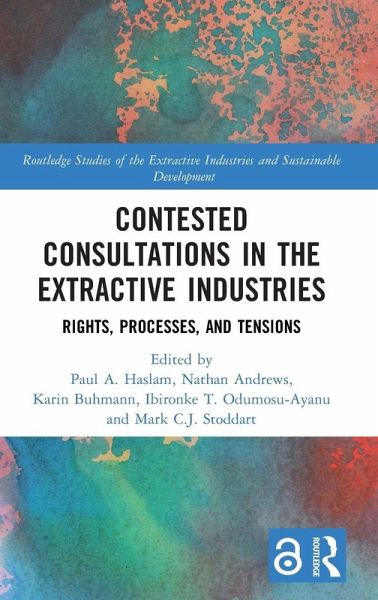
This volume explores how communities, companies, and governments contest and shape the evolution of norms, rules, and decision-making processes that govern stakeholder consultation in extractive industries. It will interest students and scholars researching public participation and stakeholder consultation in the extractive industries.
This volume explores how communities, companies, and governments contest and shape the evolution of norms, rules, and decision-making processes that govern stakeholder consultation in extractive industries. It will interest students and scholars researching public participation and stakeholder consultation in the extractive industries.
Paul A. Haslam is Professor of International Development and Global Studies at the University of Ottawa, Canada. Nathan Andrews is Associate Professor of Political Science at McMaster University, Canada. Karin Buhmann is Professor in Business and Human Rights at Copenhagen Business School, Denmark. Ibironke T. Odumosu-Ayanu is Professor and Associate Dean, Research and Graduate Studies at the College of Law, University of Saskatchewan, Canada. Mark C.J. Stoddart is Professor of Sociology at Memorial University, Canada.
Inhaltsangabe
INTRODUCTION: 1. Contested stakeholder consultations in global comparative perspective PART 1: UNDERSTANDING CONTESTATION 2. Consultation, Indigenous peoples and the extractive industries 3. Sustainable mining for whom? Agential Constructivist perspectives on global mining sector consultation regimes in Africa 4. Civil society and extractive company-community relations in Canada and Norway PART 2: THE CONSTESTED MEANINGS OF CONSULTATION 5. From consultation to consent: A potentially complex transition in the Indigenous rights context, and analogous implications for stakeholder consultation 6. Agreements, consultation, and consent in extractive projects 7. Rights-based approach to consultation with Indigenous Peoples in natural resource extraction 8. Indigenous governance, gender, and engagement with rights-holders: Lessons from Canada through environmental human rights PART 3: CONSULT HOW? PROCESSES FOR MEANINGFUL CONSULTATION 9. Meaningful engagement of affected people and communities: Exploring tensions between formal requirements and lived experiences of public participation in impact assessments 10. Public consultation in emergency situations: Lessons from decommissioning mine tailings dams in Minas Gerais, Brazil. 11. Stakeholder engagement and company-community relations in Ghana: Consultation practices, legal pluralism, and discontents 12. Impact assessment and responsible business guidance tools in the extractive sector: implications for engagement in Canada PART 4: PRACTITIONER INSIGHTS 13. Meaningful stakeholder engagement and The Canadian Ombudsman for Responsible Enterprise (CORE): Guided by principles 14. An early example of engagement and consultation in the industry setting the stage for improved social performance today 15. An early example of engagement and consultation in the industry setting the stage for improved social performance today 16. Consultation as an exercise in democracy that produces a win-win understanding across the territory 17. Challenges to the protection of consultation in Latin America: The role of the Inter-American Court of Human Rights 18. Globally recognized sustainability standard raising the bar for the mining sector worldwide 19. Between flaws, setbacks, and timid progress: Findings after 25 years of mining-related consultations CONCLUSION 20. Beyond contested stakeholder consultation regimes: A regime in flux
INTRODUCTION: 1. Contested stakeholder consultations in global comparative perspective PART 1: UNDERSTANDING CONTESTATION 2. Consultation, Indigenous peoples and the extractive industries 3. Sustainable mining for whom? Agential Constructivist perspectives on global mining sector consultation regimes in Africa 4. Civil society and extractive company-community relations in Canada and Norway PART 2: THE CONSTESTED MEANINGS OF CONSULTATION 5. From consultation to consent: A potentially complex transition in the Indigenous rights context, and analogous implications for stakeholder consultation 6. Agreements, consultation, and consent in extractive projects 7. Rights-based approach to consultation with Indigenous Peoples in natural resource extraction 8. Indigenous governance, gender, and engagement with rights-holders: Lessons from Canada through environmental human rights PART 3: CONSULT HOW? PROCESSES FOR MEANINGFUL CONSULTATION 9. Meaningful engagement of affected people and communities: Exploring tensions between formal requirements and lived experiences of public participation in impact assessments 10. Public consultation in emergency situations: Lessons from decommissioning mine tailings dams in Minas Gerais, Brazil. 11. Stakeholder engagement and company-community relations in Ghana: Consultation practices, legal pluralism, and discontents 12. Impact assessment and responsible business guidance tools in the extractive sector: implications for engagement in Canada PART 4: PRACTITIONER INSIGHTS 13. Meaningful stakeholder engagement and The Canadian Ombudsman for Responsible Enterprise (CORE): Guided by principles 14. An early example of engagement and consultation in the industry setting the stage for improved social performance today 15. An early example of engagement and consultation in the industry setting the stage for improved social performance today 16. Consultation as an exercise in democracy that produces a win-win understanding across the territory 17. Challenges to the protection of consultation in Latin America: The role of the Inter-American Court of Human Rights 18. Globally recognized sustainability standard raising the bar for the mining sector worldwide 19. Between flaws, setbacks, and timid progress: Findings after 25 years of mining-related consultations CONCLUSION 20. Beyond contested stakeholder consultation regimes: A regime in flux
Es gelten unsere Allgemeinen Geschäftsbedingungen: www.buecher.de/agb
Impressum
www.buecher.de ist ein Internetauftritt der buecher.de internetstores GmbH
Geschäftsführung: Monica Sawhney | Roland Kölbl | Günter Hilger
Sitz der Gesellschaft: Batheyer Straße 115 - 117, 58099 Hagen
Postanschrift: Bürgermeister-Wegele-Str. 12, 86167 Augsburg
Amtsgericht Hagen HRB 13257
Steuernummer: 321/5800/1497
USt-IdNr: DE450055826