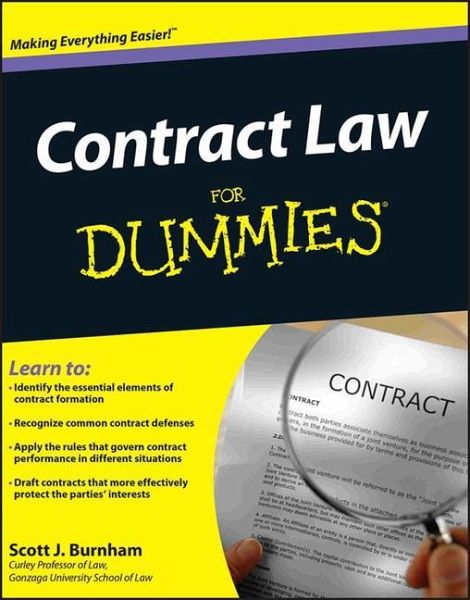
Take the mumbo jumbo out of contract law and ace your contracts course Contract law deals with the promises and agreements that law will enforce. Understanding contract law is vital for all aspiring lawyers and paralegals, and contracts courses are foundational courses within all law schools.
Take the mumbo jumbo out of contract law and ace your contracts course Contract law deals with the promises and agreements that law will enforce. Understanding contract law is vital for all aspiring lawyers and paralegals, and contracts courses are foundational courses within all law schools.
Scott J. Burnham is the Curley Professor of Commercial Law at Gonzaga University School of Law. For 30 years he has taught Contracts at law schools internationally and throughout the U.S. He is also a prolific writer on legal topics and a consultant on contract drafting for numerous businesses.
Inhaltsangabe
Introduction 1 Part I: Introducing Contract Law and Contract Formation 7 Chapter 1: Getting the Lowdown on Contract Law 9 Chapter 2: Let's Make a Deal: Offer and Acceptance 23 Chapter 3: Sealing the Deal: The Doctrine of Consideration 45 Chapter 4: Noting Exceptions: Promises Enforceable without a Contract 63 Part II: Determining Whether a Contract Is Void, Voidable, or Unenforceable 77 Chapter 5: Introducing Contract Defenses 79 Chapter 6: Considering Whether an Agreement Is Unenforceable Due to Illegality or Unfairness 89 Chapter 7: Evaluating the Parties' Ability to Make the Contract 105 Chapter 8: Assessing the Enforceability of Oral Agreements 119 Part III: Analyzing Contract Terms and Their Meaning 135 Chapter 9: Evaluating Unwritten Terms with the Parol Evidence Rule 137 Chapter 10: Finding Unwritten Terms That Complete the Contract 151 Chapter 11: Interpreting Contracts 169 Part IV: Performing the Contract or Breaching It 183 Chapter 12: Evaluating Whether Contract Modifications Are Enforceable 185 Chapter 13: Deciding Whether Unforeseen Events Excuse Performance 201 Chapter 14: Checking for Conditional Language 213 Chapter 15: Breaching the Contract by Anticipatory Repudiation 235 Part V: Exploring Remedies for Breach of Contract 247 Chapter 16: Examining How Courts Handle Breach of Contract 249 Chapter 17: Exploring Remedies in Article 2 of the UCC 267 Chapter 18: Checking for Additional Remedies 285 Part VI: Bringing Third Parties into the Picture 303 Chapter 19: Deciding Whether a Third Party Can Enforce or Interfere with a Contract 305 Chapter 20: Acknowledging the Rights and Duties of Third Parties 315 Part VII: The Part of Tens 325 Chapter 21: Ten Questions to Ask When Analyzing a Contracts Problem 327 Chapter 22: Ten Notable People (And Philosophies) in Contract Law 337 Appendix: Glossary 341 Index 345
Introduction 1 Part I: Introducing Contract Law and Contract Formation 7 Chapter 1: Getting the Lowdown on Contract Law 9 Chapter 2: Let's Make a Deal: Offer and Acceptance 23 Chapter 3: Sealing the Deal: The Doctrine of Consideration 45 Chapter 4: Noting Exceptions: Promises Enforceable without a Contract 63 Part II: Determining Whether a Contract Is Void, Voidable, or Unenforceable 77 Chapter 5: Introducing Contract Defenses 79 Chapter 6: Considering Whether an Agreement Is Unenforceable Due to Illegality or Unfairness 89 Chapter 7: Evaluating the Parties' Ability to Make the Contract 105 Chapter 8: Assessing the Enforceability of Oral Agreements 119 Part III: Analyzing Contract Terms and Their Meaning 135 Chapter 9: Evaluating Unwritten Terms with the Parol Evidence Rule 137 Chapter 10: Finding Unwritten Terms That Complete the Contract 151 Chapter 11: Interpreting Contracts 169 Part IV: Performing the Contract or Breaching It 183 Chapter 12: Evaluating Whether Contract Modifications Are Enforceable 185 Chapter 13: Deciding Whether Unforeseen Events Excuse Performance 201 Chapter 14: Checking for Conditional Language 213 Chapter 15: Breaching the Contract by Anticipatory Repudiation 235 Part V: Exploring Remedies for Breach of Contract 247 Chapter 16: Examining How Courts Handle Breach of Contract 249 Chapter 17: Exploring Remedies in Article 2 of the UCC 267 Chapter 18: Checking for Additional Remedies 285 Part VI: Bringing Third Parties into the Picture 303 Chapter 19: Deciding Whether a Third Party Can Enforce or Interfere with a Contract 305 Chapter 20: Acknowledging the Rights and Duties of Third Parties 315 Part VII: The Part of Tens 325 Chapter 21: Ten Questions to Ask When Analyzing a Contracts Problem 327 Chapter 22: Ten Notable People (And Philosophies) in Contract Law 337 Appendix: Glossary 341 Index 345
Es gelten unsere Allgemeinen Geschäftsbedingungen: www.buecher.de/agb
Impressum
www.buecher.de ist ein Internetauftritt der buecher.de internetstores GmbH
Geschäftsführung: Monica Sawhney | Roland Kölbl | Günter Hilger
Sitz der Gesellschaft: Batheyer Straße 115 - 117, 58099 Hagen
Postanschrift: Bürgermeister-Wegele-Str. 12, 86167 Augsburg
Amtsgericht Hagen HRB 13257
Steuernummer: 321/5800/1497
USt-IdNr: DE450055826