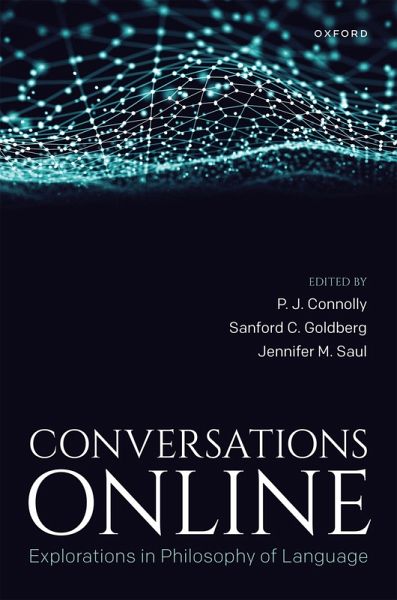
This book—the first collection of its kind—collates work from numerous philosophers of language on a diverse range of topics that arise in online conversation.
This book—the first collection of its kind—collates work from numerous philosophers of language on a diverse range of topics that arise in online conversation.
P. J. Connolly is Post-Doctoral Fellow in Philosophy at the University of Barcelona, as well as a senior member of the LOGOS research group and the Barcelona Institute for Analytic Philosophy. He received his PhD in Philosophy from the University of Sheffield in 2021 on the topic of online conversation. His published work looks at online trolling and linguistic liability. Connolly is currently researching the linguistic, social and ontological aspects of artificial intelligence. Sanford C. Goldberg is Chester D. Tripp Professor in the Humanities and Professor of Philosophy at Northwestern University. He is also Senior Research Associate at the African Centre for Epistemology and Philosophy of Science, University of Johannesburg. His research is primarily in the areas of epistemology and philosophy of language. Goldberg's books include Foundations and Applications in Social Epistemology (2021) and Conversational Pressure: Normativity in Speech Exchanges (2020). He is also Senior Research Associate at the African Centre for Epistemology and Philosophy of Science, University of Johannesburg. Jennifer M. Saul is currently Waterloo Chair in Social and Political Philosophy of Language. Prior to this, she taught at the University of Sheffield for 24 years. Her current research is on the pragmatics of racist and sexist speech, and on various species of misinformation and disinformation. Although she has served as President of the Mind Association, and won the APA's Distinguished Woman Philosopher Award, her proudest accomplishment remains serving as a consultant on a zombie movie script.
Inhaltsangabe
* Acknowledgments * List of Contributors * Introduction * Part One: Context Online * 1: Lynne Tirrell: Hit and Run Speech Acts: Not A Conversation * 2: Marcin Lewinski and Catarina Dutilh Novaes: The Many-to-Many Model: Communication, Attention, and Trust in Online Conversations * 3: Alex Davies: Sharing Content Online: the Effects of Likes and Comments on Linguistic Interpretation * 4: Lucy McDonald: Context Collapse Online * 5: Karen S. Lewis: Imagined Audiences and Common Ground * Part Two: Commitments, Community and Cooperation Online * 6: Regina Rini: Context Collapse and Pop-Up Communities: How Social Media Makes its Own Norms * 7: Alessandra Tanesini: Commitment Online: On Taking Responsibility for One's Words on Social Media * 8: Gretchen Ellefson: Conversational Goals and Internet Trolls * 9: P. J. Connolly: Conversations with Chatbots * 10: Michael Patrick Lynch: Online Communication and Political Ideology * Part Three: Speech Acts Online * 11: Michael Randall Barnes: Complex Harms in Online Speech: The Limits of the Illocutionary * 12: Amanda McMullen: Sarcasm Online * 13: Eleonore Neufeld and Elise Woodard: On Subtweeting * 14: Nikki Ernst: A Meme for Excuses * Part Four: Improving Conversations Online * 15: Arnon Keren, Aviv Barnoy, Ori Freiman, and Boaz Miller: New Atlantis 2.0: Designing Epistemically-Healthy Online Conversations * 16: Bianca Cepollaro: What's Distinctive About Blocking Implicit Toxicity Online * 17: Luvell Anderson and Ian York: Online Propaganda and the Manipulation of Imaginative Possibilities * 18: Eliot Michaelson, Rachel Sterken, and Jessica Pepp: On Amplification
* Acknowledgments * List of Contributors * Introduction * Part One: Context Online * 1: Lynne Tirrell: Hit and Run Speech Acts: Not A Conversation * 2: Marcin Lewinski and Catarina Dutilh Novaes: The Many-to-Many Model: Communication, Attention, and Trust in Online Conversations * 3: Alex Davies: Sharing Content Online: the Effects of Likes and Comments on Linguistic Interpretation * 4: Lucy McDonald: Context Collapse Online * 5: Karen S. Lewis: Imagined Audiences and Common Ground * Part Two: Commitments, Community and Cooperation Online * 6: Regina Rini: Context Collapse and Pop-Up Communities: How Social Media Makes its Own Norms * 7: Alessandra Tanesini: Commitment Online: On Taking Responsibility for One's Words on Social Media * 8: Gretchen Ellefson: Conversational Goals and Internet Trolls * 9: P. J. Connolly: Conversations with Chatbots * 10: Michael Patrick Lynch: Online Communication and Political Ideology * Part Three: Speech Acts Online * 11: Michael Randall Barnes: Complex Harms in Online Speech: The Limits of the Illocutionary * 12: Amanda McMullen: Sarcasm Online * 13: Eleonore Neufeld and Elise Woodard: On Subtweeting * 14: Nikki Ernst: A Meme for Excuses * Part Four: Improving Conversations Online * 15: Arnon Keren, Aviv Barnoy, Ori Freiman, and Boaz Miller: New Atlantis 2.0: Designing Epistemically-Healthy Online Conversations * 16: Bianca Cepollaro: What's Distinctive About Blocking Implicit Toxicity Online * 17: Luvell Anderson and Ian York: Online Propaganda and the Manipulation of Imaginative Possibilities * 18: Eliot Michaelson, Rachel Sterken, and Jessica Pepp: On Amplification
Es gelten unsere Allgemeinen Geschäftsbedingungen: www.buecher.de/agb
Impressum
www.buecher.de ist ein Internetauftritt der buecher.de internetstores GmbH
Geschäftsführung: Monica Sawhney | Roland Kölbl | Günter Hilger
Sitz der Gesellschaft: Batheyer Straße 115 - 117, 58099 Hagen
Postanschrift: Bürgermeister-Wegele-Str. 12, 86167 Augsburg
Amtsgericht Hagen HRB 13257
Steuernummer: 321/5800/1497
USt-IdNr: DE450055826