In this innovative history, Liang Cai examines newly excavated manuscripts alongside traditional sources to explore convict politics in the early Chinese empires, proposing a new framework for understanding Confucian discussions of law and legal practice. While a substantial number of convict laborers helped operate the local bureaucratic apparatus in early China, the central court reemployed numerous previously convicted men as high officials. Convict politics emerged, she argues, because while the system often criminalized people including the innocent, it was juxtaposed with redemption…mehr
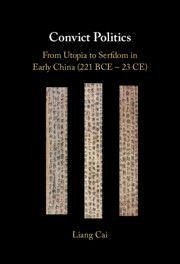
In this innovative history, Liang Cai examines newly excavated manuscripts alongside traditional sources to explore convict politics in the early Chinese empires, proposing a new framework for understanding Confucian discussions of law and legal practice. While a substantial number of convict laborers helped operate the local bureaucratic apparatus in early China, the central court reemployed numerous previously convicted men as high officials. Convict politics emerged, she argues, because while the system often criminalized people including the innocent, it was juxtaposed with redemption policies and frequent amnesties in pursuit of a crime-free utopia. This dual system paralyzed the justice system, provoking intense Confucian criticism and resulting in a deep-seated skepticism towards law in the Chinese tradition with a long-lasting political legacy.
Liang Cai is Associate Professor of History at the University of Notre Dame.
Inhaltsangabe
Introduction; Part I. Criminalizing the Empire: 1. Convict politics and convict economy: administrative space as open prison in local governments; 2. Convicts as officials: disparities between philosophical ideals and real-world politics; 3. Mutual responsibility system: criminalizing the innocent; 4. Brutal perfectionism: criminalizing job performance and collapse of justice; 5. Performance legitimacy: absolute liabilities, heavy punishments and collective lies; Part II. A Paralyzed Justice System: 'Creating' Unlawful Commoners via Redemption and Amnesty; 6. Redemption: political economy and sacrificed justice; 7. Imperial amnesty: correcting the excessive punishment and regaining loyalty; 8. Universal amnesty: from Utopian dream to His Majesty's splendor; 9. The Body politic and the parents metaphor: universal amnesty and the loss of individual justice; Part III. The Critics and Their Failure in Reform; 10. Technical bureaucrats' law and Confucian virtue: political elites and bureaucratic hierarchy; 11. Tutor to the Crown Prince and Chancellor of the empire: Confucian dream and political reality in Western Han China (206 BCE-9 CE); Conclusion: From philosophical ideals to practical realities.
Es gelten unsere Allgemeinen Geschäftsbedingungen: www.buecher.de/agb
Impressum
www.buecher.de ist ein Internetauftritt der buecher.de internetstores GmbH
Geschäftsführung: Monica Sawhney | Roland Kölbl | Günter Hilger
Sitz der Gesellschaft: Batheyer Straße 115 - 117, 58099 Hagen
Postanschrift: Bürgermeister-Wegele-Str. 12, 86167 Augsburg
Amtsgericht Hagen HRB 13257
Steuernummer: 321/5800/1497
USt-IdNr: DE450055826