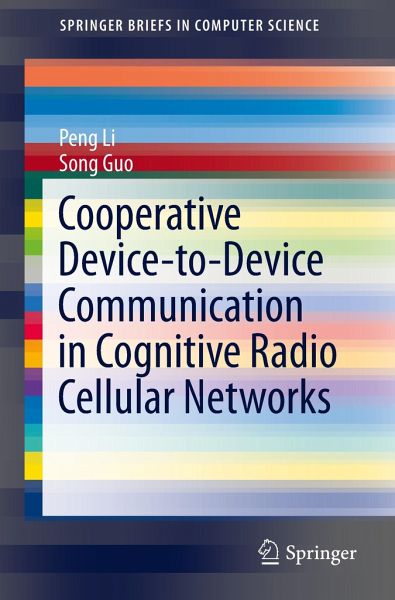
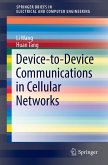
This brief examines current research on cooperative device-to-device (D2D) communication as an enhanced offloading technology to improve the performance of cognitive radio cellular networks. By providing an extensive review of recent advances in D2D communication, the authors demonstrate that the quality of D2D links significantly affects offloading performance in cellular networks, which motivates the design of cooperative D2D communication. After presenting the architecture of cooperative D2D communication, the challenges of capacity maximization and energy efficiency are addressed by…mehr
This brief examines current research on cooperative device-to-device (D2D) communication as an enhanced offloading technology to improve the performance of cognitive radio cellular networks. By providing an extensive review of recent advances in D2D communication, the authors demonstrate that the quality of D2D links significantly affects offloading performance in cellular networks, which motivates the design of cooperative D2D communication. After presenting the architecture of cooperative D2D communication, the challenges of capacity maximization and energy efficiency are addressed by optimizing relay assignment, power control and resource allocation. Furthermore, cooperative D2D communication is enhanced by network coding technology, and then is extended for broadcast sessions. Along with detailed problem formulation and hardness analysis, fast algorithms are developed by exploiting problem-specific characteristics such that they can be applied in practice.
Artikelnr. des Verlages: 86371910, 978-3-319-12594-7
2014
Seitenzahl: 92
Erscheinungstermin: 9. Dezember 2014
Englisch
Abmessung: 235mm x 155mm x 6mm
Gewicht: 155g
ISBN-13: 9783319125947
ISBN-10: 331912594X
Artikelnr.: 41483860
Herstellerkennzeichnung
Springer Nature c/o IBS
Benzstrasse 21
48619 Heek
Tanja.Keller@springer.com
Autorenporträt
Prof. Shengjie Peng is currently a Full Professor in Nanjing University of Aeronautics and Astronautics. He completed his Ph.D. (2010) in Nankai University and B.S. (2004) in Anhui Normal University. Then, he went to Nanyang Technological University and National University of Singapore as Postdoctoral Fellow with Prof. Qingyu Yan and Prof. Seeram Ramakrishna till 2017. His current research interests focus on development of rationally designed functional materials with finely tailored nanoscale architecture to tackle critical problems (such as hydrogen production, energy density, power density, cycle and calendar life, safety, and cost) in diverse energy-related applications, including water splitting, ORR, CO2 reduction, batteries, fuel cells, as well as clean and renewable energy. To date, he has co-authored over 150 peer-reviewed publications, more than 20 Chinese patents, one chapter in a book, and one English book. Based on his research achievements in electrochemical catalysisand storage, he got several honors, including Fellow of the Royal Society of Chemistry, FRSC, China One Thousand Young Talent, China Jiangsu Specially Appointed Professor, High-Level Entrepreneurial and Innovative Talents Program of Jiangsu, etc. Peng Li is an associate professor at Nanjing University of Aeronautics and Astronautics. He received his bachelor's and master's degrees from Nanjing University in 2006 and 2009, respectively, and earned his PhD from Hokkaido University in 2013. His research mainly focuses on functional nanomaterials for energy conversion and storage.
Inhaltsangabe
Introduction.- Literature Survey on Cooperative Device-to-Device Communication.- Cooperative Device-to-Device Communication Architecture.- Capacity Maximization of Cooperative Device-to-Device Communication.- Energy Efficiency of Cooperative Device-to-Device Communication.- Cooperative Device-to-Device Communication for Broadcast.- Conclusion.
Introduction.- Literature Survey on Cooperative Device-to-Device Communication.- Cooperative Device-to-Device Communication Architecture.- Capacity Maximization of Cooperative Device-to-Device Communication.- Energy Efficiency of Cooperative Device-to-Device Communication.- Cooperative Device-to-Device Communication for Broadcast.- Conclusion.
Es gelten unsere Allgemeinen Geschäftsbedingungen: www.buecher.de/agb
Impressum
www.buecher.de ist ein Internetauftritt der buecher.de internetstores GmbH
Geschäftsführung: Monica Sawhney | Roland Kölbl | Günter Hilger
Sitz der Gesellschaft: Batheyer Straße 115 - 117, 58099 Hagen
Postanschrift: Bürgermeister-Wegele-Str. 12, 86167 Augsburg
Amtsgericht Hagen HRB 13257
Steuernummer: 321/5800/1497
USt-IdNr: DE450055826