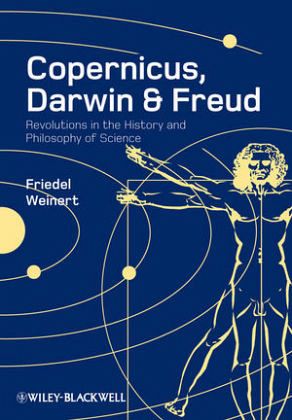
Grundlegend umwälzende wissenschaftliche Erkenntnis führt zu gleichermaßen weitreichenden Umwälzungen in der Philosophie. Diese Verbindung wird anhand des Beispiels der Lehren von Kopernikus, Darwin oder Freud aufgezeigt.
Grundlegend umwälzende wissenschaftliche Erkenntnis führt zu gleichermaßen weitreichenden Umwälzungen in der Philosophie. Diese Verbindung wird anhand des Beispiels der Lehren von Kopernikus, Darwin oder Freud aufgezeigt.
Friedel Weinert is Professor of Philosophy at Bradford University and a former Visiting Research Fellow at Harvard University and Visiting Fellow at the Centre for the Philosophy of Natural and Social Science at the LSE in London. He holds a PhD in Philosophy, a BA in Sociology, and a BSc in Physics. Dr. Weinert is the editor of Laws of Nature (1995), the author of The Scientist as Philosopher (2004) and chief editor of the forthcoming Compendium of Quantum Physics: Concepts, Experiments, History and Philosophy.
Inhaltsangabe
Preface. Acknowledgments. Introduction. I. Nicolaus Copernicus: The Loss of Centrality. 1. Ptolemy and Copernicus. 2. A Clash of Two Worldviews. 3. The Heliocentric Worldview. 4. Copernicus was not a Scientific Revolutionary. 5. The Transition to Newton. 6. Some Philosophical Lessons. 7. Copernicus and Scientific Revolutions. 8. The Anthropic Principle: A Reversal of the Copernican Turn?. Reading List. Essay Questions. II. Charles Darwin: The Loss of Rational Design. 1. Darwin and Copernicus. 2. Views of Organic Life. 3. Fossil Discoveries. 4. Darwin's Revolution. 5. Philosophical Matters. 6. A Question of Method. Reading List. Essay Questions. III. Sigmund Freud: The Loss of Transparency. 1. Copernicus, Darwin and Freud. 2. Some Views of Humankind. 3. Scientism and the Freudian Model of Personality. 4. The Social Sciences beyond Freud. 5. Evolution and the Social Sciences. 6. Freud and Revolutions in Thought. Reading List. Essay Questions. Name Index. Subject Index
Preface. Acknowledgments. Introduction. I. Nicolaus Copernicus: The Loss of Centrality. 1. Ptolemy and Copernicus. 2. A Clash of Two Worldviews. 3. The Heliocentric Worldview. 4. Copernicus was not a Scientific Revolutionary. 5. The Transition to Newton. 6. Some Philosophical Lessons. 7. Copernicus and Scientific Revolutions. 8. The Anthropic Principle: A Reversal of the Copernican Turn?. Reading List. Essay Questions. II. Charles Darwin: The Loss of Rational Design. 1. Darwin and Copernicus. 2. Views of Organic Life. 3. Fossil Discoveries. 4. Darwin's Revolution. 5. Philosophical Matters. 6. A Question of Method. Reading List. Essay Questions. III. Sigmund Freud: The Loss of Transparency. 1. Copernicus, Darwin and Freud. 2. Some Views of Humankind. 3. Scientism and the Freudian Model of Personality. 4. The Social Sciences beyond Freud. 5. Evolution and the Social Sciences. 6. Freud and Revolutions in Thought. Reading List. Essay Questions. Name Index. Subject Index
Rezensionen
"Whether used as a textbook or as a review of issues concerning scientific revolutions and theory change in their historical context, Copernicus, Darwin, and Freud may be strongly recommended." (The Journal of the International Society for the History of Philosophy of Science, 2011) "Those seeking a more conventional approach to the history and philosophy of science may well find Weinert s book informative...there is much to be learned from Weinert s comparison of Copernicus, Darwin, and Freud." ( Science & Education , January 2011)
Es gelten unsere Allgemeinen Geschäftsbedingungen: www.buecher.de/agb
Impressum
www.buecher.de ist ein Internetauftritt der buecher.de internetstores GmbH
Geschäftsführung: Monica Sawhney | Roland Kölbl | Günter Hilger
Sitz der Gesellschaft: Batheyer Straße 115 - 117, 58099 Hagen
Postanschrift: Bürgermeister-Wegele-Str. 12, 86167 Augsburg
Amtsgericht Hagen HRB 13257
Steuernummer: 321/5800/1497
USt-IdNr: DE450055826