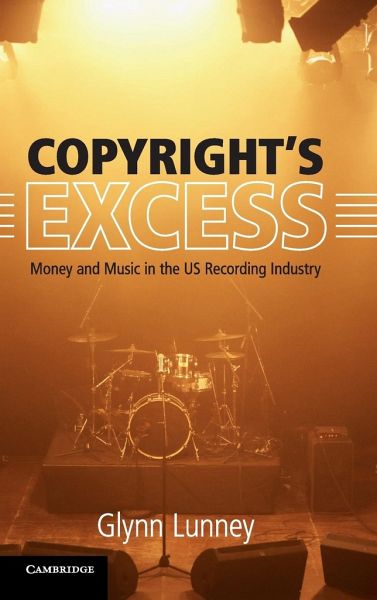
For more than two hundred years, copyright in the United States has rested on a simple premise: more copyright will lead to more money for copyright owners, and more money will lead to more original works of authorship. In this important, illuminating book, Glynn Lunney tests that premise by tracking the rise and fall of the sound recording copyright from 1961-2015, along with the associated rise and fall in sales of recorded music. Far from supporting copyright's fundamental premise, the empirical evidence finds the exact opposite relationship: more revenue led to fewer and lower-quality hit…mehr
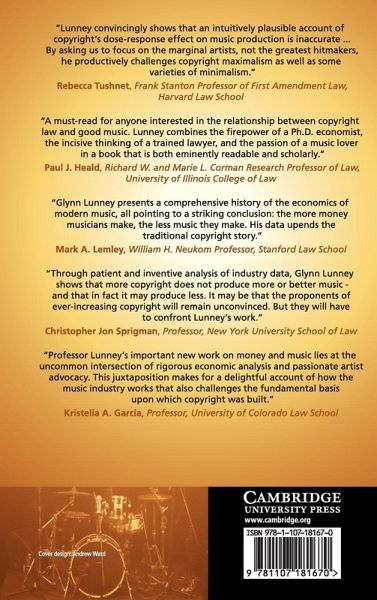
For more than two hundred years, copyright in the United States has rested on a simple premise: more copyright will lead to more money for copyright owners, and more money will lead to more original works of authorship. In this important, illuminating book, Glynn Lunney tests that premise by tracking the rise and fall of the sound recording copyright from 1961-2015, along with the associated rise and fall in sales of recorded music. Far from supporting copyright's fundamental premise, the empirical evidence finds the exact opposite relationship: more revenue led to fewer and lower-quality hit songs. Lunney's breakthrough research shows that what copyright does is vastly increase the earnings of our most popular artists and songs, which - net result - means fewer hit songs. This book should be read by anyone interested in how copyright operates in the real world.
Glynn Lunney is a professor at Texas A&M University School of Law. He holds an engineering degree from Texas A&M, a law degree from Stanford, and a Ph.D. in Economics from Tulane University, New Orleans. He is an internationally recognized scholar on copyright law and the economics of copyright. He has testified before Congress and appeared before the European Commission on copyright issues. Professor Lunney has published a casebook, Trademarks and Unfair Competition (Second Edition, 2015), and has also published numerous articles in leading law reviews, including those of Stanford, Michigan, Virginia, Vanderbilt, Emory, and Boston University.
Inhaltsangabe
1. Introduction 2. The (surprisingly weak) economic case for copyright 3. Copyright and revenue in the recording industry 4. Measuring music output 5. The search for a correlation: was more money associated with more or better music? 6. More money meant less music 7. Rationalizing copyright.
1. Introduction 2. The (surprisingly weak) economic case for copyright 3. Copyright and revenue in the recording industry 4. Measuring music output 5. The search for a correlation: was more money associated with more or better music? 6. More money meant less music 7. Rationalizing copyright.
Es gelten unsere Allgemeinen Geschäftsbedingungen: www.buecher.de/agb
Impressum
www.buecher.de ist ein Internetauftritt der buecher.de internetstores GmbH
Geschäftsführung: Monica Sawhney | Roland Kölbl | Günter Hilger
Sitz der Gesellschaft: Batheyer Straße 115 - 117, 58099 Hagen
Postanschrift: Bürgermeister-Wegele-Str. 12, 86167 Augsburg
Amtsgericht Hagen HRB 13257
Steuernummer: 321/5800/1497
USt-IdNr: DE450055826