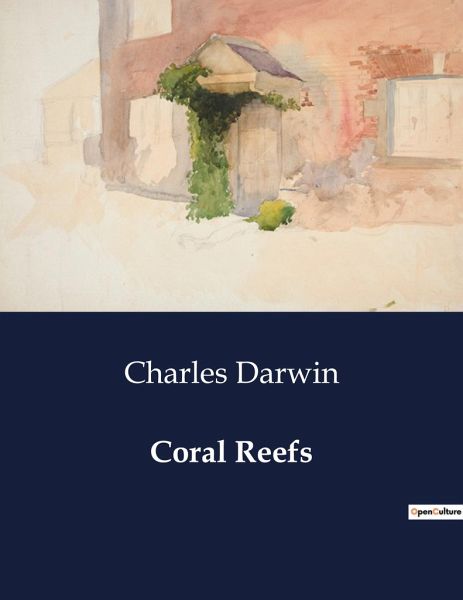
The article from the 1911 Encyclopædia Britannica discusses the distribution, types, and formation theories of coral reefs. Coral reefs are primarily found in tropical seas, with the most massive species thriving in shallow waters where temperatures do not fall below 68°F. The text categorizes coral formations into fringing reefs, barrier reefs, and atolls, each with distinct characteristics. Fringing reefs are close to shorelines, while barrier reefs are larger and further from land, with deeper channels separating them from the coast. Atolls are ring-shaped reefs with central lagoons, often…mehr
The article from the 1911 Encyclopædia Britannica discusses the distribution, types, and formation theories of coral reefs. Coral reefs are primarily found in tropical seas, with the most massive species thriving in shallow waters where temperatures do not fall below 68°F. The text categorizes coral formations into fringing reefs, barrier reefs, and atolls, each with distinct characteristics. Fringing reefs are close to shorelines, while barrier reefs are larger and further from land, with deeper channels separating them from the coast. Atolls are ring-shaped reefs with central lagoons, often formed around subsiding land masses. The article explores various theories on the origin of coral reefs, notably the subsidence theory proposed by Charles Darwin. Darwin suggested that coral reefs form around islands that gradually sink, with coral growth keeping pace with subsidence, eventually forming atolls. This theory was widely accepted due to its simplicity and applicability. However, it faced challenges from other scientists like Louis Agassiz and Karl Semper, who provided evidence of coral formations in non-subsiding areas. John Murray and Alexander Agassiz further questioned Darwin's theory, suggesting that coral reefs could form on submarine elevations without subsidence. Recent research, including deep borings in atolls like Funafuti, supports Darwin's theory in some cases, showing significant limestone deposits indicative of subsidence. The article concludes that coral reefs can form under various conditions, whether in areas of subsidence, elevation, or stability, and that the atoll or barrier reef shape does not necessarily indicate subsidence.
Die Herstellerinformationen sind derzeit nicht verfügbar.
Autorenporträt
Charles Robert Darwin, (12 February 1809 - 19 April 1882) was an English naturalist, geologist and biologist, best known for his contributions to the science of evolution. His proposition that all species of life have descended over time from common ancestors is now widely accepted, and considered a foundational concept in science. In a joint publication with Alfred Russel Wallace, he introduced his scientific theory that this branching pattern of evolution resulted from a process that he called natural selection, in which the struggle for existence has a similar effect to the artificial selection involved in selective breeding. Darwin's early interest in nature led him to neglect his medical education at the University of Edinburgh; instead, he helped to investigate marine invertebrates. Studies at the University of Cambridge (Christ's College) encouraged his passion for natural science. His five-year voyage on HMS Beagle established him as an eminent geologist whose observations and theories supported Charles Lyell's conception of gradual geological change, and publication of his journal of the voyage made him famous as a popular author. Puzzled by the geographical distribution of wildlife and fossils he collected on the voyage, Darwin began detailed investigations, and in 1838 conceived his theory of natural selection. Although he discussed his ideas with several naturalists, he needed time for extensive research and his geological work had priority. He was writing up his theory in 1858 when Alfred Russel Wallace sent him an essay that described the same idea, prompting immediate joint publication of both of their theories. Darwin's work established evolutionary descent with modification as the dominant scientific explanation of diversification in nature. Darwin has been described as one of the most influential figures in human history, and he was honoured by burial in Westminster Abbey.
Es gelten unsere Allgemeinen Geschäftsbedingungen: www.buecher.de/agb
Impressum
www.buecher.de ist ein Internetauftritt der buecher.de internetstores GmbH
Geschäftsführung: Monica Sawhney | Roland Kölbl | Günter Hilger
Sitz der Gesellschaft: Batheyer Straße 115 - 117, 58099 Hagen
Postanschrift: Bürgermeister-Wegele-Str. 12, 86167 Augsburg
Amtsgericht Hagen HRB 13257
Steuernummer: 321/5800/1497
USt-IdNr: DE450055826