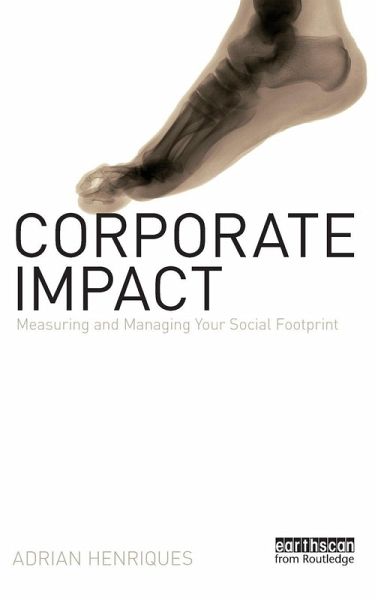
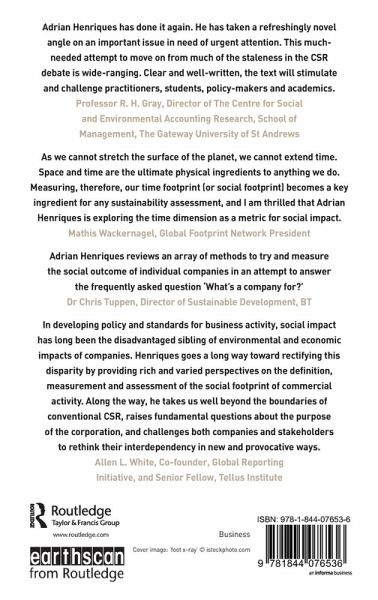
It is widely accepted that sustainability has an inescapable social component, but companies find it very hard to understand and measure their social impacts. Why is this? This book, by noted CSR practitioner, consultant and educator Adrian Henriques, provides the first coherent approach to identifying, understanding, measuring and accounting for corporate social impact. Beginning with an analysis of the nature of corporate social impact and the role of the stakeholder, the complex relationship of social impact to economic and environmental impacts is explored. This naturally leads to an…mehr
It is widely accepted that sustainability has an inescapable social component, but companies find it very hard to understand and measure their social impacts. Why is this? This book, by noted CSR practitioner, consultant and educator Adrian Henriques, provides the first coherent approach to identifying, understanding, measuring and accounting for corporate social impact. Beginning with an analysis of the nature of corporate social impact and the role of the stakeholder, the complex relationship of social impact to economic and environmental impacts is explored. This naturally leads to an examination of the contribution which social impact makes to business practice, profitability and ultimately to global sustainability. The second part of the book assesses the theory and practise of some of the critical measures of social impact which have been developed to date. This includes Social Return on Investment (SROI), local economic impact (LM3) and social capital as well as more established techniques. . It also explores new approaches such as 'social footprinting'. This is rounded out by presentation of a social accounting framework and how this can operate in parallel to standard financial accounting procedures. This volume provides a clear, digestible and practical roadmap for companies wishing to take responsibility for their role in society and improve their internal and external performance.
Adrian Henriques is an independent adviser, writer, researcher, teacher and campaigner on corporate responsibility, social accountability and sustainability. He is professor of Accountability and Corporate Social Responsibility at Middlesex University, and the author of Corporate Truth: The Limits to Transparency (Earthscan, 2007).
Inhaltsangabe
1. Introduction 2. The Social Purpose of Companies 3. Complicity and the Sexual Exploitation of Children - a case study 4. Sustainability's Social Side 5. Thinking like a Stakeholder 6. The Voice of the Stakeholder 7. Sociological Impacts 8. Signs of Impact 9. Reporting Social Impact 10. Measuring Economic Impact 11. Investing in Impact 12. Social Footprint 13. Accounting for Social Impact 14. The Elusiveness of the Social Revisited Appendix I - Market Research Appendix II - Analysis of GRI Social Indicators Appendix III - SROI Case Study Bibliography
1. Introduction 2. The Social Purpose of Companies 3. Complicity and the Sexual Exploitation of Children - a case study 4. Sustainability's Social Side 5. Thinking like a Stakeholder 6. The Voice of the Stakeholder 7. Sociological Impacts 8. Signs of Impact 9. Reporting Social Impact 10. Measuring Economic Impact 11. Investing in Impact 12. Social Footprint 13. Accounting for Social Impact 14. The Elusiveness of the Social Revisited Appendix I - Market Research Appendix II - Analysis of GRI Social Indicators Appendix III - SROI Case Study Bibliography
Es gelten unsere Allgemeinen Geschäftsbedingungen: www.buecher.de/agb
Impressum
www.buecher.de ist ein Internetauftritt der buecher.de internetstores GmbH
Geschäftsführung: Monica Sawhney | Roland Kölbl | Günter Hilger
Sitz der Gesellschaft: Batheyer Straße 115 - 117, 58099 Hagen
Postanschrift: Bürgermeister-Wegele-Str. 12, 86167 Augsburg
Amtsgericht Hagen HRB 13257
Steuernummer: 321/5800/1497
USt-IdNr: DE450055826