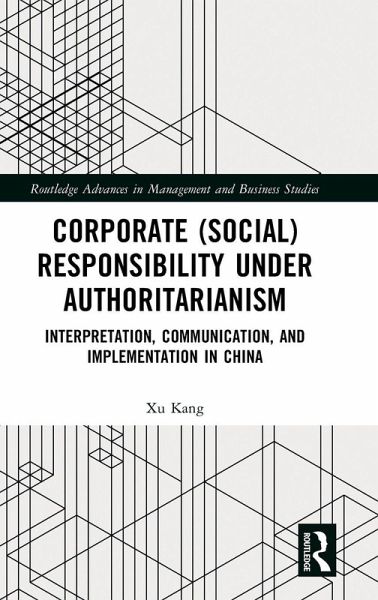
This book provides an in-depth exploration of corporate social responsibility (CSR) in the authoritarian context. It challenges prevailing CSR frameworks, which largely derive from liberal democratic contexts and overlook how political institutions shape the conceptualisation and practice of corporate responsibility.
This book provides an in-depth exploration of corporate social responsibility (CSR) in the authoritarian context. It challenges prevailing CSR frameworks, which largely derive from liberal democratic contexts and overlook how political institutions shape the conceptualisation and practice of corporate responsibility.
Produktdetails
Produktdetails
Routledge Advances in Management and Business Studies
Xu Kang is a researcher at Friedrich-Alexander-Universität Erlangen-Nürnberg and currently serves as an Ernst Mach Fellow at Vienna University of Economics and Business. His research focuses on responsible business conduct, corporate social responsibility, business and human rights, and sustainability governance.
Inhaltsangabe
List of Figures and Tables Abbreviations Chapter 1 Introduction 1.1 CSR in Authoritarian Contexts 1.2 Research Method Chapter 2 Polymorphous Corporate (Social) Responsibility in the Business-State-Society Relations 2.1 The Emergence of CSR in the Context of the State Retreat 2.2 The Conceptualisation and Operationalisation of CSR 2.2.1 Evolving Historical Foundations 2.2.2 Late 20th Century: Defining and Operationalising CSR 2.2.3 2000s and Beyond: Strategic CSR and Globalisation 2.3 Institutionalising CSR on the Global Stage 2.3.1 Towards Business and Human Rights Amidst the State Return 2.4 From Soft Law to Hard Law: Recasting the State's Role in CSR Governance Chapter 3 Contextualising Authoritarian State: China's Authoritarian Capitalism and Corporate (Social) Responsibility 3.1 Critical State Concept and the Analytical Toolkit 3.1.1 From Pluralism to Elite and Structuralist Theories 3.1.2 Post-Structuralist Interventions and Strategic-Relational Approach 3.2 Constructing the Authoritarian State 3.3 China's Contemporary Authoritarian Capitalism 3.4 The Evolution of Business-State-Society Relations and CSR in China 3.4.1 Late Qing Dynasty to Republic of China 3.4.2 Founding of the People's Republic of China to the Cultural Revolution 3.4.3 Post-Reform and Opening Up Era Chapter 4 CSR Interpretation: Symbiosis of Market Supremacy and Power Politics 4.1 Discourse on Market Supremacy 4.2 Discourse on Power Politics 4.3 Polymorphous Discourse Interplay Amidst Market and Authoritarian Power Politics Chapter 5 CSR Communication: In Clinging and Pursuit of Capital and Power 5.1 Selective Communication: Chinese Corporate Governance for CSR 5.1.1 Decision-Making Level Priorities and Shareholder Communication 5.1.2 Operational Level Discrepancies and Supplier Communication 5.2 Navigating Up and Down: Actors Alongside the Social Relation of the State 5.2.1 GONGOs as Mediators Between State and Corporate 5.2.2 Strategic Adaptation of NGOs in Power Dynamics 5.2.3 State Control, Business Lobbying, and Social Advocacy under Authoritarian capitalism Chapter 6 CSR Implementation: (Ir)responsible Business Conduct under Authoritarian Capitalism 6.1 Greenwashing vs. Value Chain Compliance 6.2 Dual Facets of Redwashing 6.3 CSR Implementation Amidst Authoritarian Capitalist Realities Chapter 7 Conclusion 7.1 Understanding the Recent Business and Human Rights Development in China 7.2 Whither CSR under Authoritarianism? Reference
List of Figures and Tables Abbreviations Chapter 1 Introduction 1.1 CSR in Authoritarian Contexts 1.2 Research Method Chapter 2 Polymorphous Corporate (Social) Responsibility in the Business-State-Society Relations 2.1 The Emergence of CSR in the Context of the State Retreat 2.2 The Conceptualisation and Operationalisation of CSR 2.2.1 Evolving Historical Foundations 2.2.2 Late 20th Century: Defining and Operationalising CSR 2.2.3 2000s and Beyond: Strategic CSR and Globalisation 2.3 Institutionalising CSR on the Global Stage 2.3.1 Towards Business and Human Rights Amidst the State Return 2.4 From Soft Law to Hard Law: Recasting the State's Role in CSR Governance Chapter 3 Contextualising Authoritarian State: China's Authoritarian Capitalism and Corporate (Social) Responsibility 3.1 Critical State Concept and the Analytical Toolkit 3.1.1 From Pluralism to Elite and Structuralist Theories 3.1.2 Post-Structuralist Interventions and Strategic-Relational Approach 3.2 Constructing the Authoritarian State 3.3 China's Contemporary Authoritarian Capitalism 3.4 The Evolution of Business-State-Society Relations and CSR in China 3.4.1 Late Qing Dynasty to Republic of China 3.4.2 Founding of the People's Republic of China to the Cultural Revolution 3.4.3 Post-Reform and Opening Up Era Chapter 4 CSR Interpretation: Symbiosis of Market Supremacy and Power Politics 4.1 Discourse on Market Supremacy 4.2 Discourse on Power Politics 4.3 Polymorphous Discourse Interplay Amidst Market and Authoritarian Power Politics Chapter 5 CSR Communication: In Clinging and Pursuit of Capital and Power 5.1 Selective Communication: Chinese Corporate Governance for CSR 5.1.1 Decision-Making Level Priorities and Shareholder Communication 5.1.2 Operational Level Discrepancies and Supplier Communication 5.2 Navigating Up and Down: Actors Alongside the Social Relation of the State 5.2.1 GONGOs as Mediators Between State and Corporate 5.2.2 Strategic Adaptation of NGOs in Power Dynamics 5.2.3 State Control, Business Lobbying, and Social Advocacy under Authoritarian capitalism Chapter 6 CSR Implementation: (Ir)responsible Business Conduct under Authoritarian Capitalism 6.1 Greenwashing vs. Value Chain Compliance 6.2 Dual Facets of Redwashing 6.3 CSR Implementation Amidst Authoritarian Capitalist Realities Chapter 7 Conclusion 7.1 Understanding the Recent Business and Human Rights Development in China 7.2 Whither CSR under Authoritarianism? Reference
Es gelten unsere Allgemeinen Geschäftsbedingungen: www.buecher.de/agb
Impressum
www.buecher.de ist ein Internetauftritt der buecher.de internetstores GmbH
Geschäftsführung: Monica Sawhney | Roland Kölbl | Günter Hilger
Sitz der Gesellschaft: Batheyer Straße 115 - 117, 58099 Hagen
Postanschrift: Bürgermeister-Wegele-Str. 12, 86167 Augsburg
Amtsgericht Hagen HRB 13257
Steuernummer: 321/5800/1497
USt-IdNr: DE450055826